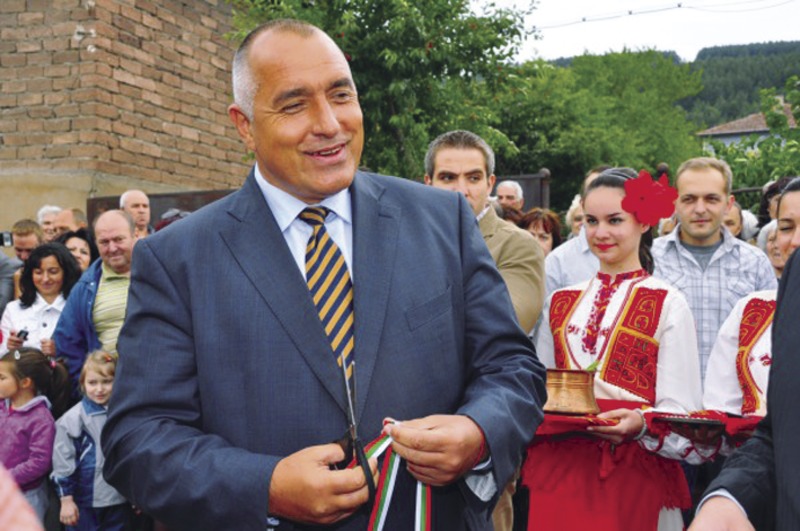
Beloved game of Prime Minister Boyko Borissov to officially open new facilities will continue well into 2012. This year is likely to be a key one to the completion of important infrastructure projects in the country. Which, as PM himself said we could, only have dreamed of in previous years.
Firstly, one should point out, the country’s
Danube Bridge II
nbsp;
After nearly 60 years of waiting, this will be the second land infrastructure link to Romania, which will also bring logistical and obvious economic benefits to the Vidin region and the entire northwestern Bulgaria. This has been an area defined as one of the poorest in the European Union.
What is even better about this project is that despite the many problems it has encountered, it will be completed without the need to give back the invested European funds. The total cost of the bridge at Vidin – Calafat, together with the associated infrastructure, is BGN232 million. The European Investment Bank lent EUR70 million, while under the ISPA Programme another EUR70 million has been provided, and the state budget allocated EUR60 million. The remainder has been given by KfW Bank and the French Development Agency.
The good news came at the end of 2011 when the European Commission gave permission for an extension of the Financial Memorandum of the project by the end of this year.
According to information provided by the Ministry of Transport, 70 percent of the facility has been constructed. A total of 417 of 479 items of superstructure of the bridge have already been produced, while 332 of them have been installed. A sum of EUR88.5 million has so far been paid, and the infrastructure of the Bulgarian side is ready at 78 percent. The construction of all road and railroad overpasses has been completed. There are new buildings for freight and passenger services at the railway station in Vidin and rehabilitation of 7.5 km railway line has also taken place.
Construction of the Romanian side is virtually completed except for activities connected to power connection, railway signaling and telecommunication systems. In an interview for the BANKER Transport Minister Ivaylo Moscov even specified the exact date for the opening of the facility 29 November 2012.
No less important project is
the extension of the Sofia subway
nbsp;
which is one of the premier’s favorite, yet from the period when he was mayor of Sofia. In May (and not in September as the provisional timetable indicated) the first underground railway line will link Mladost 1 to Tzarigradsko Chaussee. A large buffer car park with 1,300 parking places will be opened at the International Expo Exhibition Centre.
Clearly, however, the greatest interest is the construction of the second metro line linking Nadezhda to Lozenets districts. It is 6.4 km in length and has seven stations. The total value of the facility is BGN471 million. Mayor Yordanka Fandakova has promised that the new transport link will be opened in August 2012. And, it seems that this will actually happen. The boring machine has long ago reached the crossroads between boulevard Vitosha and Patriarch Evtimiy which meant an end to the digging of a 3.8-kilometre-long tunnel from overpass Nadezhda to the Central Station and from the Lions’ Bridge to TZUM. This was also the point where the two parts of the stretch being built by different companies meet.
We must not overlook that Mr. Borissov is likely to officially launch another underground stretch in Sofia this year. And it will be a section linking Obelia district to Nadezhda Hope, which in fact links the already functioning first line with the second one. The structures of two stations in Nadezhda and Han Kubrat are ready and the other two have been completed at more than 80 percent.
Along with the Sofia’s metro what is also expected to start functioning in 2012 is
the entire Trakia higway
nbsp;
The sections from Stara Zagora to Nova Zagora (Lot 2), from Nova Zagora to Yambol (Lot 3) and from Yambol to Karnobat (Lot 4) are ready at 60-65 percent. The progress on the three stretches that are under construction is remarkable. The checks are done routinely, and significant progress compared with the schedules has been reported. Representatives of the contracting companies (Trace , Aktor and Holding Patishta) even promise to put the facilitiy into exploitation ahead of deadline, said the Chairman of the Directors’ Board of the Road Infrastructure Agency Lazar Lazarov at the end of 2011.
More precise last week was the Minister of Regional Development Liliana Pavlova, who said that Lot 2 and Lot 3 are planned to be ready by 1 July. This is our top priority so that the summer traffic is absolutely safe, she pointed out.
There will be celebrations for the
Hemus highway, too.
nbsp;
In mid-July 2011 senior government officials, including Mr. Borissov, turned the first sod of the 8-kilometre section of motorway between Shumen and Belokopitovo. The overall construction costs come to BGN38 million, excluding VAT, which is a sum provided by the state budget.
With eight kilometers to be built for 14 months, the government gives a clear sign that Shumen will get a very good infrastructure – and will have quick links to roads leading to Silistra, Ruse and Sofia in the interest of safety and economy, as the then minister Rosen Plevneliev said. And if the deadline is met, the official opening ceremony will be held in September 2012.
In 2012 what is also to be completed is the
Southern arc of the Sofia Ringroad
nbsp;
– the section from Simeonovsko Shosse road to Mladost IV. The route is 2.14 km in length and costs BGN37.2 million. The whole facility is to be completed by the autumn.
Similar facility is being built about 400 km away from Sofia. Some time ago, during a visit to Burgas, Boyko Borissov ordered the South junction or the so called ‘Clover’, be ready by June 1, 2012, regardless of the complexity of construction. Reconstruction of the intersection, which is crucial for the Black Sea traffic, is also essential for the development of the coastal city and the country as a whole.
Of course, cutting of inauguration ribbons will be performed at a number of smaller objects, such as rehabilitated roads, monuments, buildings, hospitals financed by various European and national programs. A special guest to each of the ceremonies will surely be the Prime Minister himself.