The government decided to slash the option of Bulgaria relying on own production of shale gas. Respectively, which for the economists means – to diversify and reduce its supplies of natural gas and help its economy.
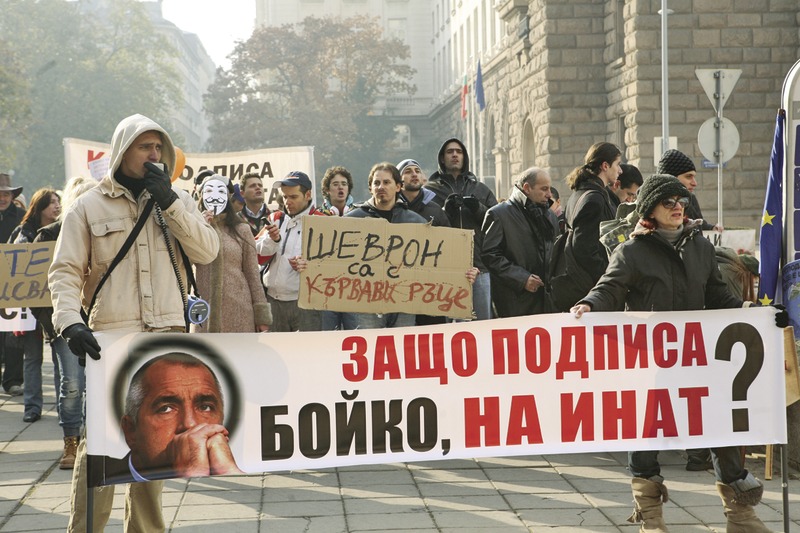
At the beginning of last week, after long and intense discussion in parliamentary committee on economic policy on a bill prohibiting exploration and production of shale gas, the ruling GERB reject the proposal of the socialists as well as that of Attaka. It provided for the imposition of a 20-year moratorium on exploration and extraction. MPs approved a version entirely banning hydraulic fracking (breaking shale with high-pressure strokes) in the exploration and production of oil and gas, mining of coal and shale gas and oil from bitumen sands.
In the event a company is already exploring or mining against the new ban, it has to stop or pay a fine of EUR100 million.
The only door left open was that the ban will apply until introduction of changes in environmental law, introducing a mandatory environmental impact surveys on the exploration itself or to future adjustments in the Subsurface Resources Act, prohibiting all hydraulic fracking in Bulgaria.
To be on the safe side, Bulgarian government withdrew its decision № 427 of 2011, which allowed the American company Chevron to search for and study of oil and natural gas deposits on the territory of Razgrad, Silistra, Dobrich, Shumen and Varna. And to be even on the safer side, it introduced a ban on prospecting and exploration of shale gas.
The reason for the decision was the lack of sufficient data to ensure environmental safety in the use of the method of hydraulic fracturing. The mistake is that for this topic we did not carry out the necessary broad public debate – to explain to people what this move means… In the end – why did we want to have this permission given? Because we expected to have a huge amount of natural gas, which first can served Bulgarian citizens by reducing the cost of their heating energy] while for the Bulgarian industry – to reduce the cost of their production. This was the reason. But since people are convinced that this is not right for, my logic is – we stop it and having withdrawn the permission, we start the debate from the beginning, said Prime Minister Boyko Borisov.
On Wednesday (January 18th) Parliament voted 158 to 8 for a ban, not moratorium, on shale gas exploration, outlawing the hydraulic breaking technology used for exploration and extraction of shale gas over the whole territory of Bulgaria and its water area in the Black Sea.
MPs shut the small loophole left after the text passed through the Economic Commission – namely that prohibition on seeking shale gas could apply until the adoption of a requirement to assess the environmental impact of such projects.
We hope that all these actions provoked reaction from the American side. In an extensive interview with a national broadcaster U.S. Ambassador James Warlick, strongly criticized Bulgarian rulers.
Do you really want to say never to a company like Chevron? It brings hundreds of millions of investment and jobs for Bulgarians. Yes, there are hazards in the development of any energy sources – be it in Bulgaria or the U.S.. There are risks with regard to nuclear energy, too, but your country has decided to appropriately regulate the development of this energy. There are opportunities for shale gas, and I hope there is an appropriate way to regulate their development and control, as happened in the U.S., Poland and elsewhere, said U.S. Ambassador to Sofia.
The year 2012 will be very intense as far as Bulgaria’s gas relations with Russia will be renegotiated. Bulgarian side will push for elimination of intermediaries to reduce the price. But one undeniable asset, such as shale gas could have been necessary to Minister Traycho Traykov and his team, when he sits at the negotiating table.
About 75% of Bulgarians support research on shale gas in Bulgaria provided there are guarantees the technology is eco -friendly, says a nationally representative survey, results of which were released by the Ministry of Economy at the beginning of last week. The survey was conducted between 6 to 12 January this year by an ESTAT agency among a thousand people over the age of 18 years.