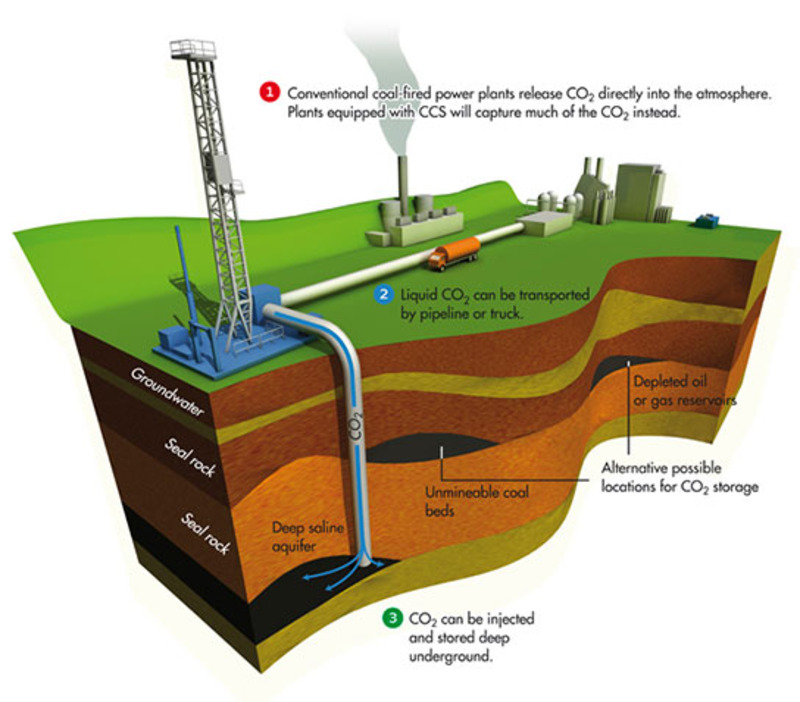
Amid noisy protests against the exploration and extraction of shale gas, rulers succeeded, and surprisingly easy, to pass another regulation that raises much concern. This time this is the Law on Underground Storing of Carbon Dioxide which Parliament voted last week. It opens another option for the country to cope with the mandatory implementation of European regulations to reduce greenhouse gas emissions. Storage of carbon dioxide in subsurface layers is an alternative to buying allowances and is expected to increase significantly the price of electricity in the middle of this year.
The problem is that this technology poses many risks that are totally ignored, and it is not certain that it is cheaper.
The only thing the law changes is to create a procedure according to which is can be established, through exploration and research, whether in our country there are suitable places for geological storage of carbon dioxide emissions, and then proceed to the storage technology, said Deputy Minister of Economy Delian Dobrev. He also assured that before giving any permission for storage, an environmental impact study will be carried out and all actions will comply with all requirements of environmental legislation. And that the use of technology will be permitted only if it is clearly demonstrated to be safe. While the purchase of allowances is cheaper than storaging, the plants will purchase allowances and will store the emissions, said Deputy Minister.
According to former Energy Minister Petar Dimitrov (leftist BSP party), however, besides being expensive, the technology is very dangerous, especially in a seismic zone, as Bulgaria is considered to be situated in. Storing large amounts of carbon dioxide in the territory of Bulgaria will turn it into a minefield. Behind this Act there is a strong lobby with its interests. It is better to develop nuclear and green energy, rather than load the bowels of the earth with poisons, said the leftist MP.
This is an experimental technology and we do not know if it could actually be a mistake. There is no need to apply experimental solutions in Bulgaria. This is a hasty decision, said Martin Dimitrov of the rightist Blue Coalition. His opinion is that the country should wait for the legalization of the technology and only then consider whether it is at all applicable here.
In fact, in almost all European countries there are severe discussions regarding the storage of carbon dioxide in underground layers. Austria has imposed a ban on the issuance of such permits on the grounds that the risks associated with technology and its impact on the environment cannot be measured reliably. Besides storage itself, the prohibition extends to the research, too. By the end of 2018 and thereafter every five years the federal government is obliged to submit reports on international experience in this field.
Finland stated categorically that there is no adequate storage capacity, and Poland will limit its actions related to the technology only to studying and research by 2026. Germany, meanwhile, is still seeking a compromise that is accompanied by serious political and environmental debates. The differences between the two chambers of parliament make the use of the technology in the country legally impossible.
As a result, in December 2011 they canceled another project to build a plant to capture and store carbon dioxide.
Storage of carbon dioxide under high pressure can cause seismic dislocations, as commonly observed in other geological drilling activities, such as mining. The kinetic energy is transferred to the underground formations through the injected carbon dioxide, which adds to the existing instability in the subsurface layers. Calculations of German scientists showed that for ten years of operation a 20 MW injection pump generates 2.1 billion kilowatt hours of energy, equivalent to the explosion of 1810 kilotonnes of TNT. This transfer of energy corresponds to an earthquake of 6.2 degrees on the Richter scale and is sufficient to cause significant seismic events, said representatives of Eco Forum for Sustainable Development.