The prospects that pipeline Nabucco may start functioning before its most serious rival South Stream are already close to zero. It seems that at this stage Europe will have to accept its dependence on Russian natural gas after futile attempts to reach a compromise with the many countries involved in a successful implementation of the Nabucco project. Meanwhile, Russia is not wasting its time. Last week, representatives of Gazprom and the Slovenian company Plinovodi signed an agreement which sets out the parameters of the section of South Stream passing through the territory of Slovenia. Moreover, in a month a joint venture will be set up – South Stream Slovenia LLC, whose primary task is to conduct the necessary spatial planning for the route of the pipe and make an assessment of environmental impacts.
The meeting also confirmed that the final investment decision for the South Stream will happen in November. This is fully consistent with the new, faster schedule for implementation of the project launched by Russian Prime Minister Vladimir Putin at the end of 2011 and, after Moscow formally obtain permission from Turkey to construct the pipe under the Black Sea. Construction works will start this year after the feasibility study of the underwater section of the South Stream and sections located in Bulgaria, Serbia, Hungary and Greece was released, plus the study on diversions to Serbia, Bosnia and Herzegovina and Croatia.
All these topics were discussed on a meeting that took place on February 28, led by Chairman of the Board of Directors of Gazprom Alexei Miller. There it was envisaged that the construction of ground facilities required for laying the pipes may begin in December 2012. Another important news is that the first deliveries of South Stream should begin by the end of 2015.
All this clearly shows that the South Stream will be there. And it seems the only unanswered question is still exactly what its capacity will be. In theory, the pipeline is designed to consist of four tubes, each of which must be able to transport about 15.57 billion cubic meters annually – or their total capacity will be around 63 billion cubic meters. In this situation the costs of the whole project will be about EUR15.5 billion – not a small amount even for such a giant as Gazprom.
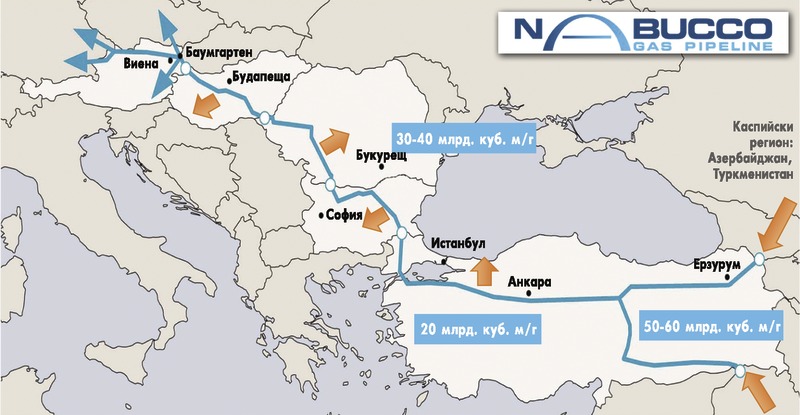
Far more serious are the problems the Nabucco project is facing. According to Western media publications the international consortium Nabucco Gas Pipeline International, is already consider a radical change of its route and its capacity due to lack of natural gas. Initial intentions were the pipe’s length to be 3900 km with an annual capacity of 31 billion cubic meters. It had to start from the eastern border of Turkey pass through Bulgaria, Romania and Hungary to reach Austria. But according to the same posts the new concept provides the route to be confined between Bulgaria and Austria, slicing by two its capacity. No further details were available. Actually so far the only country that has shown interest to deliver natural gas for the European pipe is Iraq.