Green idea will not bring fruit in Bulgaria for many years. While many locals are seeking ways how to make ends meet, the environment has become a real cause. Simultaneously, the irresponsible attitude towards nature, especially the weak commitment of politicians to the problems in the sector led to huge losses for the economy and threaten the lives and health of many.
The most significant sources of adverse impacts on the environment are energy and natural resources consumption, emission of harmful substances in air, water and soil, and waste disposal. The national report on the environmental situation in 2010 (Editor’s note – this document for 2011 will be presented in 2013 as the officers they needed at least 18 months to prepare the data) shows that over the past 10 years the total energy consumption in the country has increased by five percent. The increase, experts say, is due mainly to increased consumption in transport and by households, while the industry consumption has declined. Generally speaking, there is nothing wrong with this and may even be regarded as a sign of an improved standard of living. But the failures come from the overall energy intensity of the economy, which remains the highest in the European Union. In other words, Sofia
spends the most resources and energy
on one euro of production. Compared with Denmark, for example, Bulgaria is eight times less effeicient. But instead of taking adequate measures to solve the problem, rulers somehow neglect it and try to gloss over the situation with explanations of the type that we have exceeded targets for electricity production from renewable energy sources. The truth is that things can be greatly improved with better use of energy efficiency programmes. Proof lies in calculations of specialists that the rehabilitation only of panel buildings in the country will save as much energy as is the possible output of the now frozen nuclear power plant in Belene.
Besides being the most inefficient, our economy is far more polluting than other EU countries. Although in 2010 the desulphurisation plants in the country collected 642.6 thousand tonnes of sulfur dioxide, energy sector remains the largest source of such emissions. Thermal power plants discharge into the air large quantities of nitrogen oxides. Overally, the sector generates 88% of total greenhouse gas emissions in Bulgaria. Next to it ranks road transport. Biofuelsrquote share is simply negligible – 0.97%, and stays way below the national target set at 5.75%. Against this background and the ever increasing number of vehicles it is more than strange that the National Report for the period 2001-2010 says that emission of pollutants from road transport have a clearly indicated a downward trend. The explanation is simply ridiculous – environment experts attribute it to the renewing of the fleet.
Whatever the explanation is, the facts are quite clear. Because of unreformed energy and a close to zero energy efficiency Bulgarians
breathe the dirtiest air
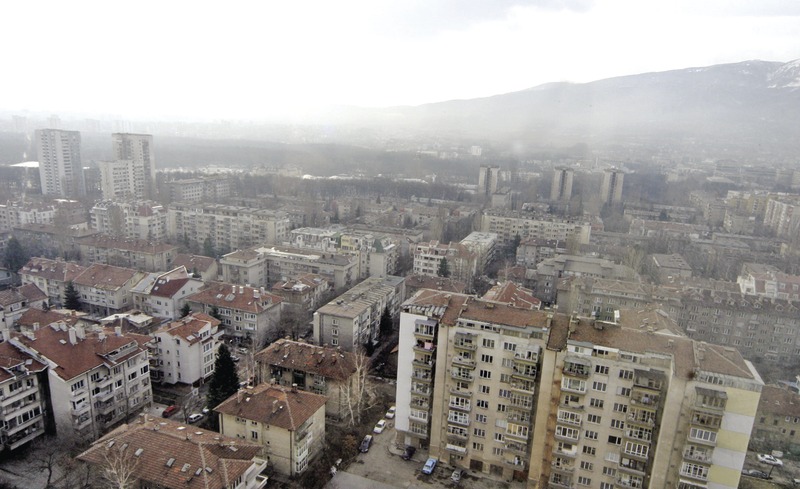
in Europe or at least one of the dirtiest. Smog in our major cities is no longer a novelty and people are so accustomed to it that donrquote t even pay attention. In September 2010 against Bulgaria EU opened a penal procedure because more than 30 of the countries biggest cities violate pollution limits for fine particulate matter. And if we do not fulfill the requirements by the end of 2013 the country will pay an annual 120 million euro in fines.
Under the European Directive on Clean Air member states shall not allow annually more than 35 cases of exceeding of the daily average rate of dust in a locality which is set at 50 micrograms per cubic metre. But in our country there are towns with more than 200 cases, which means that air there every other day is very dirty. Even the Environment Ministry recognizes that 57% of Bulgarians have to breathe more dust than acceptable.
Most dusty is the air in Pernik, Plovdiv and Vratsa.
In Montana, Vidin, Gorna Oryahovitsa and Sofia high levels of pollution have also been registered. In tAsenovgrad, Varna, Smolyan, Veliko Tarnovo, Pazardzhik, Blagoevgrad, Nikopol and Svishtov unclean air is mainly due to domestic heating (mainly the use of wood stoves), poorly maintained urban areas and road network. The settlements where, by contrast, largely to blame for pollution are energy and industry are Devnya, Pirdop, Ruse, Vidin, Vratsa, Montana, Galabovo, Dimitrovgrad, Burgas, Kardjali, Pleven, Silistra. In the capital causes of dust are the most complex and combine all possible sources.
Fine particulate matter are hardly to be underestimated, since they lead to tissue damage in the lungs. Children, elderly and people with chronic lung disease, influenza, or asthma are particularly sensitive to high values ??in the atmosphere. The harmful effects of dust pollution is more pronounced if there is air and sulfur dioxide, as often happens in Bulgaria. From them comes the increase in non-specific lung diseases, mainly respiratory infections of upper respiratory tract and bronchitis. Ridiculously enough, the municipalities that have adopted programmes to deal with this problem are in fact doing nothing.
In addition to dust and sulfur oxide, 22% of the population lives in high levels of nitrogen oxides. In the country there are still problems with lead contamination in Kardjali and cadmium in Plovdiv, because of the activity of enterprises of ferrous metallurgy.
Dirty air, of course, is far from our only environmental problem. The report on the state of the environment also points out that in Bulgaria
the noise level is far above the prescribed limits
of 55-60 dB. This fact is often associated with health risks, the environmentalists point out.
In Sofia the reason is mainly road traffic. Nearly 59 percent of local residents are regularly exposed to loud noise daily and more than 72 percent – of above-accepted values ??at night. Rail and air traffic does not strongly influence the population. Industrial sources of noise do not affect the acoustic environment of the city.
As with air pollution, in this case there are action plans and special maps showing where the most noise is have been prepared, but no particular actions have been taken afterwards. A significant improvement can be achieved even after replacing old stone pavement with asphalt.
The cost of protecting and restoring the environment at the national level is estimated at 1.27 billion levs annualy, and its share of the gross domestic product in 2010 was 1.8 percent. Consolidated costs in the budget of the Ministry of Environment and Water on programmes in the environmental sphere amount to 557 million levs, which is by 85 million lev more than in 2009.
The BANKER