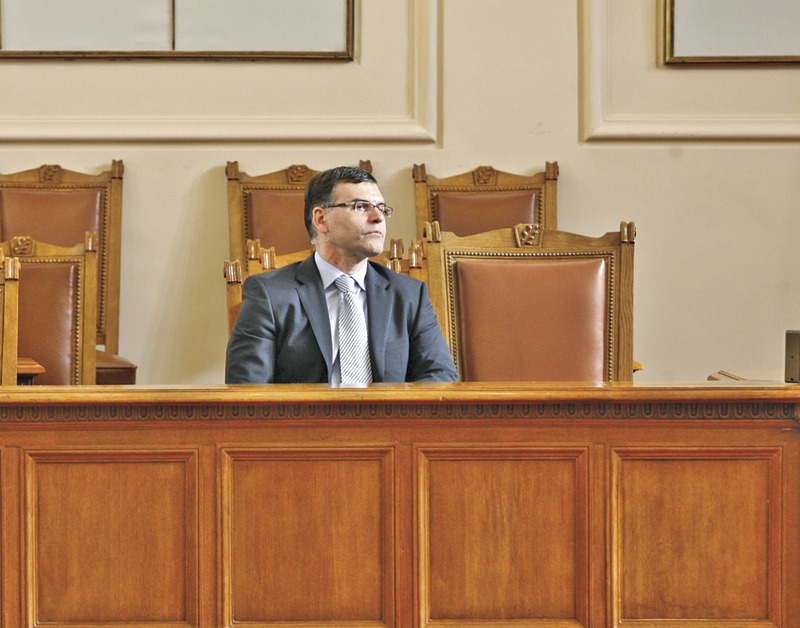
The show that took place in Parliament over the new tax on interest rates on bank deposit and 2013budget totally distract public attention from another not less important law – that for the public finances. Most of the things which are written there already exist in the current law on the state budget. The new thing, as described for the BANKER the former finance minister, is that it includes an extended version of the requirements of the EU’s Stability Pact. Yet this could be done without writing a new bill, Mr. Oresharski explained.
First bill on the public finances was examined by the Parliamentary Committee on Budget and Finance on November 13. But the only member who probably understands the matter – Mr. Oresharski, did not consider it necessary to attend that meeting. He said this bill is devoid of any new content. Two days later, the normative document was adopted on first reading in plenary session. There Mr. Oresharski presented a general analysis of the bill. But his words were a voice in the wilderness. And the other two speakers MPs – Aliosman Imamov and Dimcho Mihalevski, emphasized that this important bill needs a very thorough and professional debate.
The fact is that the document entitled Law on Public Finances, includes a whole section on Fiscal Rules, which literally copied European rules on deficit. It says that the structural deficit should not be more than 0.5 percent of gross domestic product. When government debt is below 60% of GDP, the deficit could even be up to 1 percent.
No explanation was presented as to why such differentiation is needed, since the Law on Public Debt says that the debt may not exceed 60 percent. Minister Dyankov did not share many words, and the administration led by him simply copied the draft text, as it was written by the European Directive.
None of the financial institution bothered to give any explanation of
the term structural deficit.
It is allegedly calculated through taking into account the one-off measures and measures of a temporary nature. What lies behind this vague wording probably know a handful of macroeconomists monitoring the budget fluctuations.
Lawmakers, who, in a year’s time, will have to pass the 2014 budget consistent with the Public Finance Act, will have to pass a training course on the topic before they do so. Otherwise it will be difficult for them to assess what exactly the Government wants from them.
There is also no analysis of the credibility of government predictions concerning the structural deficit. The general public will learn whether the government managed to meet the requirements, only when EUROSTAT issues a ruling on the matter or if the European Commission imposes an excessive deficit procedure on the country.
The other
two requirements to the deficit
– for it to be calculated on a cash or accrual basis – will trigger additional confusion, not only in the parliamentary ranks. The draft bill says that the deficit on an accrual basis will be calculated under the methodology of the European System of National and Regional Accounts and cannot be more than 3% of GDP. The deficit on a cash basis should not exceed 2% of GDP.
This shows clearly that the excess of government expenditure over income can not be greater than those 2%. When to this one adds also the obligations, the budget has not yet paid off, the maximum deficit should not exceed 3%. But how these limits correspond to the rules of a structural deficit, is nowhere explained. The bill however, explains in what circumstances the government may deviate from the set limits of the structural deficit. This can be done in reforming a sector with major impacts on the fiscal sustainability – such as social or healthcare sectors.
Alternatively – this is possible to take place if there is a decline in the economy, which is more than 3% of GDP. In the third scenario, all deficit restrictions drop out when there is an event beyond the control of the Council of Ministers. This can be a natural disaster or war. According to the draft bill, in such a scenario the government controls all budget events in the country.
If the project is approved in its current form, the concept of decentralization will just have to be forgotten. Municipalities are said to have rights to plan their annual income or expenses, but opportunities for investment initiatives are reduced to zero. Budgets should be balanced, but their right to incur debt are limited to the extreme.
In this situation
local authorities will be left
totally at the mercy of the finance minister (whoever he is). If the Minister refuses a subsidy requested by a mayor, the latter can do little but to raise local taxes (on there’s a legal limit) or else – the mayor just has to abandon the investment. In either case, however, the mayor in question becomes not more than a puppet in the hands of the Cabinet. In this situation, the mayors from the opposition have no chance to succeed unless they control the largest cities like Sofia, Bourgas and Varna.