Delayed by years, a new law on higher education will not be implemented until the end of the mandate of the now ruling GERB party. The text did not manage to fall within the legislative agenda of the current Parliament. And since the beginning of 2012 the office of the former Minister of Education Sergei Ignatov every month was preparing the general public for the grand moment when they will bring out their precious creation. The latest public version of the bill envisaged universities to receive state subsidies in a three-year development program, which describes in detail how many students are to study what subjects, and what resources they need to invest in equipment, in repair works, electricity, heating … Their costs would have to be covered in a way similar to the that how funds are paid to EU subsidized funding programs. Whether this is the best financial model for our higher education is quite another question, but the project is now waiting on the shelf.
The new education minister Stephen Vodenicharov already announced that his priorities are
to stir up the new operational program for science and education, to solve the case with the Scientific Research Fund to change the law on faculty staff and develop the secondary technical education that will power business with trained staff. For the higher education Minister Vodenicharov has not said even a word so far. And although during one of his media appearances to his right stood the chairman of the National Assessment and Accreditation Committee Prof. Boyan Biolchev, it is clear that the refurbishing of the rusty system of higher education will be left for the indefinite future. In other words, universities remain under the regulation of the current law of 1995, on which over the years over 40 amendments have been made. Scheduled money for universities in the current state budget come to 663.9 million levs and they must ensure the maintenance of all studies, to allocate money for social and welfare costs of students and postgraduates, to repair buildings and university dormitories. This magic is absolutely impossible to happen, since the standard for a student’s maintenance for a fourth consecutive year has stayed frozen at the minimum of 693 levs, since until 2009 it had been 963 levs. The resources are going down, the costs and inflation are rising, the number of students are melting. First to complain of the financial scarcity was the Sofia University St. Kliment Ohridski, where
tuition fees will be raised by 8%.
So the cheapest training there will now cost 360 levs in the school year 2013/2014 while the candidates for nurses and pharmacists will pay 500 levs per semester. The university will also drastically liberalize the access to higher education, and in only eight out of 102 study programmers subjects the results of state matriculation exams will not be recognized for admission.
Ruse University also announced an increase in fees by between 5 and 10%. So far we have tried to conform with the economic environment and tried to ease conditions for our students, but now we can not but consider inflation and appreciating maintenance costs, said Vice Chancellor of Student Affairs Prof. Mihail Iliev.
With the approach of summer admission exams probably many other universities will follow the example of Sofia and Rousse. Recently, the rector of the Southwestern University Neophyte Rilski Prof. Ivan Mirchev insisted annual allowance to be updated at least by the size of the inflation and the Technical University of Sofia asked for 4 million lev to repair dilapidated buildings.
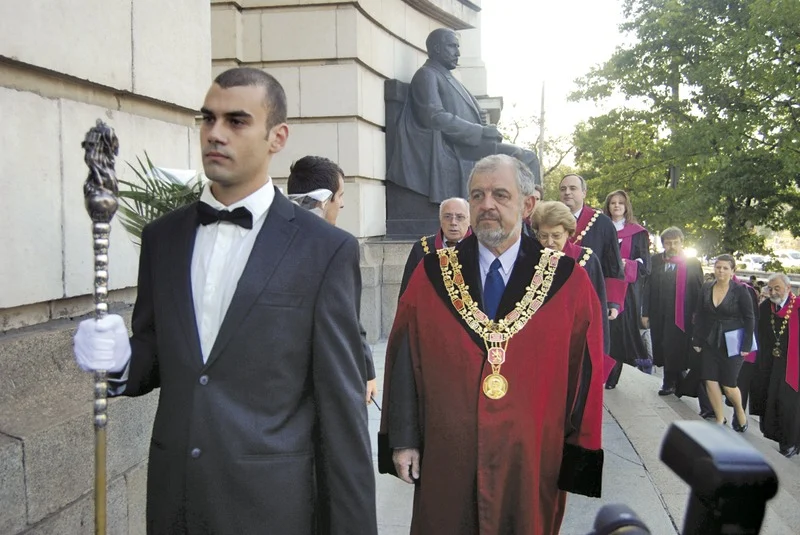
The bad thing is that the unpopular move among the students with the increase of fees will only bring headaches for university managers, but it does not solve their financial problems cardinally. He rector of Sofia University St. Kliment Ohridski Prof. Ivan Ilchev for example noted that the with the estimated 350 thousand lev in additional income, the university will be able to repair three or four audiences in the central building of the University and add to the resources needed for the payment of fees for heating, water and electricity. Nothing more. At the same time, the funding of programs like teaching and pedagogy, as well as the rare languages, which soon expect crisis in staffing, remains at the absolute minimum.
Salaries of teachers in Alma Mater have been frozen at the level of 2008 provided that
students’ scholarships jumped twice during this period. Associate professors and professors are already hopelessly technologically backward compared to their students. Because of the meager salaries whole faculties are losing educational potential. You can not attract quality IT or mathematician assistant with 500 levs a month when in the private sector they will receive at least four times that sum. The system of further financial stimulation according to the rating of universities does not in any way can offset cutbacks in their budgets. Sofia University St. Kliment. Ohridski has received 5 million levs in addition for the last three years, while during this period the state has saved in expenditure 40 million lev from reduced subsidies.
The BANKER