The system of financing education with delegated budgets may be good in concept, but its implementation in Bulgarian schools devided them into poor and less poor. Because of the famous uniform expenditure standards for school maintenance they went into frantic race just to attract more students. The worst part is that struggling in financial competition, some of them completely moved away from the quality of teaching, as evidenced by increasingly poor results of the annual exams. Since the money started to follow students, in the capital and major cities it has naturally come to the phenomenon mega-schools. They train educate more than 1,000 students, their teachers are better paid, the facades of their buildings are shiny and the computers and desks there are of a newer generation.
In the rest of the country educational pestilence seems to have occurred. Directors receive monthly salaries of 250 euros and pray in the classrooms of their schools to enter least 50 children otherwise they will lose their meager subsidy granted to them by the state. Teachers are not
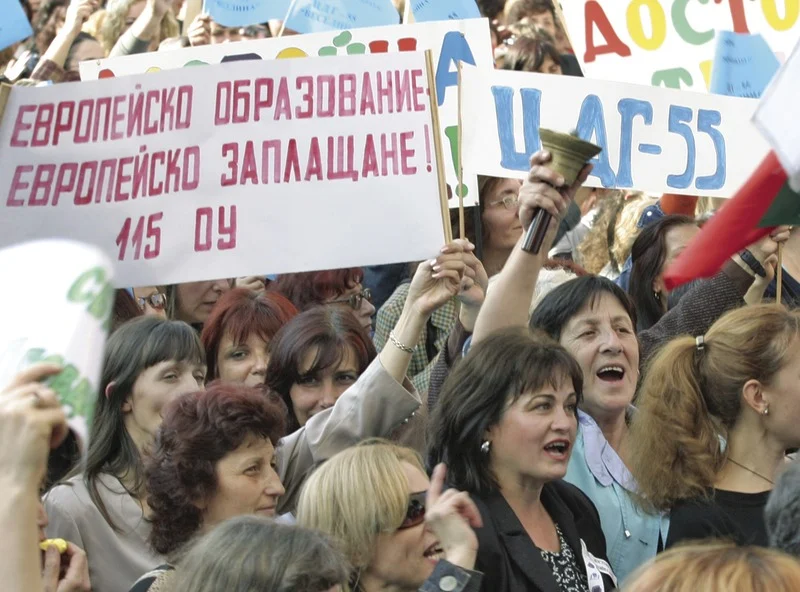
motivated to develop professionally and are just present. The new law on pre-school education has remained on hold in Parliament, and to everybody it is clear that educational reform is going in the wrong direction. According to the Syndicate of Bulgarian Teachers who should be most familiar with the matter, the right way is the only one. They offer all the political parties to conclude a pre-election agreement with the commitment, in case they win the election, to increase by 18% the uniform expenditure standards from the beginning of 2014.
In fact, during the cabinet of GERB, the annual budget per pupil was frozen at 1350 levs per year for three years, although the cost of the school jumped by about 12% in this period. Teachers have repeatedly asked the standards to be raised to 1438 levs, but only after threats of mass strike the cabinet adopted the cosmetic increase of 5% since the beginning of 2013. Under the law, the teachers welcomed the year with slightly higher salaries. Of course, mainly those who gravitate around the bigger schools. The fresh money into the system were divided unequally, causing a new wave of teacher dissatisfaction. It turned out that teachers in 86% of schools have received 8 per cent increase in their salaries, but in 97 schools the salaries were raised by only 4%. In the other 29 schools where they teach between 20 to 120 students, there is no change in teachers’ remuneration.
Overall, the average gross salary of teachers and directors was nailed to the 719 levs and non-teaching staff gets on average 485 levs. And if it looks like income, which in no way corresponds to the reputation of the teaching profession, in some regions, such as Shumen, Razgrad, Kardzhali, Pazardzhik and Blagoevgrad, the situation is even worse. In smaller schools, those with the status of protectedq the teaching staff takes only between 310 and 500 levs. Accordingly, the latest study from the teachers union for social and economic consequences of the introduction of delegated budgets shows that there is nobody who is happy with the status quo. Teachers
continue to frown on their salaries
and do not agree with the pay gap across regions and types of schools. Moreover, it is clear that the sector is depopulated from young cadres and increasingly feminized.
Business organization is confident that the problem will largely be solved if a standard maintenance be increased to 1834 levs. For this to happen, however, a sum of about about 600 million levs is needed. Trade Union leader Plamen Dimitrov even points out that the system can not produce quality, since during the last teachers’ strike in 2008 the government gave 3.5 percent of its gross domestic product on education, and now only 2.6 percent.
The BANKER