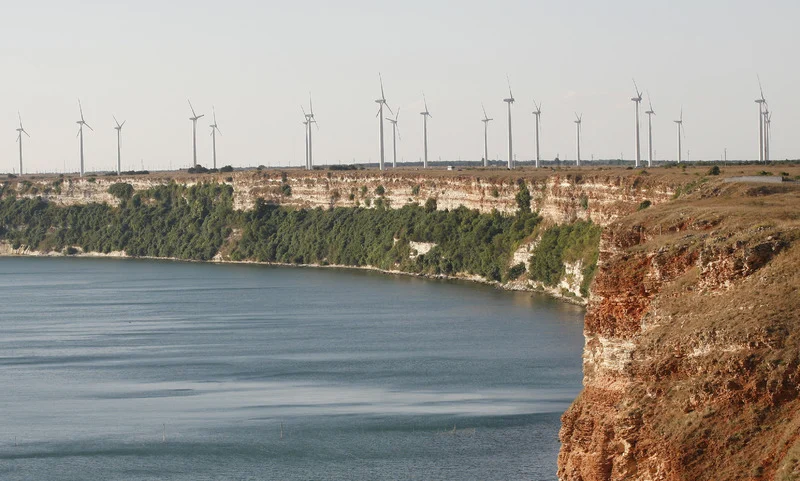
If one looks closely at the short columns that Bulgarian newspapers publish on their economic pages, one will surely spot a message that has been often repeated in the recent weeks. In general, it states that upon order of the Electroenergy System Operator for the respective day the total production wind and photovoltaic plants on the territory serviced by CEZ, EVN and Energy Pro is limited by 40%. However, this is only the first visible part of things.
After last years the government was pouring money into manufacturing licenses for electricity from wind and sun, now, when the general attitude has been electrified, the state administration started slowly closing the tap of the green businesses. Significantly, since the beginning of last week, the Ministry of Agriculture and Food started accepting applications for two measures of the Programme for Rural Development – Support for the creation and development of micro enterprises and Diversification into non-agricultural activities. Judging from the orders approved by the responsible Minister Ivan Stankov, money that the state will give on the first measure is about 51 million levs, and on the second – roughly 92 million levs, but much more interesting is the third point in both documents, which states that investments for the production and sale of renewable energy (solar, wind, hydro, geothermal), with a capacity of up to one megawatt are not eligible. This way, the loophole, which used by people close to the government to accumulate some money from green energy off the state, yet with a grant from the European Union, is now closed. We’ll see for how long.
Representatives of the Ministry of Agriculture admitted that the reason for cutting the green projects has been caused by the current crisis, which we all have witnessed in recent weeks. Accordingly, the money will be allocated to create another type of micro or tourist attractions in smaller municipalities. This is not bad, but it would be much better if the idea had come up earlier.
Up until 31 March 2013 the Programme for Rural Development approved 4308 projects, of which 1136 are related to the two above-mentioned measures, and the total approved grant amount them is an impressive 354 million lev. Unlike other operational programmes for which information is public and accessible through the ISUN system, the data of the Ministry of Agriculture of rural areas show only the recipient of EU funds, but not the kind of the project that has won the grant. Therefore, it is very difficult to say exactly what portion of the more than 1,100 contracts were for the construction of photovoltaic and wind farms. But judging by the names of the companies and their objects, their number is definitely not small.
In April 2011, for example, Iskra power plant was assisted by 391.1 thousand levs, applying with projects for over 518 thousand levs. The company deals with construction and operation of photovoltaic power plants and major shareholder in it is 24-year-old Iskra Naidenova, shows a check with the information system Daxy.
The same amount as support from the programme for rural development has been granted the T Solar Ltd. with a project worth over 774 thousand levs. The company’s scope of activities is the production and sale of electricity from renewable energy sources.
The contract with Davidov Energy was signed on 22 March 2011. The project of this company is for a total of 467,710 levs and the granted aid is 374,168 levs. According to the Daxy, the company is involved in design, construction and management of power generation projects from renewable energy sources, photovoltaic modules, solar energy conversion into electricity, wind energy production, and production of solar panels.
The list has a number of other names, which are clearly related to the development of photovoltaics as – New Energy Group, Eco Solar Holding Group, Solar Mitkov Company, Cesare solar, Solar Energy 2000 etc. They have also taken a solid amount in the form of subsidies to carry their ideas. Here, we found and an extremely curious project. On 27 January 2011 the project of company Prime Eco Energy for over 1 million lev was approved and on the same day half of the amount was received as assistance from the state. But more interesting is that the company owner is 22-year-old Doan Hassan and the company again is engaged in the design, construction and operation of eco-fuels and energy sources based on biomass.
The BANKER