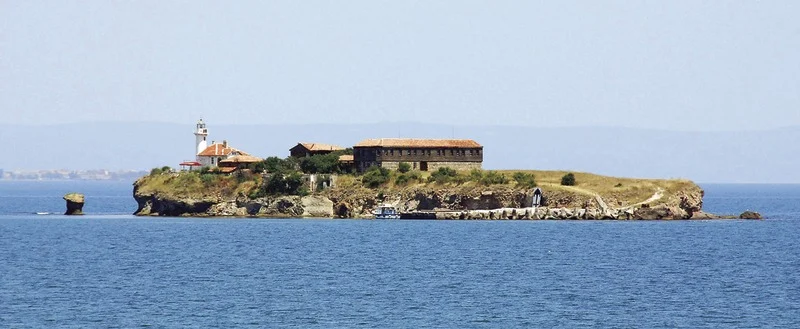
Bulgaria can, too, establish its own offshore areas, just as the UK and the USA. This colorful idea was born when the parliamentary economic committee was discussing the Law for Economic and Financial Relationships with Companies Registered in Jurisdictions with Preferential Tax Regimes and their actual owners last week. Author of the proposal was the leftist MP and vice president in the government of former PM Jean Videnov – Rumen Getchev. According to him, Britain has allowed the creation of offshore islands under its authority in order to benefit from them. Quite seriously Getchev proposed for this purpose the Black sea islands of St. Anastasia and St. John.
In response to this proposal, the author of the draft bill – Jordan Tsonev of the Movement for Rights and Freedoms (MRF) explained that the project is just a beginning to the solution of the complex problems with shady capitals and he would accept to review any ideas that would be proposed between the first and second reading. In his words, however, it is better that we do now accept any investment rather than have ones of dubious or unclean origin.
As absurd the ideas proposed by Mr. Getchev may seem they are not devoid of some realism. The truth is that Bulgaria even now a tax oasis. It may sound incredible, but it’s a fact! In some websites for registration of companies, our country has as an offshore zone status – alongside Cyprus, Gibraltar and the Isle of Man! True, there is a requirement for the publicity of the managers of the company, but the focus is on the 10 percent flat tax. It is as low as on the island of Aphrodite and lower than in Liechtenstein, where the charge collected by public limited companies is 12.5 percent. We have a bunch of other benefits – such as 60 agreements on avoidance of double taxation, against 53 which Cyprus has concluded. If we add to this the fact that the minimum capital requirement for registering a limited liability company or a single-person limited liability company is 1 euro, the offer becomes even more attractive. There are Internet offers for registration of offshore companies in Bulgaria Business consultant Turner Little, for example, asks for 1950 pounds, excluding VAT, for the establishment of such a company in the country.
If we look purely theoretically, the country could make no use of these advantages without resorting to some kind of island law or adopting some special rules. This is how the big companies that are working here, instead of registering all sorts of tax havens firms in various corners of the world can just remain here. However, as it is well known, money does not like publicity.
However, going back to Law for Economic and Financial Relationships with Companies Registered in Jurisdictions with Preferential Tax Regimes, what need to be clarified is how it will regulate the status quo of the off-shore companies that are already operating in the country. The question is, what will happen to companies that have already received licenses. The options that have been discussed so far are three: for withdrawal of the licences, replacing of the company with another one whose owner is known, or asking for a declaration by the authorities of the respective jurisdiction for disclosure of the names of the individuals standing behind the company. According to Jordan Tsonev however the latter option is practically impossible for most areas, so what remains are only the first two ones.
Ultimately, the bill was passed unanimously by the economic committee with the votes of the socialists, MRF and the nationalist Ataka. GERB MPs left the meeting early and did not participate in the vote. If the text is approved by Parliament after January 1, 2014 it will introduce a ban on companies registered in jurisdictions with low tax regimes, engage directly or indirectly in twenty fields of the local economy. These are banking and finance, insurance, pension and health funds, public offering of securities, concessions, public procurement, privatization, acquisition of state or municipal property, licenses under the Excise Duties and Tax Warehouses Act, establishment, acquisition or participation in professional sports club, applying for priority investment projects, energy, gambling, trade in dual-use goods, mobile communication, water and sewage networks; collection, transport and disposal of waste, as well as the media, but with exception of websites.
From the beginning of the next year, for all companies with unclear owners special tax regimes enter into force. The transitional and final provisions of the law make adjustments to the Tax and Social Insurance Procedure Code, which envisage deals with offshore companies to be treated as such with related parties. The scope extends to Bulgarian companies over which companies registered in jurisdictions with low tax exert control. The proposed changes also create opportunities the existing mechanism for hidden profit distributions and related to it sanctions to be applied to transactions with offshore companies, said Tsonev. According to him, the changes would lead to corporate tax on the ineligible expenditure of the local resident of 10%, to a tax on dividends for the non-resident coming from a jurisdiction with low tax – 5%, and to a penalty on undeclared hidden profit distribution of 20%.
The BANKER