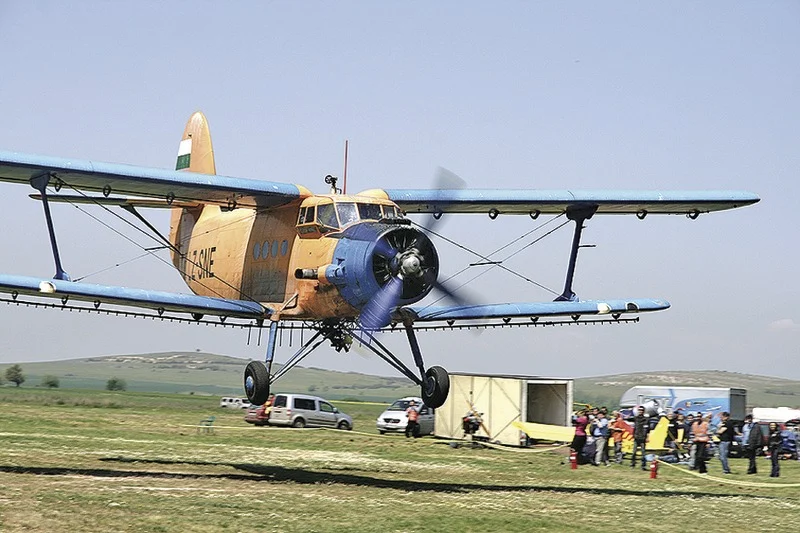
Bulgarian State finally realized that apart from commercial there is also light aviation. Moreover, last week saw the end of the public discussion of an ordinance with the too descriptive title – Registering, initial determining of airworthiness, and maintenance of ultralight aircraft, training and issuing licenses to pilots and their control. If it is signed by the Minister of Transport, the Civil Aviation Administration Directorate General will be released from the activities related to the so-called non-commercial flights. Or, directly said, this will create a parallel structure, which will greatly facilitate the work of the state administration.
Now the small aircraft sector is three-quarters of all aviation in the country, but part of it is in the informal sector. The state has not registered all ultralight aircraft because to register a paraglider or a motor hang glider costs as much as to register a Boeing and an Airbus. In addition, an owner must pay to maintain the aircraft’s airworthiness and cover the costs for the air servicing programme. However, this will change with the new ordinance, and therefore it is a very big step forward, Tzvetan Doganov, president of the Association of Ultralight Aviation in Bulgaria told the BANKER weekly.
The story of the ordinance in question is as curious as it is indicative of the carelessness of Bulgarian administration. Yet the regulation of civil aviation of Europe in 2002 says that unmanned light or ultralight aircraft are not subject to mandatory regulations, allowing part of the activities to be given to other regulatory authorities, different from the national ones. But then the government in Bulgaria did not respond. In 2008 Regulation № 216 of the European Parliament came out, setting forth the rules of civil aviation. In its fifth article it was noted that: It would not be appropriate for all aircraft to be subject to the general rules … and these are essentially the ones with simple design that were built by amateurs, that are few and are operated mainly on a local scale.
The resolution of the European Parliament voted on 3 February 2009, again emphasized that aviation associations and societies, active in sport aviation and aviation for relaxation and leisure have to be empowered and given control rights.
Again, we requested changes to the Civil Aviation Act and only at the end of 2011 Article 119 was amended enabling activities related to light aviation to be taken away from the state administration. To speed things up, we wrote the ordinance and proposed it to the Civil Aviation Administration. It had to come into force in August 2012, but for more than two years it has been aging on the shelf at the Ministry of Transport. Only now it was opened for discussion, said Tsvetan Doganov .
Representatives of the industry, however, fear that no matter what discussion has been held, the document may again not be put into force. My personal guess is that the Air Traffic Control state enterprise does not want to have free flying vehicles at no charges. From there they are probably lobbying to have a fee for servicing or the light aircraft sector be left to self-servicing. Military Air Forces are also not keen on having the sky of Bulgaria crowded with all kinds of small airplanes and gliders, although this is common practice in the western EU, said the chairman of the Bulgarian Association of light aviation Momtchil Riladzhiev.
Even those fears do not justify, the regulation is awaiting new problems. At least, NGOs active in the non-commercial aviation have to negotiate which one of them will assume the control activities delegate by the state.
The BANKER