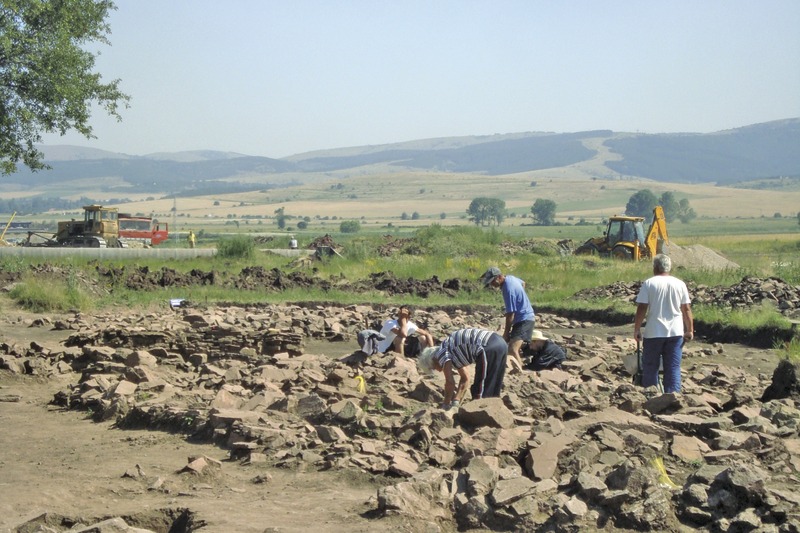
No archaeological surveys along the routes of new highways have been performed or commissioned since the beginning this year by Bulgariarquote s Road Infrastructure Agency. Attempts by the institution to hire teams for the excavations along Maritsa, Struma, and Hemus highways and the new motorway to Serbia have failed one after another, which ultimately slows down the implementation of road projects. So after long discussions about the importance of the archaeological findings along the routes of the countryrquote s highways under construction, the decision of the present government to pay up for archaeologists is about to be fruitless .
Money for excavations repeatedly provoked sharp debates among academics and former ruling GERB party. Former PM Boyko Borissov regularly accused archaeologists of impeding and delaying the construction of roads and even instructed them to wear quilted jackets and switch on heaters to complete their studies faster. Today, the attitude to the guild is different, but companies that could make complete rescue excavations along the new roads are not present.
Recently Road Infrastructure Agency announced for the third time a competition for a company to carry out archaeological studies on Lot 2 of the Struma highway from Doupnitsa to Blagoevgrad. These are established sites that fall within the area of the road and will be affected by its construction. Among them are Late Antiquity settlement in the Cheresharnika zone near Doupnitsa, a necropolis and a town in the land area of German, another late medieval and Renaissance town in the area, a Neolithic village near Mursalevo and a similar one next to Kocherinovo. For the study and conservation of all sites a sum of nearly half a million levs has been earmarked, but the problem is that in the previous two procedures: on 30 July and 13 September not a single offer was submitted. The deadline for participation in the current auction is December 12. This time, even if it comes to contracts, quilted jackets and heaters, the delay will hardly be compensated. Hence, the builder of the plot – Consortium Struma- Lot 2, which includes Impreza Italy GBS Infrastructure Construction and Patstroy endash 92, will inevitably be late with its work.
The situation is similar with the first lot of highway Maritza – from Orizovo to Dimitrovgrad, so the deadlines for opening the 31-kilometre stretch has been extended until mid-2014. In late May, Road Infrastructure Agency called a tender with a budget of nearly 1.1. million levs for archaeological excavations along the lot, but after a month the procedure was terminated since no proposal was received. Then – on July 29, the road agency decided to send invitations directly to Sofia University St. Kliment Ohridski, the National Institute of Archaeology, the Regional History Museum of Stara Zagora, and the Regional History Museum in Haskovo. But to everyone’s surprise, none of these institutions wanted to deal with the protection of archaeological discoveries. So far it is known only that the findings in the area of ??the Chirpan village Zlatna Livada and the Dimitrovgrad village Velikan date back to Late Antiquity and the Ottoman period. Parts of a village and a cemetery have been found, plus numerous fragments of pottery, glass bracelets and other valuables. If and when a new procedure for excavations there will be announced is not known.
No offer was submitted in the competition for research on Hemus highway between kilometres 337 and 342, near junction Belokopitovo. For the study of the field of 13 decares 360 thousand levs was set aside and the plan was that the works should end this autumn, but obviously the work will be put off for next spring. What is worse is that the road agency has not announced a new procedure.
Archaeological research along the future highway from Sofia to Kalotina has also not been made, although for this purpose 660 thousand levs has been provided. This time the problem is not a lack of willing participants but in the incompetence of the officials of the Road Infrastructure Agency. After the announcement of the tender at the end of May, the National Institute of Archaeology lodged a complaint to the Commission for Protection of Competition, claiming that the provisions of the Public Procurement Act regarding archaeological excavations had not been met. Competition watchdog ruled on June 30 the competition unlawful, but the road agency decided to terminate this procedure only on November 25. Now a new attempt at announcing the same tender is forthcoming.
In fact, the very construction of the highway to Serbia is still in question because of depleted funds under the Transport Operational Programme. The idea is for it to be built in two phases, the first including the construction of the section from the border to junction Hrabarsko by the end of 2015. The continuation from Hrabarsko to the North Tangent of Sofia is included in the priority projects of the new programming period of the Transport programme. However, it would be wise to carry out the archaeological research on time and not at the last moment. It is known that on both sides of the road near Slivnitza in the area and the village of Saray and Aldomirovtsi there are artefacts from the late Iron Age and Antiquity.
The BANKER