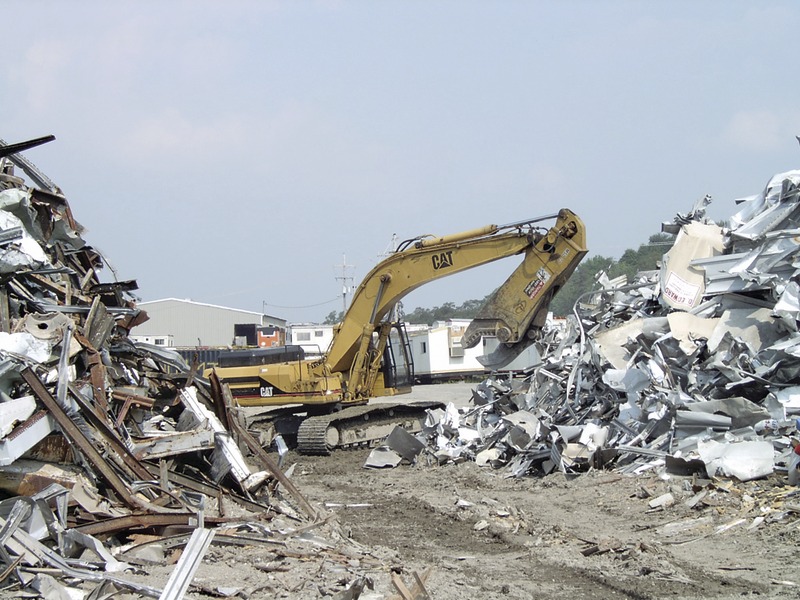
It seems that companies trading in ferrous metals in Bulgaria will work under new rules. Dozens of organizations, associations and companies have already sent to the Ministry of Environment and Water their proposals for amendments to the Law on Waste Management, mainly asking for repealing most of the provisions introduced by ex-rulers from GERB, due to which the industry is said to have reported a serious crash last year. The truth is that while exercising its normative powers, members of the former National Assembly created a real mess, and the turnover in the sector shrank by 2.2 billion levs to below 2 billion levs.
The biggest problem for companies proved to be the bank guarantees that are required from them in order to continue operating. According GERB’s rules they need to pay 25,000 levs as a registration fee and additional 5,000 levs for each site they have. Because of this requirement, as calculated by industry representatives, currently a sum of over 22 million levs is blocked in banks, although in conditions of a financial and economic crisis liquidity is crucial.
To solve this problem, the Bulgarian Association of Recycling insisted on the fixing of a deposit of 10,000 levs. According to the President of the Bulgarian Association of Recycling, Borislav Malinov, the current size of the fee is prohibitive for small and medium-sized companies and many of them have gone into the informal sector. The proof is the smaller number of companies – from nearly 2,400 in early 2012 they dropped to less than 900 now. The Association estimates that the number is below the sanitary minimum of 1,200 needed for the country. If the amount is reduced, many companies will be back in the real economy, said Mr. Malinov.
According to Deputy Minister of Ecology Chavdar Georgiev, however, the exact amount of a bank guarantee, which is an economic regulation tool, can be determined only after an expert analysis. Whether it is high or low, whether it interferes with the companies’ activities, or – on the contrary – to stimulates them, is too early to say. Studies are needed. Currently, these businesses still operate, he added.
Another proposal of the Recycling Association is to return equality between operators and demanded bank guarantees for activities related to end-of -life vehicles, electronics, electrical equipment, batteries and accumulators. Now a there is a paradox in junkyards as actually they process ferrous and nonferrous metals from old cars, but the requirements for them are very low.
He wants a repealing of the provision giving rights of individuals to gratuitously give for processing household ferrous and nonferrous metals, at the specially constructed municipal posts. The idea of the former rulers was that this way any theft of infrastructure materials would be rendered pointless. Except that, according to the businesses, it is unconstitutional as it restricts the rights of citizens. The obligation to transmit gratuitously waste that has a market value is a kind of expropriation. No owner would give their waste for free, but will seek to gain something in return. This could be a prerequisite for the development of the informal sector – illegal sites or what recently appeared in the form of pawnbroker’s houses for metal objects. The final tax of 10% on the value of the waste will not go to the state either, the representatives of the Association for Recycling are convinced.
What will be maintained, however, is the requirement for waste with no household origin: such as cables and conductors parts of rolling stock, railway rails, road signs, guardrails, metal lids, shafts, parts of street lighting or pipes and sewerage systems as well as metal monuments to be accepted only in the presence of a certificate of origin.
Among the proposals of the companies dealing with scrap metal is the elimination of mandatory electronic payment on all transactions with non-ferrous metals, as well as the provision of a 24-hour surveillance and record keeping for one year. The first provision, say business representatives, is against the law on limiting cash payments where there are thresholds. Also, the practice in the Member States of the EU who introduced non-cash payments showed a reduction in turnovers. As for video storage, they want the limit of keeping the records to be 30 days since their preservation for longer would mean huge investments. Same reasons have been pointed out with respect to the terms for keeping the records and accounting books.
Last but not least, private entrepreneurs will try to convince the new government that the best mode of the regime of trading in ferrous and non-ferrous metals is to introduce registration rather than permit issuing. Thus, the registration authority would not have discretion for appropriateness, but in accordance with the regulations will be obliged to register the applicant. In case this proposal is not accepted, we suggest that the competent authority is a central body whose discretion will be equal for all, said the Association for Recycling.
Ultimately, which of the quoted and of the many other proposals for amendments to the Law on Waste Management will be adopted by the government will become clear as early as the first month of 2014. So far, the Minister of Environment and Water Iskra Mihaylova has promised to make a detailed analysis of the legal framework and the evaluation of its impact on the sector, in order to assess the need for adjustments.