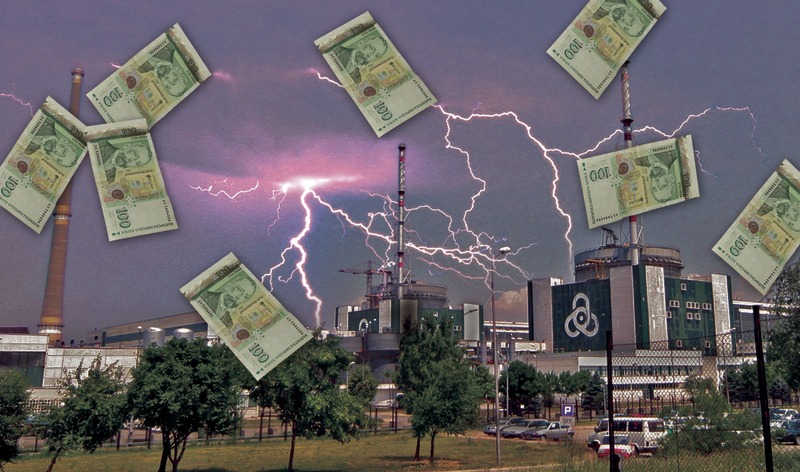
The time of the main guarantor of the energy stability of the country – NPP Kozloduy expires and the Ministry of Economy and Energy, Bulgarian Energy Holding and the plant management continue to give conflicting signals as to by how much they may decide to prolong the lifetime of the key 1000 MW blocks at the nuclear plant. In the public space they have thrown messages about huge amounts to go to the future programme on the continuation of the life of V and VI reactors producing the cheapest electricity in the country, but it is not clear what this programme will be nor who will provide the money for it. It is only known that the lifetime of the first one expires in 2017, and the other one will have to close down four years later.
All analyzes, documents, and repair works are made for a minimum of 20 years of extension of the life of V and VI blocks, which means they will run at least until 2040, said at the beginning of 2013, the then Minister of Economy and Energy of the Government of GERB, Delian Dobrev. Similar statements were made at the beginning of 2014 also by the Executive Director of NPP Kozloduy Ivan Genov. He told reporters, that the assessment of the remaining resource of the two reactors showed that their life can be extended by 30 years. Far more moderate in his statements for the future of the reactors is the current energy minister in resignation Dragomir Stoynev. During his short term, he ventured only to note on several occasions that the blocks should continue to operate after 2020.
In fact, by law the Nuclear Regulatory Agency (NRA) issues licenses for the operation of nuclear units for a period not exceeding 10 years. That is, it is very important now to establish whether the units will work another 10, 20 or 30 in order to provide for the necessary investments. Whatever the technical operations to be carried out may be, it is not profitable to open for repair a 1,000 megawatt reactor more than once.
To implement the first stage of the project to extend the lifetime of the two 1000 MW units in April 2012 a contract was signed between the NPP Kozloduy and the OAD Consortium Rosenergoatom (Russia) – EDF (France) for comprehensive investigation of actual situation and assessment of the remaining lifetime of the equipment and facilities of Units 5 and 6. The project was completed on time. At the time – on the basis of the audit results – a programme to extend the operation of the V block was developed and agreed with the NRA. A similar programme will be presented in the NRA for the VI block, NPP Kozloduy said in its response to the BANKER. However, what this first stage includes and how long it will last is not understood by the obscure phrases used, not to mention the money necessary to prolong the life of the two reactors.
Incidentally, the cost is also constantly changing. In 2012 it was announced that it will be 266 million euros, and at the beginning of this year came to „no more than 400 million euros“. In June Bulgarian media quoted Deputy General Director of Rosenergoatom, Stanislav Antipov, who said the operation would cost between 500 and 600 million euros.
The key to extending the life of the 1000-MW reactors is in the so called „steam generators“ and their lives are now running out. On this occasion, nuclear expert and former head of Kozloduy, Yordan Yordanov, told the BANKER that: „The steam generators have been working in a specific lithium mode, repairs have been done on the spin collectors and many other local Bulgarian improvements have been implemented to allow them to operate for another ten years, but no more. Then they would have to be changed. For each reactor four such facilities are needed which generally cost between 300 and 500 million euros, or for the two units the amount will be about 2 billion levs (1 billion euros). We also need to make a repository for storing the replaced steam generators, because they are high-level radioactive. And there is not even a draft project of such an operation. What is also needed are assessments of the impact on the environment, research, purchase of technology from the Russians, ordering of the equipment, transportation etc. In addition, the change of a single steam generator will need between six and 12 months of work. This means that for a half a year in the summer each of the reactors will not produce electricity for a period of four years. How much does it cost? In a nutshell – the replacement of the steam generators would cost just as much to install new blocks,“ said Yordanov.
According to Ivan Genov things look different. About ten years ago experts from the Bulgarian Academy of Sciences and Russian organizations have evaluated the resource to the generators of V and VI blocks. For the sixth block their report strongly suggested that there is no problem with its exploitation – by the end of the projected period, and as well for a future extension of its life by another 20 or 30 years. A specific case was the one with V block, for which it has been found that the steam generators can be used until the end of the projected period. The recommendation was in the next licensing period to reassess their situation in order to show whether they will require replacement.
The big question is whether or not to spend money supposedly for a 30-year modernization of the units, while in fact they will work only ten years. And all these twists and turns with numbers and deadlines – aren’t they just an eyewash? This tactics, of course, is beneficial for the companies that operate the nuclear power plant and provide services for it. Grounds for such suspicions have been provided also by the recently mentioned increase in the capacity of 1000 MW reactors in the mix with the extension of their life cycles, although the two things have nothing to do with each other.
According to nuclear experts, to increase the capacity by 4%, one would need to change power generators, the control system and reactor protection and most importantly – the type of fuel. The currently used one, which is enriched at 4.4%, will not be applicable and the country will need to buy a new – higher enriched one – of 4.64%. In turn, this will lead to new costs for the plant, which will hardly help improve its financial position.
If Bulgaria really wants to extend the life of both the blocks with more than ten years, the best option seems to use loans, not own funds of Kozloduy as advocated by Ivan Genov. Especially given that today 70% of the dividend of the company goes back to the state treasury. In Bulgaria it would be wise to have a few large financial institutions with an interest in the plant and its functioning as long as possible to pay back their loans. This was made during the period in office of Ivan Kostov in mid 1990s and the programme for the modernization of V and VI block was for 491 million euros. Of these, 180 million were own funds of NPP Kozloduy and the rest were drawn in the form of loans. But then the whole sum rose significantly compared to the initially estimated amount, and some measures that were stipulated quietly dropped out.
The BANKER