Credit Suisse Geneva Banker Said to Send Client Funds to Wife
-
Banker moved $1.5 million into wife’s Monaco account
-
‘L’ also put $2 million into Dubai account he controlled
The Credit Suisse Group AG wealth manager at the heart of a trading scandal told prosecutors in interviews that he took clients’ money and moved it into personal accounts in Monaco and Dubai, according to four people with knowledge of the investigation.
The banker, who can only be identified as “L” under Swiss law, moved $1.5 million into his wife’s account at a bank in Monaco in 2008, said two of the people, who asked not to be identified because the proceedings are ongoing. A second transfer of $2 million was made three years later into the account of a Dubai firm that he controlled, the people said.
For months after L’s initial confession to prosecutors last September that he was moving clients’ money around to cover investment losses, the 52-year-old maintained he never profited from the falsified transactions, the people said.
The revelations from his interviews with prosecutors are the latest developments in a probe that raises questions about Credit Suisse’s wealth management business and how one of its managers was able to falsify client trades for seven years before one big bet on a small-cap U.S. drugmaker went badly wrong, forcing him to confess his wrongdoing.
The money was taken from the accounts of top clients: Bidzina Ivanishvili, a billionaire and former prime minister of Georgia; Vitaly Malkin, a former Russian senator; and two more wealthy Russian patrons of the Zurich-based bank.
L’s lawyer, Simon Ntah, said the transfers went both ways. The banker did move money into accounts he controlled alone or with others that he had made from profitable trades. But at other times, he also used his own money to help clients cover losses, Ntah said.
Wine Cellar Auction
“The clients complain about money they lost but aren’t saying anything about the money that my client made for them,” Ntah said. L has given permission for many of his belongings, including the contents of his wine cellar, to be sold at auction to raise money to compensate his clients, according to the people.
L, a French citizen, has been held in a Geneva prison hospital since his arrest in January because he is considered a flight risk. The banker’s home in the hills above Lake Geneva is less than 10 kilometers from the border with France, which doesn’t usually extradite its own citizens.
To read more on the jailed Credit Suisse banker and the Oligarch’s millions, click here.
Credit Suisse has said that the banker engaged in criminal acts to “deceive the bank’s control system” and concealed his actions from colleagues.
Concealed Deceptions
“The former relationship manager concealed his deceptions from colleagues and this is to the best of our knowledge an individual case,” Anna Sexton, a spokeswoman for the bank, said in an e-mail. A spokesman for Geneva prosecutors declined to comment on the investigation.
L, however, may no longer be seen as a lone wolf by Swiss law-enforcement officials. Three other suspects were identified by the Geneva prosecutor’s office last month on suspicion of money laundering in the case. While all three men had at some point worked for Credit Suisse, only one was there at the same time as L.
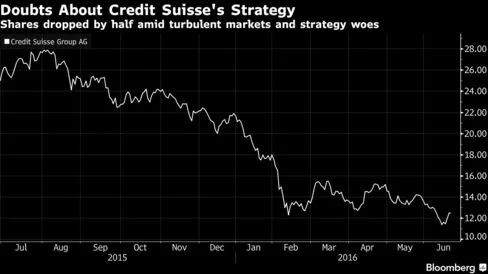
Shares of Credit Suisse, Switzerland’s second-largest bank, have plunged 50 percent over the past year amid losses in turbulent global markets. Tidjane Thiam has struggled to rebuild investor confidence since taking over as CEO last year as he’s shifted the bank’s focus from investment banking to wealth management.

Clients pulled 1.5 billion Swiss francs ($1.5 billion) in the fourth quarter in funds that were connected to Ivanishvili’s claims, people familiar with the situation said earlier this year. The bank has also set aside 250 million Swiss francs in provisions, understood to be for litigation related to the case.
Four clients including Ivanishvili and Malkin have already filed criminal complaints against the banker and have accused Credit Suisse of money laundering for failing to have controls in place to prevent the wrongdoing.
The Georgian, who is worth an estimated $5.4 billion, won a ruling last week granting his investment firm Wellminstone SA victim status in the probe, which will allow his lawyers to see company documents, e-mails and other evidence. A Swiss court threw out an appeal by Credit Suisse, which argued it was the only injured party because it physically held the funds. The bank declined to comment on the decision.
Credit Suisse, the Jailed Banker and an Oligarch's Millions
-
Swiss banker held on charges he misused clients' millions
-
Georgia former Prime Minister, others claim huge losses
For years, he was a member of the elite of Swiss bankers. Now, the former Credit Suisse wealth manager is in a prison hospital in Geneva, charged with fraud, misappropriation, and criminal mismanagement, facing as many as 10 years behind bars.
The case reaches beyond the executive, who under Swiss law can’t be identified in public. Credit Suisse now faces criminal accusations from three clients, alleging it played a role in the fraud.
The timing is terrible for Switzerland’s No. 2 bank. Its new CEO, Tidjane Thiam, is betting its future on managing money for the rich. Wednesday, he announced plans for more cuts at its investment bank. He also told Bloomberg Television he was blindsided by risky debt and illiquid positions taken at the trading unit that he expects to contribute to a loss for the bank in the first quarter.
At least one client involved in the Geneva case – one of Credit Suisse’s largest – is pulling his accounts from the bank. In criminal complaints with prosecutors, his lawyers accuse the bank of money laundering and “churning” his accounts to boost its revenue with unnecessary trades. Wealthy men from the former Soviet Union, the clients said their losses reach into the hundreds of millions of dollars.
“The catastrophic situation in the accounts wasn’t caused by an unfortunate investment policy but by a chain of trades, the vast majority of them unauthorized, that created excessive concentrations of risks for clients in order to simultaneously procure important revenues for the bank,” lawyers for one said in a complaint filed with prosecutors in January.
Complex History
Credit Suisse spokeswoman Anna Sexton said in an e-mail that the now-fired banker “violated internal rules and Swiss law and engaged in criminal acts to deceive the bank’s control system.” She added that the bank believes he “concealed his deceptions from colleagues and that this is to the best of its knowledge an individual case.” She declined to comment further.
In December, the bank filed its own criminal complaint against the banker, in which it said it was still trying to untangle the complex history of his transactions.
Credit Suisse is amending its internal policies in the wake of the revelations, increasing supervision of the highest-earning client advisers, requiring independent confirmation of large transfers and making other changes to ensure such abuses don’t happen again, according to a person familiar with the moves.

The banker’s motivations for the years of deception, which he admitted in statements to the bank, remain unclear. Credit Suisse said it hasn’t found evidence he benefited, but “it can’t be excluded that he could have sought personal gain” from the trades, according to the criminal complaint the bank filed against him. The banker said in a statement to Credit Suisse in September that although the unauthorized trading went on for at least six years, he didn’t gain financially from it. His lawyer, Simon Ntah, said his client is cooperating with authorities.
Prosecutors are still investigating and haven’t decided yet whether to bring a case to trial.
Years of Deception
The story of the banker’s rise to the stratosphere of global finance and the crash that followed, reconstructed by Bloomberg based on legal filings, including a transcript of the banker’s questioning by Credit Suisse after he was exposed in September, as well as interviews with eight people with direct knowledge of the case, lifts the curtain on a world that prizes secrecy. It raises questions about whether the bank should have done more to question the seemingly stunning successes of one of its top producers, who was reprimanded at least once over the period but managed to keep his alleged fraud a secret.
When Credit Suisse hired him in late 2004, the suspect, then 40 years old, had no banking experience, having worked as an auditor and in pharmaceuticals, he told the bank when questioned after he was exposed. One job had taken him to Russia, where he’d learned the language.

Bidzina Ivanishvili at his summer house in Georgia, in Aug. 2013.
Photographer: Daro Sulakauri/Bloomberg
But less than two years after joining Credit Suisse, he said, he was handling the bank’s biggest clients in the region after his boss moved to a rival bank. With as much as $1.6 billion under management, the clients were among the bank’s largest.
The richest by far was Bidzina Ivanishvili, a tycoon who’d made billions in banking, metals and real estate mostly in Russia in the 1990s before returning in 2004 to his homeland of Georgia. In 2012, he would become the country’s prime minister for a year.
Trusted ‘Totally’
The banker said he quickly won his client’s confidence, despite his lack of industry experience. “This client trusted me totally,” he told the bank.
Ivanishvili didn’t respond to requests for comment. Credit Suisse records show the billionaire’s accounts started out smaller but he steadily increased the amount of money he entrusted to the banker, according to a person familiar with the bank’s probe.
The banker said the deception of his biggest client began at the depths of the global financial crisis in the winter of 2009. Betting that markets were bottoming out, he said Ivanishvili decided to move $600 million that had been held in a conservative portfolio of bonds through the bank’s Singapore office into riskier stocks.
But just over a month later, the banker was shocked to learn in an e-mail that his colleagues in Asia had decided not to make the shift.
As a result, Ivanishvili had missed out on a big gain in stock prices, the banker said, earning far less on his fixed-income holdings.
Investigators hired by Credit Suisse have been unable to confirm this version of events, according to a person familiar with the situation.
Secret Trading
The banker resolved to make up the missing gains in secret.
“From that moment, around April-May, I told myself that all my clients had to make profits so they would stop annoying me with their criticism about lack of performance,” he told bank investigators.
Within weeks, he said, he was actively trading without permission, using Ivanishvili’s credit line to buy about $100 million in Russian stocks and bonds.
“He liked this kind of investment,” he told the bank later. “So I took advantage of the opportunity to buy more of these assets than he wanted.”
With markets around the world surging, he had soon more than made up the missed gains, with returns of as much as 180 percent, he said.
Forging his client’s orders proved easy, the banker would tell his employer after he was discovered. “I simply used a cutout of his signature and put it on the transfer orders, and photocopied the whole thing,” he said.
The banker said he decided to use some of the extra profits to cover losses a pair of his other, smaller clients had suffered earlier.
He felt a special loyalty to the two Russian gas-industry executives, he said, because they’d been among the first big clients he’d recruited himself.
No Tolerance
With about 200 million dollars between them at the bank, according to the banker, they were smaller fry than Ivanishvili but “they always expected big profits and they wouldn’t tolerate losses.”
They’d lost at least $17 million in 2007-2008 on Meinl European Land Ltd., an Austrian real-estate stock they said was pushed heavily by Credit Suisse, according to their lawyer, Giorgio Campa.
The banker said he made up for their losses by taking about $60 million in profits from the unauthorized trading on Ivanishvili’s accounts and transferring it to them.
“Neither the parties nor our internal services noticed the transactions,” he told bank investigators after he was exposed.
Still, the stress of the deceit and his work began to take a personal toll. His wife encouraged him to quit, he said.
Nonetheless, his business took off and new clients flooded in. He became one of Credit Suisse’s most successful bankers, according to people familiar with the situation.
Despite the gains, he was reprimanded at least once, for providing inadequate documentation, which cost him a promotion to managing director, according to a person familiar with the bank’s investigation. But his deception wasn’t exposed.
Biotech Bet
Starting around 2012, he encouraged his clients to invest heavily in a U.S. biotechnology company called Raptor Pharmaceutical Corp. Ivanishvili and the banker’s other accounts soon became some of the largest single holders of the stock, according to public disclosures. The share price more than doubled in 2013.
But in addition to the purchases the clients had authorized, the banker said he bought millions more shares on credit that he’d taken out without their permission.
For a few years, the returns were good, generating millions in gains as he sold shares to lock in profits and pumped more money back into the stock.
He was nearly exposed in 2013, when he inadvertently sent a statement to one of the Russian clients that included the unauthorized loans and sub-accounts, totaling more than $50 million, according to the criminal complaint filed by the client. But the banker reassured him by telling him he’d gotten the wrong statement – one for a different client with the same name, he told him. He quickly sent him a new, doctored version where the unauthorized activity was concealed.
The banker didn’t mention this episode in his comments to Credit Suisse in September.
Abrupt End
The end came abruptly on Sept. 14, 2015, when Raptor announced that trials of a new drug had failed. The stock plunged 37 percent.
Ivanishvili began getting margin calls, one for $128 million, for the leveraged positions the banker had bought without permission. One of the Russian clients was shocked to find he was facing an almost $8 million margin call for the other man’s account, according to his criminal complaint.
Four days later, the banker confessed to Credit Suisse. In the corporate security office in Geneva, he told investigators he could have prevented the margin calls with more unauthorized trading. But he was trying to enjoy the last day of his Italian vacation, he said. “I had had enough of this situation that had upset me so much.”
Credit Suisse terminated his contract Sept. 22, 2015, according to its December complaint.
After the margin calls, Ivanishvili hired Geneva law firm Lalive to pore through his statements and demand missing account records from the bank for his own probe of where his money had gone.
On Dec. 21, his lawyers filed their complaint against the banker for criminal mismanagement, forgery and misappropriation, in which they also chronicled evidence of what they said was Credit Suisse’s foot-dragging in producing account records.
‘Churning’ Accounts
A month later, the Lalive team alleged in another filing with prosecutors that the fraud went far beyond the banker as the bank conducted unnecessary transactions through the accounts to generate millions in excess commissions and fees – “churning.”
In early December and again in January, Credit Suisse discussed settling the case with Ivanishvili’s representatives, but the two sides couldn’t agree on compensation, according to people familiar with the talks.
Ivanishvili’s lawyers wrote in the Dec. 21 filing that the losses are estimated in the “multiple hundreds of millions of dollars,” but more data are needed to compile a precise estimate.
“This type of management, catastrophic and leading inevitably to enormous losses for its clients, could not have been achieved without the help of multiple departments at the core of the bank, as well as by the participation, active or passive, or at least with the full knowledge, of numerous people,” his lawyers wrote in a filing with prosecutors on Jan. 27.
Less than a month later, the two Russian clients went one step further, filing criminal complaints against the banker for criminal mismanagement, misappropriation and forgery, that also named the bank. They both allege senior bank executives encouraged the banker to conceal the huge losses suffered on the Meinl deal as far back as 2007. One of the clients hired private investigators to probe the losses.
In its Dec. 23 filing with prosecutors, Credit Suisse confirmed the banker transferred funds from Ivanishvili’s accounts to those of the Russian clients without permission, but said it was still investigating their other allegations. “It seems difficult at this point to determine if [he] acted alone or with a third party,” the bank said.
Jailhouse Hospital
Credit Suisse said in February that it suffered a 1.5 billion Swiss franc outflow of client funds in the fourth quarter related to potential litigation. People familiar with the situation said that withdrawal stemmed from Ivanishvili’s claims. The bank has set aside 250 million Swiss francs in provisions for litigation related to the banker’s case, a person familiar with the matter said.
This month, Ivanishvili’s lawyers filed a complaint with prosecutors alleging the bank’s negligence amounts to money laundering, harming their client. Credit Suisse said it continues to believe the banker was an isolated case.
The banker remains in the hospital of Geneva’s Champ-Dollon prison. A judge has rejected his request for bail, since as a French citizen, he could flee across the border and avoid extradition. His lawyer is seeking to have him released and moved to a civilian hospital for treatment.
“The clients and the bank made a lot of money and we never heard them complain,” Ntah, the lawyer, said. “Now the markets have reversed, everyone is saying they didn’t know what was going on.”