Големите банки планират да създадат нова дигитална валута
Четири от най-влиятелните световни банки обединиха сили, за да разработят нова виртуална валута, за която вярват че ще се превърне в стандарт в индустрията, който да разчиства и урежда финансовите сделки в блоковата верига, позната също като публичната счетоводна книга, която отчита всчки транзакции с валутата биткойн.
Швейцарската банка „ОБС“ АД първа въведе така наречената „монета за удобно решение“ и сега работи с Дойче банк, Банка Сантандер, Банката на Ню Йорк Мелон и брокера ИКАП, с цел да представи идеята на централните банки и намерение да я комерсиализират в началото на 2018.
Този ход, който ще бъде обявен в сряда, е един от най-осезаемите примери за банки, които си сътрудничат по конкретна счетоводна технология, за да впрегнат силите на децентрализираните компютърни мрежи и да подобрят ефективността на финансовия пазар.
„В момента търговията между банките и учрежденията е трудна, бавна и скъпа и затова всички ние имаме големи бек-офиси,“ сподели Джулио Фаура, ръководетил на проучването и развитието в Сантандър. „Целта ни е да направим процеса по-ефикасен.“
Технологията зад блоковите вериги е една сложна система от алгоритми, която позволява на така наречените криптовалути, например биткойн, да се купуват, продават и проверяват по електронен път от мрежа от свързани компютри без централна счетоводна книга.
Въпреки първоначалния скептицизъм към блоковите вериги, породен главно от възможността за измами, в момента банките търсят начини да използват тази технология за да ускорят бек-офис системите за уреждане и да освободят милиардите в капитал, които са служели да поддържали сделки в световните пазари.
Общите разходи на финансовата индустрия за разчистване и уреждане на сделки се оценява на 65-80 милиарда долара на година, според доклад от миналата година на Оливър Уайман.
Разработени са няколко конкурентни системи за дигитални валути. Setl е група базирана в Лондон и основана миналата година от инвеститори в хедж фондове и търговски мениджъри, която също цели да фиксира плащанията във финансовите пазари с дигитален кеш, който да е свързан директно с централните банки. Citigroup работи по своя собствна валута, наречена „citicoin“, докато Голдман Сакс вече се опитва да патентова „SETLcoin“, с който да позволи на сделките да се решават почти мигновено. Джей Пи Морган също работят по подобен проект.
Монетата за удобно решение, базирана на технология развита от Clearmatics Technologies, цели да позволи на финансовите институции да плащат за ценни книжа, като облигации и акции, без да се налага да изчакват традиционните парични преводи. Вместо това ще ползват дигитални монети, които директно се обръщат в кеш в централните банки, като така значително се намалят времето и разходите за следтърговси споразумения и клиринг.
Монетите, всяка от които е конвертируема в различни валути, ще се съхраняват в блокови вериги, или разпределена счетоводна книга, което ще им позволи бързо да се разменят за ценни финансови книжа, с които се търгува.
„Нужна е форма на дигитален кеш на разпределената счетоводна книга, за да се извлече максимална полза от тези технологии,“ обясни Хайдер Джафри, управител на fintech innovation в „ОБС“ АД. „Това, което тази технология ни позволява да направим, е да намалим времето, нужно на тези процеси, като например чакане за получаване на плащането. По този начин се освобождава капитал, затворен по време на процеса.“
Той също така сподели, че екипът, работещ по проекта, ще прекара следващата година в търсене на одобрението и сътрудничеството на регулатори и на центални банки, с цел да осигурят „ограничено и с нискорисковано“ комерсиализиране в началото на 2018. Членовете на консорциума планират да защитят твърдението, че системата ще подобри прозрачността за регулаторите.
Федералният резерв на САЩ, Банката на Англия и Централната банка на Канада са част от централните банки, които проучват потенциалните ползи от дигиталните валути. Притесненията им включват опасения за сигурността и потенциалният ефект върху стабилността на банковата система.
Дейвид Трет, ръководетел на практиката за изплозване на блокови системи на капиталовите пазари на Accenture, заяви, че технологията е все още в етап в който ще са нужни „три до пет години преди да се приеме в мащаб и още няколко, преди да стане масова.“
А това е оригиналът: https://www.ft.com/content/1a962c16-6952-11e6-ae5b-a7cc5dd5a28c
Dollar Weakens on Fed Outlook as Emerging-Market Shares Advance
August 18, 2016 — 2:17 AM EEST Updated on August 18, 2016 — 7:13 AM EEST
-
Japanese shares drop as yen rises through 100; Aussie climbs
-
Mongolia hikes interest rate to 15% as currency tumbles
The dollar retreated versus all of its major peers after minutes of the Federal Reserve’s last meeting damped prospects for a U.S. interest-rate increase this year. Yen gains weighed on Japanese shares, while corporate earnings gave a lift to stocks in Hong Kong.
The Bloomberg Dollar Spot Index sank to a three-month low after the Fed record showed officials saw little risk of a sharp uptick in inflation, helping push odds of a rate hike this year back below 50 percent. Australia’s dollar jumped after better-than-expected jobs data. Japan’s Topix index fell as the yen strengthened beyond 100 versus the greenback, while the MSCI Emerging Markets Index was set for its best close in a year. Crude traded near $47 a barrel in New York after the longest run of gains in a year.
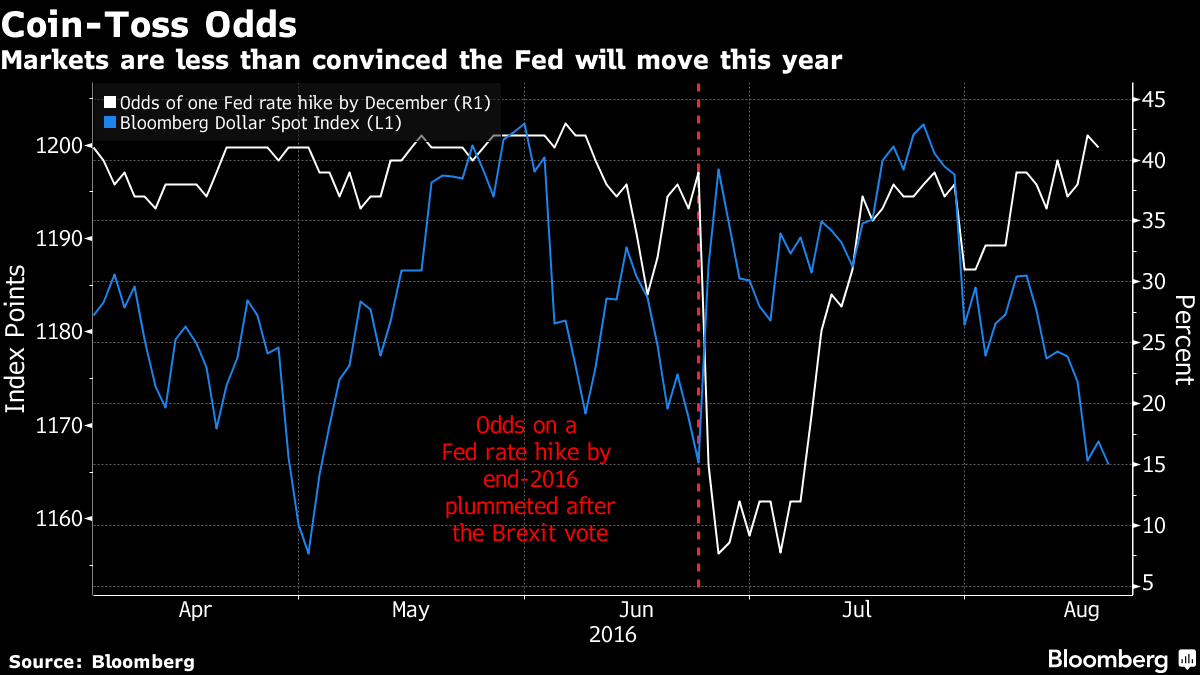
Bets that central banks around the world will remain accommodative amid uneven growth propelled global equities to a one-year high this month and sent the dollar tumbling. The Fed minutes struck a more dovish tone when compared with comments this week from New York Fed chief William Dudley, who flagged the prospect of a rate hike as soon as next month. Dudley will hold a press briefing on Thursday in New York and his San Francisco counterpart, John Williams, is also due to speak.
“The message appears to be that as much as a September hike is a possibility, the Fed is unlikely to move until there is a consensus on the outlook for growth, hiring and inflation,” said Rodrigo Catril, a currency strategist at National Australia Bank Ltd. in Sydney. “Recent data would therefore suggest a hike is not imminent.”
The European Central Bank may shed light on its policy outlook when it releases an account of July’s monetary policy meeting on Thursday. Euro-area inflation data are also due, while the U.K. will report on retail sales and the U.S. has weekly jobless claims figures coming. Nestle SA and Wal-Mart Stores Inc. are among major companies announcing earnings.
Currencies
Bloomberg’s dollar gauge, which tracks the U.S. currency against 10 major peers, fell 0.3 percent as of 1:06 p.m. Tokyo time, after rising 0.2 percent last session. The index was up as much as 0.5 percent on Wednesday ahead of the Fed minutes’ publication.
“The minutes struck a cautious note against any rushed rate hike decision,” said Mitsushige Akino, a Tokyo-based executive officer at Ichiyoshi Asset Management Co. “The odds are for a December hike, rather than a September one, and the yen looks set to extend gains from here.”
The yen strengthened for a fifth day, gaining 0.3 percent to 99.98 per dollar. South Africa’s rand gained 0.7 percent, leading gains among the currencies of commodity-exporting nations. The Aussie climbed 0.6 percent after a report showed Australia’s unemployment rate unexpectedly fell to 5.7 percent in July.
Mongolia’s tugrik dropped for a record 24th consecutive day, sliding to an all-time low. The nation’s central bank raised its benchmark interest rate to 15 percent from 10.5 percent to support the currency, while the government announced salary cuts for executives and management-level staff at state-owned enterprises in a bid to prevent a default.
Stocks
The MSCI Emerging Markets Index rallied 0.8 percent as benchmarks in Hong Kong and Indonesia rose more than 1 percent. The Topix dropped 0.9 percent and Australia’s S&P/ASX 200 Index lost 0.5 percent. The Philippine Stock Exchange Index erased losses after the government reported better-than-expected economic growth for the second quarter.
The Hang Seng Index climbed 1.6 percent, with all of its four biggest gainers rallying in the wake of earnings. Tencent Holdings Ltd., which has the biggest weighting on the gauge, surged as much as 6.2 percent to an all-time high after reporting a 47 percent jump in quarterly profit that beat analysts’ estimates.
"There’s a euphoria," said Francis Lun, chief executive officer at Geo Securities Ltd. in Hong Kong. “Given the economic conditions, investors were not expecting too much from earnings.”
Treasury Wine Estates Ltd., which owns Penfolds and is the world’s largest listed vintner, jumped as much as 13 percent in Sydney after reporting increases in annual sales and earnings. Samsung Electronics Co., the world’s largest maker of phones and memory chips, rose to an all-time high in Seoul.
S&P 500 Index futures gained 0.1 percent after the U.S. benchmark ended the last session within 0.4 percent of a record high.
Commodities
Crude oil fell 0.1 percent to $46.75 a barrel in New York, after advancing on each of the last five trading days. It gained 0.5 percent on Wednesday as data showed U.S. crude and gasoline stockpiles declined, easing an overhang of supplies that are at the highest seasonal level in at least two decades. OPEC is on course to agree an output-freeze deal because its biggest members are already pumping flat-out, Chakib Khelil, the group’s former president, said in a Bloomberg interview.
“The decline in crude inventories and the much bigger drop in gasoline stockpiles is clearly a positive,” said Angus Nicholson, a market analyst in Melbourne at IG Ltd. “There has been a lot of momentum in the oil price, fueled by some jawboning with regards to the possibility of a supply freeze deal.”
Gold rose 0.4 percent, climbing for a fourth day amid the dollar’s retreat. Silver and platinum rose more than 0.9 percent.
Copper added 0.7 percent in London, nickel gained 1 percent and aluminum traded near a 13-month high. The World Bureau of Metal Statistics reported late Wednesday that all six industrial metals included in the London Metal Exchange’s LMEX Index saw shortages between January and June, with the aluminum market’s shortfall widening to 479,000 metric tons in the first half, from 331,000 tons in all of 2015.
U.S. Treasuries due in a decade advanced for a second day, pushing their yield down by one basis point to 1.54 percent. Morgan Stanley recommends buying five-year notes, saying the absence of inflationary pressures in the world’s biggest economy will push the probability of a Fed rate increase this year to 30 percent in coming weeks. The likelihood was 49 percent on Wednesday, according to Bloomberg calculations based on Fed fund futures.
The yield on Australia’s 10-year bonds fell three basis points to 1.88 percent, having fallen as low as 1.86 percent prior to the employment data.
Fed Officials Split in July on Whether Rate Hike Needed Soon
August 17, 2016 — 9:03 PM EEST Updated on August 17, 2016 — 10:40 PM EEST
-
While some saw time for increase close, others wanted to wait
-
Minutes omit reference to timing of future interest-rate hike
Federal Reserve officials were divided in July over the urgency to raise interest rates again, with some preferring to wait because inflation remained benign and others wanting to go soon as the labor market nears full employment.
Such divergence in views, as shown in minutes of the central bank’s July 26-27 meeting issued Wednesday, means officials are likely to need more concrete evidence that inflation is picking up and economic growth is strengthening before deciding that an increase in borrowing costs is justified. Investors will listen closely for additional clues on timing when Fed Chair Janet Yellen speaks Aug. 26 at an annual symposium hosted by the Kansas City Fed in Jackson Hole, Wyoming.
“Several suggested that the committee would likely have ample time to react if inflation rose more quickly than they currently anticipated, and they preferred to defer another increase in the federal funds rate until they were more confident that inflation was moving closer to 2 percent on a sustained basis,” according to the records of the policy meeting, released in Washington.
“Some other participants viewed recent economic developments as indicating that labor market conditions were at or close to those consistent with maximum employment and expected that the recent progress in reaching the committee’s inflation objective would continue, even with further steps to gradually remove monetary policy accommodation,” the minutes also showed.
Explicit Timing
The report contained no explicit reference to the timing of the next potential interest-rate increase, beyond noting that a “couple” of officials were advocating for one in July. Some voting members “anticipated that economic conditions would soon warrant taking another step in removing policy accommodation,” the minutes said.
“There certainly is a lack of consensus,” said Millan Mulraine, deputy head of U.S. research and strategy at TD Securities in New York. “For the Fed to move there has to be a much broader consensus than we see right now.”
At its July meeting, the Federal Open Market Committee left the benchmark interest rate in a range of 0.25 percent to 0.5 percent while noting that “near-term risks to the economic outlook have diminished” and that June’s strong job gains followed a weak May.
Longer Term
The minutes expanded on those views to show that some policy makers saw developments including the U.K.’s vote to leave the European Union as imparting longer-term uncertainty about the outlook for global growth. In addition, several officials were concerned that U.S. job gains would again slow, which would make the case for raising interest rates “less compelling.”
A number of Fed policy makers have suggested in public comments since the last meeting that it will probably still be appropriate to raise interest rates at least once this year, with some indicating a move could come as soon as the FOMC’s Sept. 20-21 gathering.
Investors put the probability of a rate increase this year at roughly 50 percent, according to the prices of federal funds futures contracts. Such odds were down slightly on Wednesday from the previous day.
New York Fed President William Dudley said Tuesday during an interview on Fox Business Network that the U.S. central bank is “edging closer” to another hike and that “the market is complacent” about the amount of tightening that will be needed over the next year or so.
Rates Steady
The FOMC has left rates unchanged since voting in December to raise them from near-zero levels, marking the first increase in nearly a decade. Concerns about the prospects for global economic growth, sagging inflation expectations, and mixed readings on the U.S. economy have kept them sidelined.
“Members generally agreed that, before taking another step in removing monetary accommodation, it was prudent to accumulate more data in order to gauge the underlying momentum in the labor market and economic activity,” the minutes also showed.
St. Louis Fed President James Bullard said Wednesday that the central bank should be patient in raising interest rates with economic growth low.
“I like to move on good news about the economy,” Bullard said to reporters after a lecture at Washington University in St. Louis. “We have had some good jobs reports here but on the other hand GDP growth is only 1.2 percent year over year, inflation is still below target, inflation expectations are low.”