The interests of local big shots will be seriously affected, as the consolidation of the water sector and the opening of the door to new concessions after that of Sofia Water Company are pending in the near future if the plan for the development and management of water and sanitation sector in the country in next 25 years gets passed in its current version. The key document is in a phase of coordination between institutions, and recently Minister of Regional Development Desislava Terzieva promised to publicly present it only after it has passed through regional structures. It is more than likely that some of the parts of the text will not be particularly beloved by some of the local authorities.
Now 66 water companies provide services to consumers in Bulgaria. It is no secret that the managers of many of them have become a sort of feudal lords who have achieved remarkable symbiosis with the political powers and have accumulated and purchased immense volume of property as well as have large bank accounts. As the BANKER has already posted, their well-being can be envied even by the managers of some of the largest and most successful private companies operating in the country.
However, their undisturbed wellbeing is supposed to be shaked.
The strategy envisages consolidation of the industry to a maximum of 28 regional entities. Across Europe there is a trend towards consolidation of the water sector. Usually it is dictated by the pursuit of economies of scale. A sectoral benchmark for optimal size of a service area is the presence of at least 250,000 customers of water and sewerage services. The stricter the rules for drinking water quality and waste water discharge are, the more technical skills and tools are required for the smooth operation and management of water supply operators, the cost of which can be managed better by larger operators. Significant scale savings are achieved also in the field of finance and financial management, as small companies are often forced to pay significantly more for borrowing than larger operators, the document said.
In practice, it will go back to the model that worked in Bulgaria up to 1989 – 28 regional utilities that are state-owned and a municipal one in Sofia. But more importantly – there will be only one operator within each administrative region, and thus some of the existing water companies will have to cease to exist. Respectively, the feudals are projected to dwindle and this perspective will enhance their resistance to the adoption of the strategy.
Otherwise, the new model will be introduced through changes in the water act to settle
the long-lasting stalemate with the state of the ownership
and asset management. According to the Ministry of Regional Development it can be done within 16 months.
The first step of the procedure will be the now existing water operators to draw up a list of all public assets in their balance, and the local governments to do the same for the facilities on their territory that are used for the provision of water and sewerage services. This should be done within four months, after which the lists will be submitted to the Ministry of Regional Development. In the following six months it will develop protocols for the distribution of these assets between the state and municipalities that will have two months in which to lodge any objections. If there is no resistance, water companies will have, within three months, to remove out of their balance sheets all public water assets and hand them over to the water and sanitation associations. These organizations were regulated yet in 2009, but over the past four years have failed to work. They include the owners of water systems and facilities and they are the entities to manage the entrusted infrastructure.
Another key point is that water associations will sign contracts with companies to maintain the infrastructure and provide services for their respective territories. The possibilities for this are two – direct awarding to the current operator or choosing a new one. In the first case the operation and maintenance of the systems and equipment will be provided through a pseudo-concession contract for a decade, if there is no requirements for substantial investment or for 15 years if there is an obligation for more serious investments. Far more interesting, however, is an alternative for
selection of a new operator under the Law on Concessions.
In this case a concession contract with a duration of up to 35 years may be used, and the Construction Ministry is working with International Financial Corporation for the development of the model. The authors of the strategy point out the negative attitude in Bulgarian society towards any public-private partnerships in the water sector, which of course is not suggesting that the changes will be voted on and approved by Parliament. No doubt investors will not stay indifferent to concessions in the sector, especially since the current water companies are consolidated and possibly there will be a larger operator to serve more than one administrative area. During the period in office of the former GERB cabinet such interest was readily expressed by Germany’s Berlin Wasser. In 2012 with the help of the World Bank a pilot project was prepared for the concession of an operator in Pleven. It subsequently failed, but interest in such public-private partnerships had been shown by large companies in France, Austria, Spain, Italy and even the United Arab Emirates.
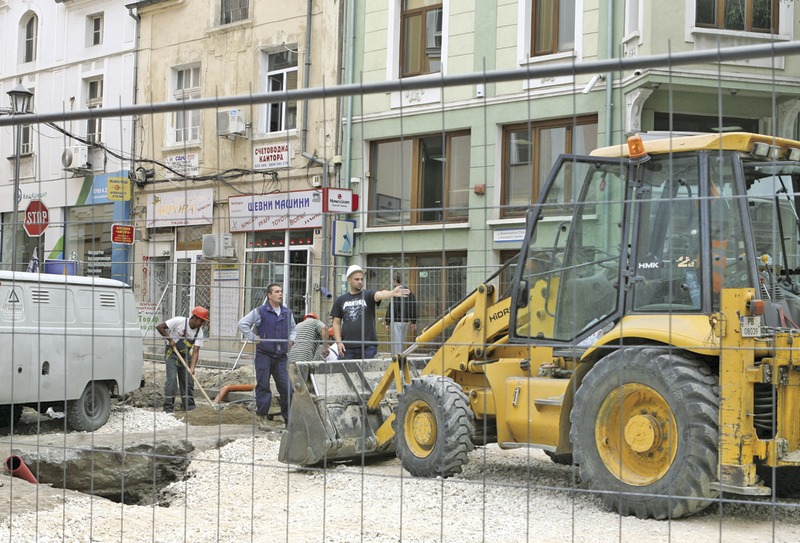
Objectively speaking, if Bulgaria really wants its water systems to be upgraded, this cannot happen without the involvement of the private sector. Investments today are far below the level required to maintain the quality of the network. It spans to over 75,000 thousand km in total of which about 30,000 kilometers were built before 1970. According to the World Bank’s estimates the rehabilitation and replacement of the old equipment will need between 650 and 800 million levs a year. At the same time, actual investments in water supply since 2007 have amounted to less than 200 million levs a year.
The BANKER