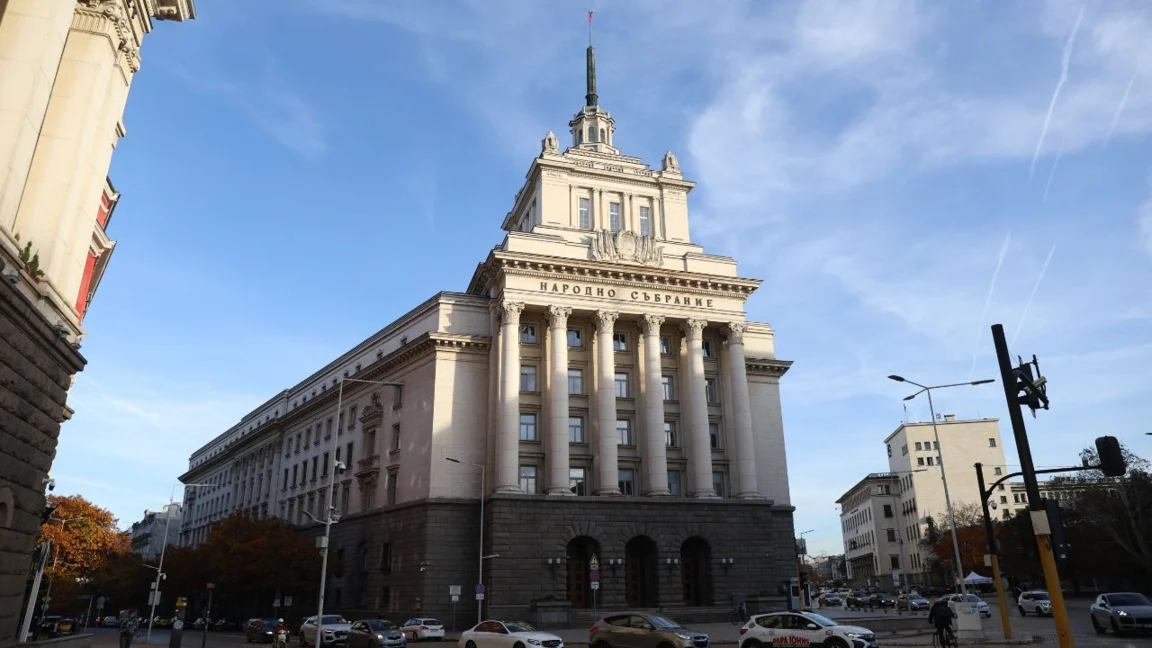

Complex to resolve remains the problem whether Bulgarian Posts would remain state-owned or not. After much wrangling and speculation, on Wednesday (30 November), the ruling majority in Parliament approved on second reading the amendments to the Privatization and Post Privatization Control Act, in which Bulgarian Posts remain on the list. Ironically, the decision about which new serious social tension sparked was taken while under the windows of Parliament unionists shouted Resign!.
In adopting the amendments to the privatization on the first reading back in September, representatives of GERB promised that the Posts will be returned on the prohibitive list. According to information uncovered by the BANKER, this happened despite pressure from the Finance Minister Simeon Dyankov, who hoped the money from the eventual sale of the company to alleviate public finances next year.
GERB MP Valentin Nikolov said that when discussing the act in parliamentary committees first they removed the company from the list and this was consistent with the view of the finance ministry. The idea then was to sell a minority stake of Bulgarian Posts and the state to retain control over the enterprise.
Post Offices remain on the prohibitive list. Another question is – what reforms should take place there, the debate has already begun, said this week the Vice Chairman of the Parliamentary Group of GERB Valentin Nikolov.
Although tension around the Posts appears to be diminishing, questions about how the government plans to change the company are many. Few remember that in his first months as Transport Minister, Alexander Tsvetkov presented views on a broad reform in the Bulgarian Posts. His intentions were to create five new subsidiaries in which a partner will be attracted among private companies, selected through competition. And that in these competition procedures foreign companies will be able to participate. The present 28 territorial branches were to be converted into seven regional divisions.
Our goal is to develop each of the subsidiaries by attracting strategic partners to provide fresh money, explained representatives of the ruling party back then. Sources of the BANKER said rulers were now seriously considering this model again. And if that happens, the question arises whether they are in fact preparing the first step of a hidden privatization.
According to the Finance Ministry, Bulgarian Posts have fixed assets amounting to BGN74.837 million, although according to information obtained by the BAKER this data is from calculations from 20 years ago.
MPs from the opposition commented that in fact among the most attractive assets are the buildings of Bulgarian Posts which are located in town centers in the country. One should not forget also its recreation centers. The state company owns seven holiday complexes in popular resorts in the country. These are objects in the Golden Sands, St. Konstantin and Elena and Ravda, in Bankya, Pancharevo the lake Batak and Apriltsi. True, they are not in particularly flourishing condition, but if repaired, they can become at least three-star hotels. Anyway, this property certainly allures many potential investors.
It suffices just to recall the transaction for the sale of BTC. At the time of Mr. Saxe-Coburg-Gotha’s Cabibet, the state telecom has been sold for ridiculous BGN260 million. And when the right of veto of the state expired, the land lots of BTC were traded at a significant profit. This was how in 2009 the successor to the BTC – Vivacom managed to sell a significant part of the units it proposed on market (over 100 properties). The jewel in the crown was undoubtedly the sale of the Telephone Palace located in the center of the capital against the sum of EUR22.5 million.
One should not miss the fact, that the broad public is constantly being reminded that Bulgarian Posts were working at a loss, but no one can explain on what market the company actually works. Nobody talks about trends in the sector, which attracts hundreds of thousands of euro per year and is constantly growing.
At first glance, things do not look rosy. After three consecutive years in the black figures, in 2009, Bulgarian Post reported a loss of BGN2.8 million. Last year, it managed to stabilize the situation (with BGN446 thousand in profit), but since the beginning of 2011 and the company is again in the. Its first-quarter loss was BGN1.2 million which in May swelled to BGN3.2 million and by the end of September reached BGN6.25 million. The negative result for the entire year as expected to hit BGN10 million.
Recently it became clear that the state company is urgently seeking a loan to settle its debts. If it is privatized, its fate will probably be like that of the State Railways, said a few days ago Transport Minister Ivaylo Moscov.
The explanation of the rulers for these gloomy predictions is that from 1 January this year monopoly of the state-owned enterprise on the so-called reserved area (the lightest letters of up to 50 grammes). So now companies like T-post, M amp; BM Express and Econt Express can now compete equally with Bulgarian Posts for the correspondence of state institutions, municipalities and others.
But to explain everything with the market liberalization is not serious. Private owners have yet to prove themselves to customers. Moreover, most agencies, municipalities, and individual organizations have long-term contracts for the distribution of letters with the state posts, suggesting that the actual effect of the removal of the restriction will be felt as early as next year.
nbsp;
nbsp;