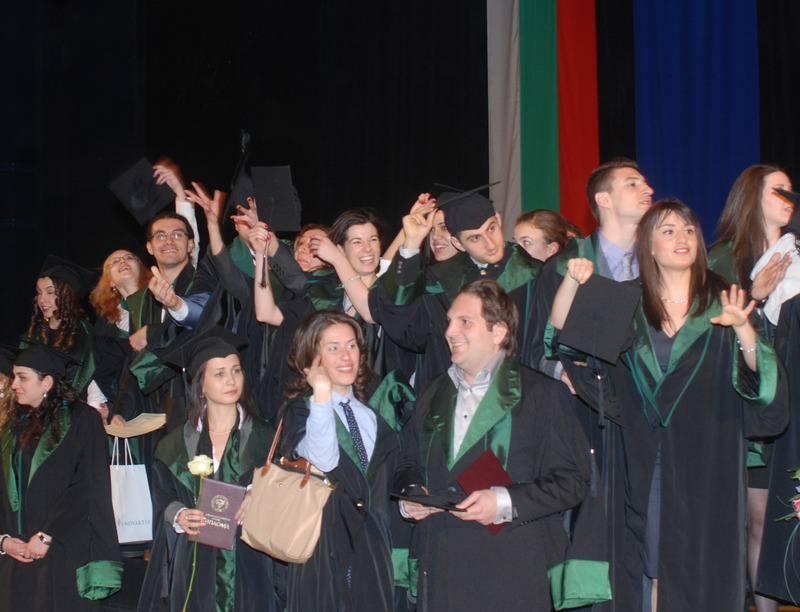
Because of the lower control criteria and outdated systems in Bulgarian universities thousands of Bulgarian students have been able to take their certificates for completed higher education, even without being present at a single lecture. Then they have to face the cruel truth that they are completely unprepared to enter the labour market. During the school year 2011-2012, almost 65 thousand Bulgarian students are regularly enrolled in distant learning programmes in public or private universities.
Only for this year’s subsidy for the 37 colleges and universities accredited by the state the Ministry of Education and Science will pay BGN390 million. If this is much or little money is still too early to tell, but the fact is that the funding model has to bet be radically changed, and the state finally should finally stop pouring hundreds of millions
in a dysfunctional system. The paradox is that the approved 2011-2012 enrollment plan by the Council of Ministers is in sharp contrast with the demographics of the country and in no way accounts for the declining trend in the demand for Bulgarian higher education. According to the adopted our universities had to welcome almost 72 thousand young people, while the statistics show that last year’s high school graduates were by about 10 thousand less.
Under the current law on higher education money follows the student, i.e. the level of university funding depends on the number of candidates enrolled and the cost of specialties where they are trained. But in the last two years, the average base rate for state support per student has fallen from BGN963 to BGN693 lev, forcing colleges and universities to advertise unrealistically high number of places for new students as well as lower the admission criteria in order to survive. On the other hand, the lack of real competition leads to lower quality of education. So more young people opt for studying abroad, although there fees are far more expensive.
Data provided by the Ministry show that the country’s leading universities have failed in their mission to enroll enough students. Nearly 7500 places remained vacant and therefore the public universities in Bulgaria have failed to absorb almost BGN18 million in subsidies from the state.
The biggest gap between expectations and realities was shown at Sofia University St. Kliment Ohridski, which in the recent past was famous for its strict access criteria. Sofia University failed to find suitable students for 890 of the places it offered or 12.6% of all vacancies. The oldest university in Bulgaria is followed in these terms by Technical University in Sofia, Plovdiv University, University of Rousse, and the Economics Academy in Svishtov.
Although the desire of the State to fill financial gaps in education, by bringing students from abroad is commendable, so far its achievements in this direction are negligible. Only 1,657 foreigners have registered for the 2011-2012 school year, and over 1,100 of them come from Turkey.