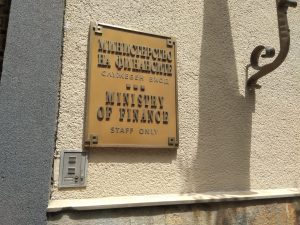
Deputy Prime Minister and Finance Minister Simeon Dyankov may trigger a penal procedure against Bulgaria by the European Central Bank such as the one initiated against Hungary. This will happen if the amendments to the Silver Fund Act are voted by the Cabinet and then the Parliament, without waiting for the ECB’s statement. The Finance Minister has sent the draft to ECB for consultation, but in his desire to absorb money from the reserve fund for future pensions he is rushing things, which could be harmful to the image of both the state and the ruling GERB party in Europe. Minister Dyankov might believe that the ECB’s reply is not mandatory, but advisory. A quick check with the European legislation, however, shows that such an opinion is completely wrong. Under the Lisbon Treaty the signature of the head of the ECB Mario Draghi is of imperative nature to the EU member states.
Reliable source, requesting anonymity, told the BANKER that the ECB’s view towards forthcoming amendments to the Silver Fund is extremely negative and this is to be made clear in writing in the coming days.
On April 5, financier No 1 in Bulgaria made consultations on the phone with the Bulgarian National Bank and the Financial Supervision Commission. The heads of these structures were invited to an emergency meeting of the Advisory Board for Financial Stability on April 9, Monday. It turned out however that C-Bank Governor Mr. Ivan Iskrov could not attend due to his being abroad.
But even if he had been in Sofia, however, the meeting could have hardly taken place, because the Rules of Procedure of the Advisory Board envisage a written invitation to be sent out plus written responses of the invitees. A request to meet also has to be made no later than seven working days before the requested date of the meeting, says the regulation. Thirdly, a requirement asks the Secretariat of the Board to distribute the preliminary agenda at least five days before the date of the meeting. None of the above requirements were met by the inviting Ministry of Finances.
What is certain, however, is that on 6 April (Friday) the Governor of the Bulgarian National Bank and the FSC head received formal notices signed by Minister Dyankov. Most interestingly, the Minister invited the two financiers at a meeting in relation to the use of the Silver Fund. This makes it absolutely clear that Mr. Dyankov does want to use the fund to cover debt payments and not as euphemistically expressed so far – to expand opportunities for investment.
The whole impetus is focused on the much cherished new Silver Fund Act. Dyankov is well aware that Mr. Mavrodiev, CFS head, is strongly against the state’s intention to meddle into the financial affairs of the Silver Fund. The Governor of the Central Bank is against, too. Having in mind that the votes of the three of them count, Financial Minister cannot push the project with one vote against two. But a failed meeting is needed to justify why the Cabinet has not carried out prior consultations within the Advisory Board for Financial Stability.
As a matter of fact the State Budget Act obliges the Financial Minister by December 31, 2011 to submit to the Board a strategy for debt management for 2012 and for the next two years. When the three top officials met for the last time on December 13, Mr. Iskrov and Mr. Mavrodiev reminded that the finance minister has to comply with this legal requirement. Mr, Dyankov promised to present the debt strategy at the next meeting of the Advisory Board. However, four months later Minister Dyankov has not sent such a strategic document. He did not intend to do so even at the meeting asked by him on April 9. Any use of the Silver Fund must be part of the much expected debt management strategy.
Two months ago, Mr. Mavrodiev sent letters to Dyankov and Iskrov to summon the Council and discuss urgent issues related to managing the debt burden of Bulgaria. As the BANKER wrote, Iskrov replied the next day he was ready for the meeting, while Mr. Dyankov needed almost two weeks to respond. He wrote a meeting could be held between April 9 and 12. Instead of meeting on April 9 Mavrodiev and Iskrov respond in writing they are prepared for a meeting in the first days after Easter (April 15).
The State Budget Act for 2012 states the gross domestic product of the country would be BGN81.6 billion. It was proposed by Mr. Dyankov, and passed in parliament. In another document, however, again signed by financier No1 – the National Reform Programme, it was indicated that Bulgaria’s GDP would be BGN78.5 billion. This leaves BGN3 billion missing, said economist Dimitar Chobanov of the University for National and World Economy. According to him there is a real danger that GDP growth this year could be negative, and tha country lacks reserves in such scenario. It would also raise the deficit, which instead of BGN1.1 billion could reach BGN1.6 billion, more than 2 percent of the GDP, Mr. Chobanov predicts.
Budget 2012 is considered too optimistic as an outlook for the Bulgarian economy and therefore probably the gap in the Treasury will be greater than expected, said economists from MacroWatch. They warned about the government policy at a press conference on the eve of Palm Sunday and asked the Ministry of Finance to outline a budget plan in a negative economic scenario, as well as to control government spending.
Budget 2012 has been developed at an annual economic growth forecast of 2.9 percent. All predictions, however, have been revised downward. According to the Bulgarian National Bank, the growth will be 0.7 percent. The European Commission expects a rate of 1.4 percent. When estimates are inflated, more spending is planned, experts said.
Desislava Nikolova of the Institute for Market Economics quoted Finance Minister Simeon Dyankov as saying that the budget will not fail even at a growth rate of 1 percent. But no one has said how this may happen, Nikolova Mrs. pointed out.