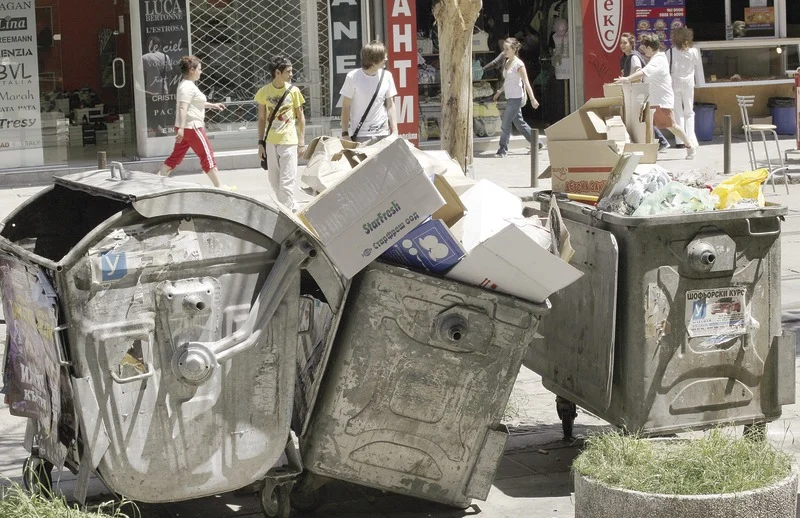
When people don’t protest they will pay. Bulgaria may be the only country in the European Union where the garbage fee is not formed according to the amount of generated junk volume, but according to the value of the housing property.However, Bulgarians are the only ones who uncomplainingly pay the robbery. In Bulgaria there is no difference whether there are no people living in a flat or there are ten – in each case the amount to be paid to the municipality, is the same. In other words, the principle of a polluter pays is replaced with property pays, which turns the waste tax into a second property tax. Not to miss is the fact that this tax covered under the mask of a fee is many times greater than the actual tax.
It is inconceivable that the Law on Local Taxes and Fees now sets as the default way of charging a fee that is the amount of generated waste and the use of other criteria (such as tax assessment) is only an alternative provided for when we cannot determine how much pollution is actually generated. In cities local administration has no discretion which one to implement – the one based on the amount of trash or another one. They have to chose the first one. Town Councils have never told us what the objective reasons are as to why it is impossible to determine the amount of waste produced by the contaminant.
The truth is that the amount of municipal waste from households can be defined in at least ten ways that are being applied across Europe. Why, for example, Albania, Kosovo and Romania may make such systems, but Sofia cannot? Of course, there are variations of this system, but the problem is that government do not want to introduce them.
Last week the Bulgarian Industrial Association (BIA) has once again asked for a possible new and fair way of determining and paying the fee garbage, Executive Chairman of the organization – Mr. Danev even urged companies to attack the current system before the administrative courts claiming the ordinances which regulate the way fees are calculated is illegal and unconstitutional. Danev reminded that the Commission for Protection against Discrimination already ruled on the case favourable for the businesses. Ombudsman, who also recommended to Parliament to change the legal framework for the calculation of the garbage fee. Even President Rosen Plevneliev, during his election campaign, promised to approach the Constitutional Court on the issue.
To make clear how unjust is the determination of the tax based on the taxable value of property is not enough to see what different companies pay as amounts. According to a study by BIA companies from different regions give municipalities for their garbage between BGN30 and BGN3100 per worker and from BGN20,000 to BGN150,000 lev per tonne. Some large companies may have been forced to pay a ridiculously high fees. For example, Sodi Devnya paid to the local budget BGN500,000 while city government spends to clean whole community just about BGN1 million.
In fact, any calls to protest will probably remain silent, as they cannot be challenged in court and people will continue to pay, even if they haven’t thrown out a single napkin. The reason is a decision of the Administrative Court in the capital on the occasion of a complaint against the Ordinance establishing and administering local taxes and service prices. According to the judges challenging the norm to the extent that forces people to pay tax based on the value of property is not possible, as with a decision of November 18, 2011 a three-member panel of the Supreme Administrative Court has already ruled on the issue.