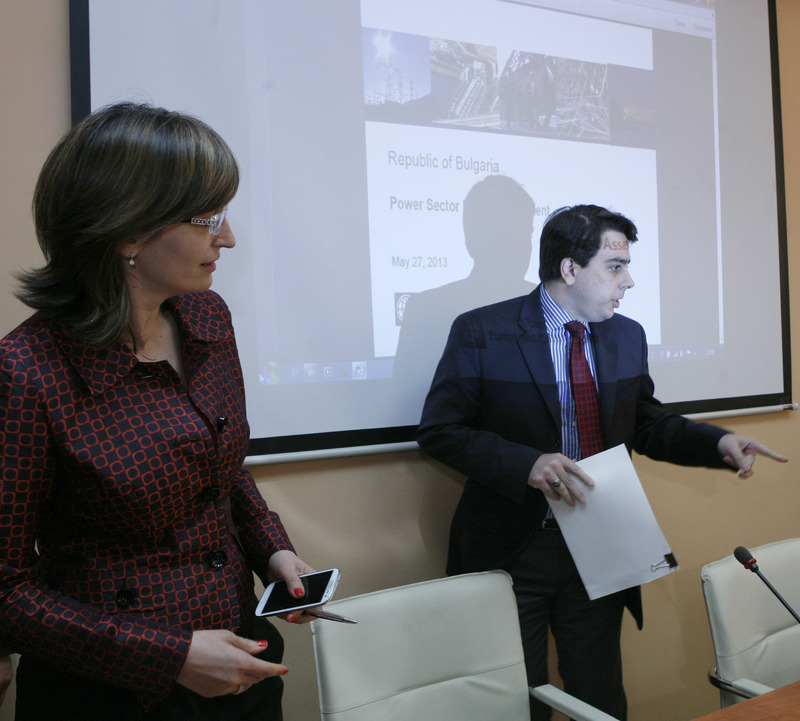
Colossal loss of 2 million levs per day, warm ties between politicians and heads of energy companies and non-transparency and dependence of the national regulator…these were the slaps Bulgaria received from the European Commission and the World Bank in their analyses of the situation with the country’s energy sector presented in the last days of the cabinet of Deputy Prime Minister Ekaterina Zaharieva and Economy Minister Assen Vassilev. These problems in energy sector are nothing new for the general public, of course, but when the two institutions famous for being so diplomatic in their statements expose the dirty public secrest so obviously, its time it is high time serious reforms were undertaken.
The support from Brussels and the World Bank was sought shortly after the forming up of the cabinet led by Marin Raykov, and the biggest concern expressed by the institutions is the
financial deficit in the sector.
The way to use the available facilities in the country, and the pricing model creates enormous gap between revenues and expenses. Total liabilities in the industry come to just over 13 billion levs for the next 17 years. This means that if the sector does not restructure, it will have to pay between 800 million and 1 billion levs per year to keep the price of electricity at current levels, which is 1.16% of Bulgaria’s gross domestic product, said ex-minister Assen Vassilev.
Many experts saw an opportunity to get out of this situation by increasing exports to neighbouring countries. The World Bank, however, flatly contradicts this possibility. The fees paid by traders for export, have multiplied – from EUR4.8 in 2005 to EUR17.5 in 2013, which certainly hampers exports.
Even if exports increase, this will not help – for the first quarter of this year, they were equivalent to the levels from 2008-2009: between 2 and 2.5 GWh. Yet even in the best of circumstances, the exports will not solve the problem of overcapacity in the system, said Vassilev.
Actually, at the bottom line is an extremely financially troubled National Electric Company. It is the sole buyer on the regulated market and is obliged to buy electricity produced under long-term contracts (the U.S. TPP Maritza East 1 and Maritsa East III) and power generated from the now extremely expensive renewable energy sources and cogeneration, which do not meet the requirements of the European directive on large combustion plants and legislation on air quality. When we add to all this the megaproject Belene and Tsankov Kamak, net liabilities swell to the phenomenal amount of 2.1 billion levs. In this situation naturally NEC began to delay payments for purchased electricity and handicaps the work of other participants in the production chain: production – transmission – distribution, generating thus high intercompany indebtedness.
More disturbing is that the European Commission and the World Bank are pretty sure that consumption over the next decade will not increase due to the declining population of the country, the high potential for energy savings in industry and households, as well as the possible production of electricity at lower prices in neighbouring countries. A stronger argument to forget Belene is hardly possible to give! The World Bank even ventured to openly state that
the second nuclear plant is a ruined investment.
Or, in other words, the decision seems to be only one – reforming the model of a single buyer (that is NEC) and a regulator that sets prices depending on individual performance and technology of the manufacturer. Yes, this may mean that plants previously tolerated as Bobov Dol, Maritza III and a number of district heating and power plants will have to drastically reduce and even stop production. But experts from the World Bank are more than clear – we need to reduce the cost of electricity that is purchased by improving the allocation of the regulated market quotas. And the Electricity System Operator should serve first the cheapest plants before others.
The country has to stop buying power from expensive plants when it is not oblideg to do so and make the system function in the most efficient manner, respecting the contracts, said former Minister Vassilev. So far – do good, but we come to the next big problem – related to the management of the power system. It is no secret that the vast majority of permits to eco plants in recent years
have been distributed to politically nepotistic
structures from the executive and legislative branches. Therefore, the World Bank recommends the interests of all civil servants and MPs in the energy sector to be fully disclosed in order to build trust.
Bulgaria may also increase the use of its water power plants, which it now sets asides only for emergencies. According to the ex-minister measures are to be taken on a grand scale and all sector players must take their responsibility. In other words – the energy sector in Bulgaria will either have to be reformed according to a EU model or suffer a slow and painful death.
The BANKER