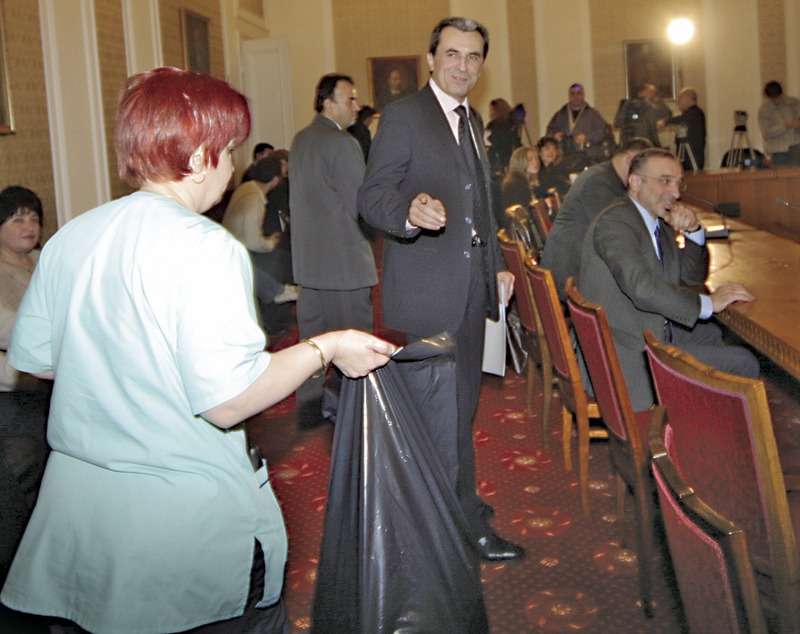
Few people realize that apart from the high-level political cleansing of the state one also needs the real cleaning – the one that is done with a bucket and a mop. And this also does not come cheap to taxpayers. Bulgaria’s top administration is numerous, it uses large buildings and has high standards. The liquid soap must be special and antibacterial, scented and protecting the skin without irritating it. The toilet paper cannot be just ordinary. On top of that, it is necessary that all hygiene services in the ministries and their subordinate agencies comply with the requirements of environmental care.
To choose the appropriate cleaners for government buildings, Finance Minister Peter Tchobanov, who is the central authority responsible for public procurement, has announced a special procedure for selection. With companies that meet the required conditions framework agreements will be signed for 2015 and 2016, then the individual structures will decide which one among them they specifically choose.
Unlike previous similar contest in 2012, now requirements to the candidates are even more inflated. To participate in the contest companies must have a minimum turnover of documented cleaning services in the last three years (2011, 2012 and 2013) not less than 1.5 million levs without VAT. For comparison, previously 400,000 levs were sufficient The minimum number of employees also increased – from 20 to 50 people. However, it is clear that this number of people is still insufficient, especially considering the huge premises of the administration. The documentation makes it clear that what will be cleaned is a space over 150 thousand square meters combined, with institutions which employs several thousand people. It is a fact that, according to the trade organization of workers in the cleaning industry for an average one is considered a company with a staff of at least 200-300 people, and a large one should have 800 to 1200 people.
Another serious condition for the smaller players are at least five executed contracts for activities similar to the subject of the present order. And on top of that, candidates must have implemented a system of quality management standard ISO 9001 and have experience in providing cleaning services to corporate clients.
The country wanted to change some of the requirements, but again missed the final touches to the other parts and it seems that in the implementation of the contracts there again will be a repeat of previous mistakes in auctions to clean state buildings. The reason for such concerns arises from the very formation of the price. Participants will still need to submit different unit prices per square meter for the various activities and services, which in most cases, according to professionals in the field, leads to absurd situations. For example, how to determine the unit price per square meter for daily cleaning of a lavatory with the loading and delivery of supplies? The amount of liquid soap, hand towels, perfumes and toilet paper is not determined by the size of the building, but is dependent on the number of people who use them. Moreover, individual departments vary widely in type and therefore the price of used consumables varies, too. Ministries of Finance, Foreign Affairs and Labour and Social Policy want plain liquid soap dispensing cans of 5 liters. Their counterparts in Economy Ministry on their turn rely on white, concentrated, soft, scented and protective to the skin soap dispensers branded by TORK. Significant differences exist in the toilet paper, hand towels and other supplies.
Another paradox creates a requirement to determine the unit price of the number of jobs for polishing and dusting of desks, tables, office furniture and equipment, without saying what exactly one job does. The situation is similar with the disposal of garbage – where authorities again are asking price for one piece of trash container, but it is definitely more precise to calculate it by the quantity of trash. Somewhere there may be multiple number of smaller containers and elsewhere – more scattered, but much larger ones.
Generally, in the above formulated conditions and at the lack of specific parameters each one can offer any price and eventually win a contract with unrealistic and unattainable offer.
The previous auction of 2012 dragged on for nearly a year due to these gaps and misconceptions that allowed the decisions of the Central Public Procurement Authority to be constantly attacked before the Commission for Protection of Competition and the Supreme Administrative Court.
Proposals for participation now may be submitted until July 4, and their opening is scheduled for July 8.
The BANKER