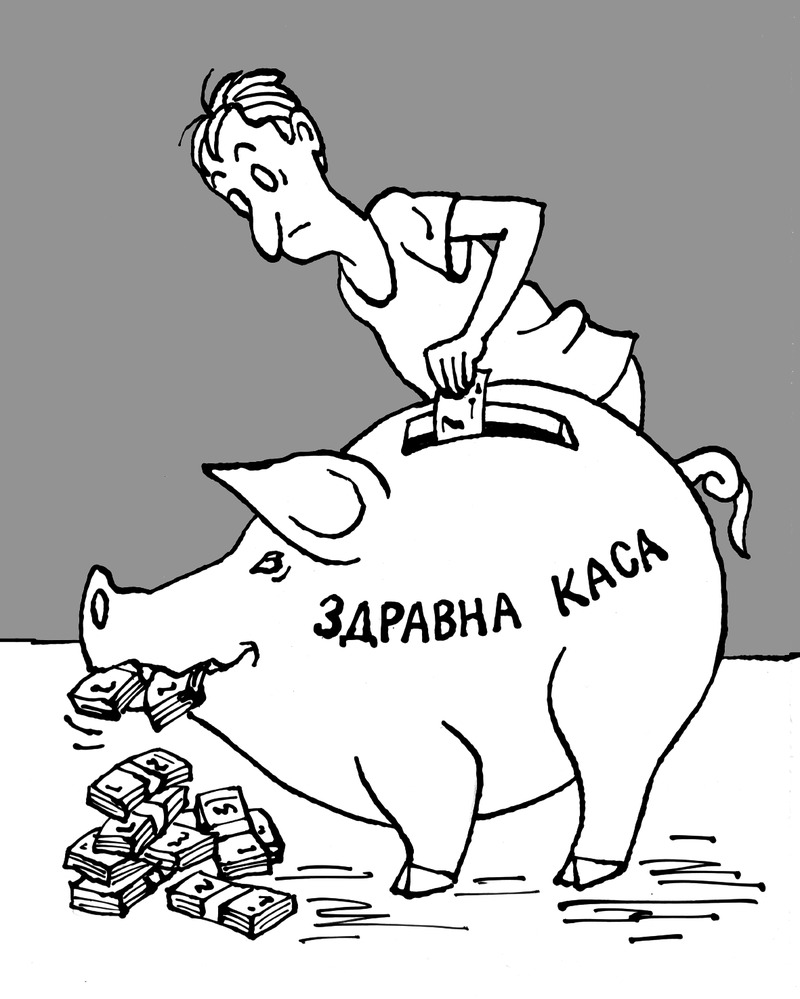
The Supervisory Board of the National Health Insurance Fund (NHIF), no matter what composition it has, is always doing the same thing. Representatives of the state, employers and trade unions gather „in the dark“ – further away from the spotlight of media, and redistribute „brotherly“ under the big table money from people’s insurance contributions. The important last meeting of the supervisor at which had to absorb the 225 million levs allocated under the latest update of the budget on healthcare was conducted in the same scenario. But it still produced great news. It is that the health fund before general public’s very eyes was transformed into a public trading fund that on vague criteria distributes the people’s health insurance to hospitals in the form of some kind of dividends. Or so it emerged after governors of the institution surprisingly announced it was a „trade secret“ and they could not disclose what the amount of disbursements to each of the hospitals was. Trade secrets and spending public funds collected from the public as obligatory insurance premiums are highly incompatible concepts. The same would be if the National Social Security Institute declared a trade secret the information on how much money is spent on pensions, given that most of the funds have been accumulated through people’s social security contributions.
Naturally, the lack of transparency gives rich soil for malicious interpretations that hit the already collapsing authority of the Health Insurance Fund. Some see this as a desire to conceal „the nepotistic“ hospitals that in a situation of a budget deficit
outrageously receive more money.
Others consider it as a veiled attempt of the supervisor to transfer part of the money for the infirmaries to the payments for medications. To gloss over the eyes of society, the Healthcare Fund promised to provide references on how much each hospital received under its clinical paths for the first half of 2014 and the same period of the previous year. But the figures that will be made public in any case will not be a representative picture of the whether spending for hospital care was real or „inflated“ and if there are hospitals dearer to the rulers and others that are not.
But what is happening here and now is more important than historical comparisons. The governing board of the health fund refuses to answer exactly this question. Chairman of the Supervisory Board of the NHIF and Deputy Finance Minister Kiril Ananiev only noted that in September hospitals will receive 120 million levs, given that in August their budget was 104 million levs. This amount is unlikely to be sufficient, since for this same month clinics have reported activities worth about 130 million levs and they remained underpaid by the fund after it introduces some not quite legitimate restrictions.
What must be taken into account is the fact that in September hospitals were, traditionally, loaded with a large number of hospitalizations and consequently this expenditure will open a gaping deficit of around 20 million levs. Kiril Ananiev said that there is money for the September activities over the preliminary limits, but it is unclear on what basis the accounts are made and experts are skeptical about their correctness.
Mr. Ananiev also noted that the supervisor has decided that some money from the fund’s reserve – 56.7 million levs – will go for medicines for home treatment. For this item the fund has now 145 million levs and per month it spends about 50 million levs out of it. The additional funds will be reallocated after the resource has been exhausted. But they still will not suffice. Medicines for home treatment and dietary foods, according to the estimates of experts, will need more than 96 million levs, so what still remains is to find another 40 million levs. Additional 23 million levs is missing for cancer medicines, although after the budget update this sector received 25 million levs more. Another 17 million levs is the sum lacking for medicinal products. So if one makes the final calculations, it appears that
the deficit for medicines and medicinal products is only 80 million levs
It can be covered with the 70 million levs from the expected over-performance in the collection of health insurance payments of citizens by the National Revenue Agency (NRA) by the end of 2014. Of course, an important condition is that this revenue optimism remains a well-grounded expectation.
But still the dilemma of what to do with spending on hospitals persists. Even with the additional 200 million levs their balance sheets will still be in the red with about 130 million levs. NHIF should use its last buffer – 46 million levs from its budget remain unallocated and unspent under the item „Other health insurance payments.“ Thus it appears that the institution can cope and far less than the required update of 117 million levs on which the Cabinet insists.
But it can pretty well do without any update if it solves the problem with the too many hospitalizations. Finally, the problem was transferred to the controllers of the regional health insurance funds. „Indeed, we have information that hospitals register people who do not need treatment because they are afraid that in the future there will be no money,“ Ananiev said. This hole in the system is unlikely to be blocked in the next month or two, as hospitals
have long perfected the methods as to how
with small tricks they can „treat“ healthy patients
just on paper. They simply can not be caught by the current control system. The anomalies in terms of their reported activities are huge and require a special study and analysis. For example, in January 2014 hospitals reported medical services performed for over 165 million levs and in February their activity was only 87 million levs. In March and April, the values went back in the range of 130-140 million levs per month.
But the current „pro forma“ inspections by the Fund, for which hospitals are notified in advance, uncovered only minor offenses. Here and there they found a patient that was not in fact treated in the respective hospital. It would be quite different if the accounting departments of each hospital working with the insurance fund received one inspector from the insurance institution as a long-term attached supervisor. It would be enough if by the end of the year these experts review each account and each newly reported activity for patients. This may see hospitalizations nationwide falling by several hundred thousand. Then no new budget update will be needed, and officials will finally be able to say that they earn their wages.
The BANKER