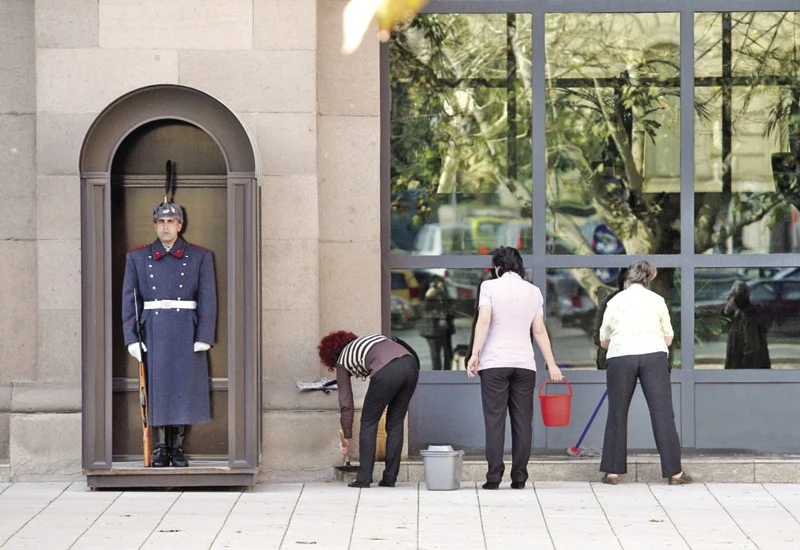
Like all people, the rulers, too love their working places to be clean. For their comfort, however, all taxpayers pay. Of course rulers have high requirements for their toiletries. And this costs a lot.
For the cleaning of government departments an auntie with an apron and bucket in hand is not enough. From next year even hygiene of ministries and their subordinate agencies will need to be performed also with care for the environment. For this purpose, the Central Procurement Authority has announced a special procedure for selection of companies to clean up government buildings in an environmentally friendly way. They are searching for a total of six companies, with which framework agreements will be signed, then the individual structures and bodies will decide which one to choose among them.
Procedure allows us to improve these services in terms of environment and health. Reducing the use of cleaning chemicals using appropriate doses or new methods is particularly effective way of reducing the impact of cleaning on the environment. For the products without a label participants in the procedure will have to certify compliance with technical specifications by a technical dossier of the manufacturer or a test report from a recognized body, a representative of the Ministry of Finance explained the concept. Finance Ministry is the head organ of the Central Authority for Public Procurement. In addition to the preparations there are also requirements to the staff, who must have received appropriate training and possess the appropriate qualifications.
To participate in the proceedings firms must have not less than 400 thousand levs, VAT excluded, in turnover from cleaning services in the last three years (2009, 2010 and 2011) as well as have fulfilled at least five contracts similar to the subject of the current contract. A company must have implemented a system of quality management ISO 9001 standard and have experience in providing cleaning services to corporate clients.
Highly questionable, however, is the requirement the candidates to have at least 20 employees. Without being a specialist you might realize that this is insufficient, especially given the large buildings of the ministries and agencies. From the very announcement it becomes clear that over 150 thousand square meters of workspace will have to be cleaned. According to trade organization in the sector, an average cleaning company is considered one with staff at least 200-300 people, while large ones have between 800 and 1,200.
Policymakers missed the final touches to the other details of the contract and it seems that it will repeat the mistakes of the last tender for the cleaning of public buildings. Then big companies in the sector defined conditions of the contest as incompetent and unprofessionally written and refused to participate in it. Only five candidates turned up – Assenko, Djiza BG, Facility Optimum Bulgaria and the single-person companies NIM Nadezhda Vasileva and Plameks – Plamen Mihailov, although documentation for participation in the procedure was purchased by 17 companies. Contracts were signed with all the candidates despite the drastic difference in their bids.
What companies complain most about is that they have to give prices per square metre rather than prices per person, which is obviously unreasonable when one calculates quantities of liquid soap for example. In addition, various agencies vary widely in type and the price of consumables used.
It now remains to be seen whether the competition this year will attract more companies than the previous year did. It is more than interestingly whether the big players on the market will once again miss the option to compete for the state’s millions. All this will become clear in early August, as proposals for participation in the procedure may be submitted until August 2, and their opening is scheduled for the next day.
The BANKER