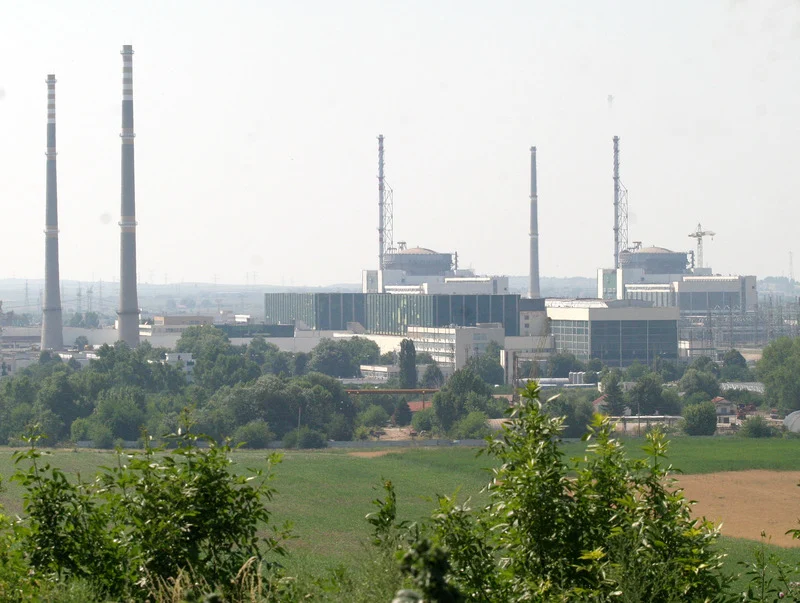
Along with the excitement about the referendum on the future of NPP Belene it appears that everybody has forgotten a far more important issue – the future of the two reactors at the country’s now sole nuclear plant.
This is the question with the modernization of blocks V and VI. In the energy strategy and documents of the tripartite coalition indicated it was envisaged that the two reactors will be decommissioned in 2017, and in 2021, respectively, with their production of electricity volume being be replaced by the still non-existent NPP Belene. The ruling GERB have also recently been experiencing active inactivity and risked to completely miss the deadlines for submission of the required documentation for the modernization of these facilities.
The facts are as follows. All experts now admit that it is high time reactors V and VI were urgently updated to be able to work after the expiration of their initially design period. Few, however, know that the modernization of NPP over the years have been taken over 1 billion levs – in loans and company equity. Part of the loan are still a burden for the first nuclear power plant. And the benefits from absorbing these amounts were mainly for contractors and subcontractors. The surprise is that a sum of more than half a billion levs is yet to be poured to update the 1000 MW reactors.
According to Energy Minister Delian Dobrev and Executive Director of NPP Kozloduy Valentin Nikolov the entire programme of modernization of V and VI blocks will cost around 250 million euros. The aim is to provide an additional
15 to 20 years of lifetime to both reactors.
The intentions are for this to take place in two stages. The first includes a comprehensive survey and assessment of residual life of equipment and facilities. To this end, on April 19 last year, a contract was signed with a consortium of companies Rosenergoatom (Russia) and Electricite de France (France). The contract is for 31,243,087 levs, or just under 16 million euros, which should also be added to the cost of modernization.
The two companies will identify and map out the measures that will be implemented in the next investment phase. It will include training programmes for extension of service to be agreed with the NRA and will be implemented in the period 2014 – 2017 on the V-th block and 2016 – 2019 on the VI-th block.
In fact, it will be only after presenting the investment project that the final cost of modernization will become clear. Let’s assume that at this stage it would only take a total of about 266 million euros. According to what is now known, this sum will be paid entirely from own funds of the plant.
However, anyone who opens the webpage of the Kozloduy plant and click on the section modifications will remain extremely surprised. It creates the impression that
blocks V and VI are some of the most advanced not only in Europe but also in the whole world.. The programme for their upgrade dates back to 1990s and covers 212 individual measures and seeks the implementation of large-scale improvement project of the 1000 MW units of NPP Kozloduy
The above programme was settled during the Cabinet led by Mr. Ivan Kostov
and was for about 491 million. Of these, 180 million were own funds of the plant, and the rest were loans guaranteed by the NEC and the state since the agreements were ratified by parliament.
Euratom (the European Commission fund managed by the EBRD) lent 212.5 million euros, which covered the activities that to be carried out by Framatom (French-German corporate consortium including the German giant Siemens and the French national nuclear operator). American Citibank lent nearly 74 million dollars to fund the activities of the U.S. company Westinghouse. Other 52.5 million. dollars were given by Moscow’s Roseximbank. They paid the operations of the Russian state company Atomenergoexport.
Money has long been absorbed by companies and their Bulgarian subcontractors and now NPP Kozloduy is paying interest on loans and capital contributions, which will last until 2020. Although individual loans are quite preferential- with a long grace period, low interest rate and long repayment term (the loan to Roseximbank has been repaid in advance), the money paid for the reconstruction of the two units with all the extra charges, will probably swell to 700 million euros.
What did we get against these colossal sums?
In 2003 the head of the department Modernization and Investments in the sixth block Nayden Naydenov assured us that as a result of updates the lifetime of the two reactors would be extended for 15 years beyond their design lifetime (back then they claimed it was to be 40 years).
Three years later, in June 2006, the leadership of the NPP Kozloduy again convince us that the country has already filled 191 of the planned 212 measures of the large-scale project for modernization of units V and VI in the plant. Again the promises were that after upgrading, the operating time block V will be extended by 35 years (from 1988), and of Block VI – by 39 years (from 1993).
Separately, on 22 April 2008 a contract was signed between the NPP Kozloduy and the Ukrainian scientific-production association Radii to replace the uniform complex technical equipment of the three channels of the safety system in units V and VI NPP Kozloduy. For which another 67 million euros were paid.
But now the country is to pay again for the modernization of units, which allegedly underwent the whole range of improvements.
The portion of the programme providing diversification of nuclear fuel was discarded and now both tribunes in Kozloduy can work only with Russian cartridges. Some significant changes in the safety systems were not carried out, although other unimportant for their safety steps were taken, such as replacement of the turbine condensers, said a for the BANKER former CEO of Kozloduy Yordan Yordanov.
He expressed confidence that some day somebody will be held accountable for the huge sums invested in nuclear power because it is money guaranteed by the Bulgarian state. Unfortunately, such a thing has not happened so far. Even a debate is missing.
This matter is worth investigating, because the Ministry of Economy and the Bulgarian Energy Holding really needs to see what kind of modernization is the one that swallowed billions of levs. Otherwise the money will continue to sink into the peaceful purposes of nuclear energy.
The BANKER