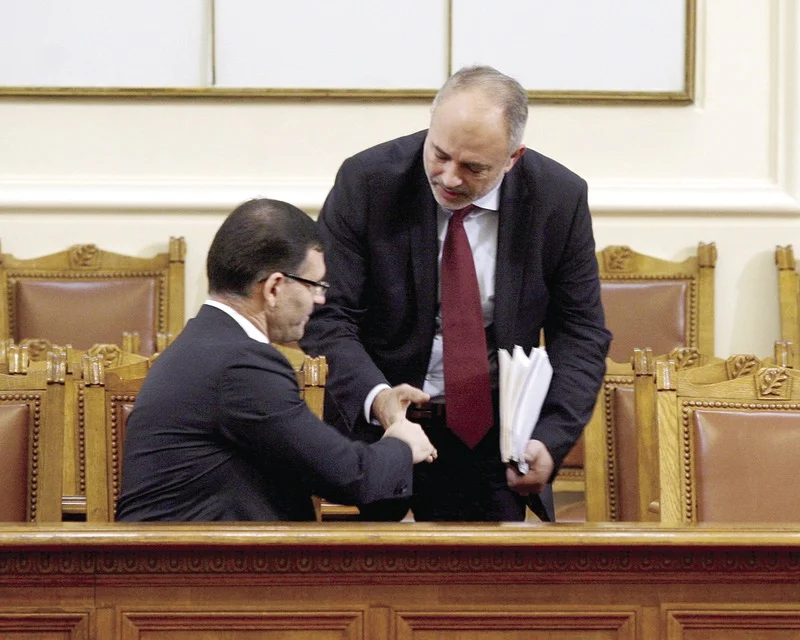
Former finance minister Simeon Dyankov at the end of 2011 carried out an unilateral, absurd and not agreed with the social partners pension reform. One of its postulates was that prospective retirees of the three categories of labour should be forced to grin and take it that they have to work by four months more, hoping to somehow get their hands on the money theyu earned with decades of hard work. During the (post) Parliamentary debates within the Social Committee of the Parliament, Dragomir Stoynev of the socialist party warned that the country has one of the worst conditions for retirement throughout the European Union, and the employment rate in the country has dropped dramatically to 44%, with many people losing their jobs and being unable to retire because of the harsh conditions imposed on them by the Government. It turned out that Stoynev was right.
An analysis of the National Insurance Institute for new pensions in 2012 and shows that the new retirees melte like snow due to the mistaken social policy. Last year into pension went a total of 89,879 people. The number is by almost 20,000 less than the one of previous 2011, which in practice means that a Bulgarian town about the size of Gorna Oryahovitsa was forced to work more. The Cabinet Borisov irresponsibly transferred part of the security burden from the state to the people. The idea of the pseudo-experts was to increase the retirement age, and the term of service in a hope to pour fresh 6 billion levs by 2020 into the half-empty accounts of the insurance institute. The rough estimates, however showed that at an average pension of 260 levs for 2011 all the saving from the unpaid pensions for those who have to worl by four months more comes to merely 20 million levs. At this rate of savings, it is impossible to reach to the final goal. Unless, vulgarly speaking, most of the prospective retirees are not forced to die of hunger, cold and deprivation.
Employed Bulgarians seem to have understood what awaited them and the majority of retired last year decided to grasp the earliest possible option for retirement. Many have taken advantage of the early retirement scheme, some of others proved disability second, while a third group found other reasons. People now prefer to retire early and try to do with a smaller pension, but somehow try to survive in a difficult economic environment. More than half of the new retirees have not turned 60 with an average age of going into pension dropping to 56.2 years. Let’s say in the most popular third category of labour men now retire at 63 years and 4 months, while women – at 60 years and 4 months. This means that the actual mismatch between actual and planned age of retirement is about five years.
Besides poor and hungry, Bulgarian pensioners are also incapacitated. In 2012, a total of 27,452 people started receiving personal disability pensions due to sickness, and their shair to the overall number of people going into pension jumped to 36 percent. Of course there is a small portion of people who try to cheat and get money from the state on the basis of forged documents and false declarations. It is now certain that in the midst of the crisis Bulgarians are becoming more creative in their attempts to deceive the state, which in turn is becoming more brutal in emptying their pockets.
The BANKER