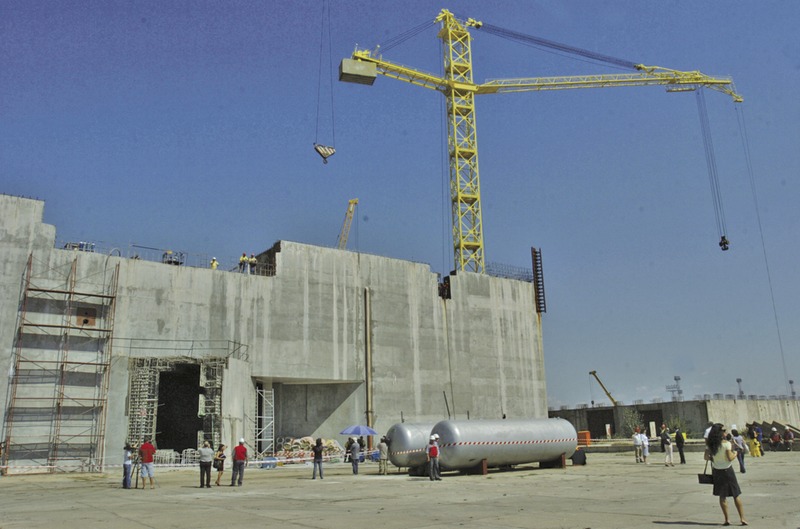
Last week at the annual forum in Varna dedicated to nuclear energy – BULATOM Vice President of Atomexportstroy (ASE) Gennady Tyapkin launched the version that Russia may withdraw its arbitration claim for 2 billion levs if the Bulgarian side resumes the construction of its second nuclear power plant Belene. At the same time Mr Tyapkin did not fail to stress that it is a matter of days that his company submits all documents to the International Court of Arbitration, and that the amount for which the claim is made on the basis of precise calculations can not be changed arbitrarily.
Tyapkin added that the finished project is already among the safest and cheapest in the world and the construction of Belene could begin as early as 2015 and as equipment for both units is fully prepared and nothing prevents it immediate shipment to Bulgaria.
Russians are well aware that now is the time to push to restart the second nuclear power plant. Newly elected Prime Minister Oresharski said that there is a sense that it would be more profitable to finish the project for the construction of Belene, as he believes the Russian company ASE will almost certainly win the arbitration case, and Sofia will be forced to pay large compensations although the claim is not approved of in its entirety. But he said something else: I see the Belene as question of economy rather than a one of politics. If the project has the necessary efficiency, it is appropriate to think of carrying it out, if not – it is not worth it. At this point it is hard to answer – whether we will continue with it or not. I will give my definitive statement only after taking into consideration of all the facts, after checking whether past analyzes are valid as of today, after being informed about the prices of the equipment for the plant and other significant components.
In this situation, the government will have a difficult task to decide which the smaller evil is. While in power, GERB claimed that studies of British bank HSBC and consultant correspondence from 2008 between NEC and the German company RWE (which at that time was chosen as a strategic investor) clearly shows the price of Belene at more than 10 billion euros. Meanwhile, the socialist BSP and ASE are talking about very different amounts – about 6 billion euros. The gap actually comes from the fact that the BSP and the Russians all the time thought how much the new NPP will cost with two 1000 MW units, with associated infrastructure, obtaining the permits, licenses, etc., but in 2006 and provided that it is built overnight. Then or now, the state cannot just cash this deal. That is, it will have to borrow from a bank, or rather – a bank consortium and the standard price escalation in such ventures is about 40 percent of the total cost. This way the value of the Belene project reaches about 10 billion.
The same problem will be faced by the new cabinet, and perhaps it can be even greater. In Varna Vice President of ASE Gennady Tyapkin said that the resumption of the construction of the second nuclear will probably change the cost of the project, since any delay leads to a change in costs. It is more than clear that the price is supposed to go up. In other words, only one percent indexation of the multibillion-dollar NPP Belene would impose a significant burden on Bulgarian state.
One should not forget also that the World Bank openly called the second nuclear project a failed investment. The same financial institution, and the European Commission in its analysis of the energy situation pointed out that under current capacity and potential for energy savings in households and the economy the country will have a power surplus by 2030.
Ultimately, at this stage it seems that the most sensible course of action of the new government will be not to succumb to Russian pressure and not to rush with significant decisions. Because as much as Rosatom claim that for them Belene is not that important, in fact it will legitimize them on the European market. Their other chance to break into the community’s single market is their participation in the tender for the expansion of the Czech nuclear power plant Temelin, which however is about to fail after Prime Minister Petr Necas openly declared: To sign something of this scale, I need to make sure that investments will generate income.
The BANKER