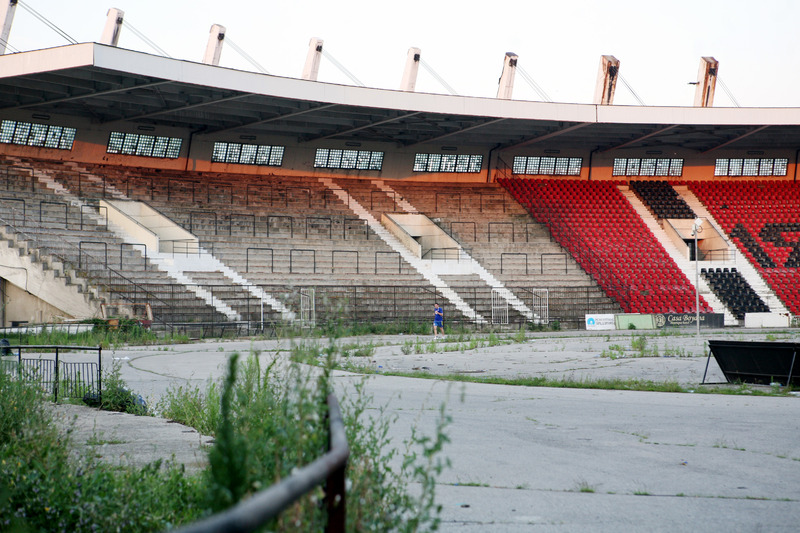
The clash around the host ground of Ludogoretz team in the playoff game against Basel for entry into the Champions League was smoke without fire. The lot was favourable to both football and music fans who were at war because of the time conflict between the club game of the year and the cult show The Wall of the rock legend Roger Waters. If we believe what was said and written: the worst case scenario – a duplication of the two events at the National Stadium Vasil Levski – could make an enraged Cyril Domuschiev withdraw his football investments from the country, while Sports Minister Mariana Georgieva was said to try and chase out Roger Waters to perform at a meadow near Sofia. Many tried to build upon the scandal, but no one found it necessary to comment on which is the main cause of the drama. And it is that for more than two decades, both state and football managers have been turning a blind eye to the shameful fact that Bulgaria doesn’t have a single a stadium which meets the requirements of the European football governing body (UEFA) to conduct matches from the real phase of the Champions League.
Indeed, there were dozens of plans and prospects for a new national and club stadiums, but none of them was started. Probably due to the good relations between the president of the Bulgarian Football Union (BFU) Borislav Mihailov and UEFA’s head Michel Platini, to Bulgarian football many compromises have been made. Even the modern for the local standards Vasil Levski stadium does not meet the requirements of UEFA for a stadium of fourth category, which is the level required to play games from the playoff phase all the way to the semifinals in the league of the rich countries. It is disturbing that the existing regulations of the European head office were set out back in 2010, but since then no one in Bulgaria stirred a finger to create a decent facility.
However, from the site of the National Stadium Vasil Levski one may learn that the facility is among the top five in his class in Europe. The site doesn’t mention which class, but certainly – not the premium category of UEFA. Under the heading ‘technical data on the website it is indicated that the facility has 26 gates for entry/exit, two transport ones and one main entrance, the site with the athletics track are equipped with heating and lighting, maintenance of heating, ventilation, sound and lighting system, while the monitoring and other maintenance activities are managed by an integrated computer system, 91 cameras protect and monitor all sectors for the audience. The number of water closets is 270 and 80 are the seated places for journalists with all communication options and output of video and audio signal to mobile television stations in the parking lot. As other advantages the site mentions an intruder alarm (throughput) system with counters that provides a sample of the number of viewers at any time as well as a sound system of the U.S. company JBL.
These parameters are not that desperately bad, but to be categorized at level four, a stadium must meet many criteria. Among them are the minimum power of 1,400 lux of the lighting, VIP parking lot for 150 people, plus 400 parking places for buses, the minimum number of VIP seats – 500 at least 2 sectors with 50 places for disabled people in wheelchairs, two toilets for every 375 spectators plus an urinal for every 125 people. Obviously, Vasil Levski stadium will hardly cover the hygiene requirements and the obligation to have a certain number of parking places and seats for handicapped people, especially at full capacity. Particularly the case with the lights is on the border of the requirements because the National stadium has a lighting of 1,400 lux but even if a single bulb burns down, this would make the capacity drop below the line. In addition, it requires the stadium to have at least 100 seats for journalists, half of which are equipped with desks. For cases concerning poorer countries UEFA’s administration has introduced convenient for all parties exceptions from the rules. When due to a failure to meat the criteria to license (in this case Ludogoretz) a club has to play their home match of UEFA in a foreign country, the headquarters of the European football association may compromise. So, if the facility covers the basic safety requirements, the size of the terrain, capacity and media coverage, it may host the match. But it is not known how much longer uEFA would make these exceptions.
In this respect, BFU again was fatally late to incite a change in the government policy. Football managers dared to ask by letter premiere Oresharski if the country will propose to host matches of Euro 2020 just 20 days before the deadline for submitting the documents. The headquarters of BFU made Bulgaria’s premiere acquainted with UEFA requirements for those interested to take the host grounds of championship matches, which will be held in several countries. Mikhailov is ready to apply for a standard package including 3 games from the group stage and one from a second round, for which stadium with a capacity of 33 000 seats is sufficient. The Football Union proposes that Vasil Levski stadium be repaired or, a new multifunctional stadium be constructed with modern facilities suitable for various events. Oresharsky however, will have to decide soon, as the deadline for applications is August 26, and the required documents must be submitted to the UEFA headquarters no later than 12 September. The Football Union in fact had to prepare basic financial estimates on how much the two proposed options would cost and not just a brief document comparable to a PR message.
The tragic situation with club sports facilities is continuing. Only Lazur in Burgas and the stadium of Beroe Club are licensed for third category matches.
The BANKER