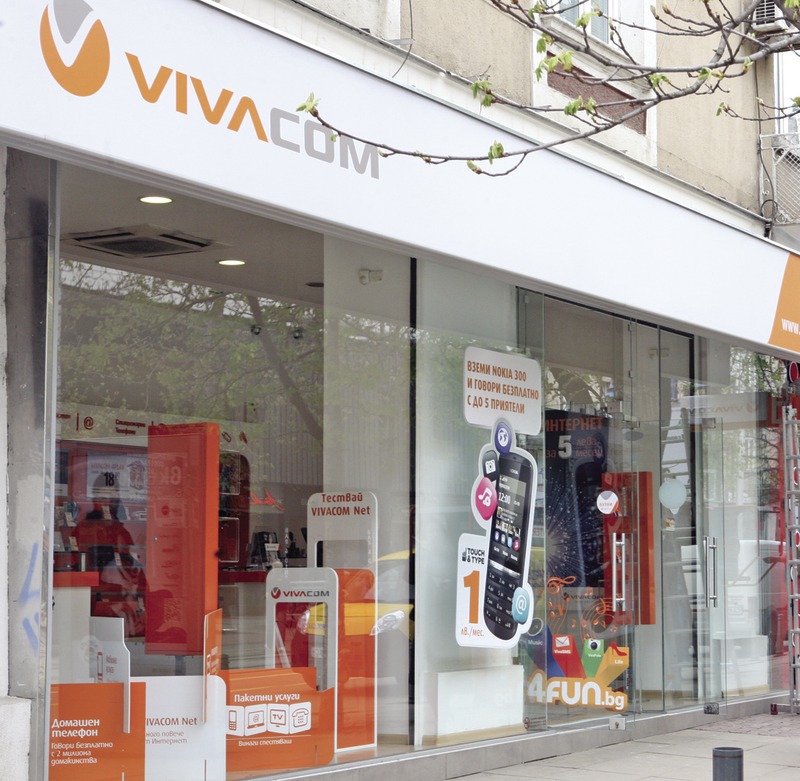
Serious redistribution of market shares, drastic cut of turnovers and modest profits. Such is briefly the situation with the Bulgarian telecommunications sector today and projections are that it will become increasingly bleaker.
Crisis, new regulation and the market saturation have largely exhausted the profit margins that until recently GSM operators could impose on customers. The profit of Mobiltel for 2012 was 92 million levs, while in 2010 it was over 220 million levs. Vivacom on its turn is in the red with 39 million levs, once in 2011 it had reported a modest profit of 9.2 million levs, and for the year before that – 113 million levs. There are no official data for Globul, but there is no reason to believe that the situation with this player could be quite different.
Indicative of the turmoil in the industry is the fact that for the fourth consecutive year, the mobile operatorsrquote earnings have been going down, losing about 200 million levs from their volume. A recently published report by the Commission for Communications Regulation says that in 2012 revenues of Mobiltel, Globul and Vivacom from mobile telephone services have fallen by as much as 12.1 percent and are now just 1.52 billion levs. For the first six months of 2013 data were even worse. In 2008, the three operators out of GSM- telephony in Bulgaria generated a combined revenue of over 2.2 billion levs.
The lion’s share of the pie still is held by Mobiltel, but also this is the one that suffered the biggest blow. The company’s turnover for 2012 declined by over 11 percent and it is now only 896.6 million levs. Revenues from mobile voice services came to 679.7 million levs, which represents a 44.6 percent slice of the market. In practice, the telecom has said goodbye to another 3.9 percent share of the money being poured in this sector. Interestingly, all these losses of Mobiltel have become a revenue for Vivacom whose market share rose to 19.3 percent, or just over 294 million levs. However, the total turnover of the former state operator for 2012 also declined, albeit by less than 4 percent – down to 862 million levs.
Unchanged remains the position of Globul which continues to hold 36.1 percent of mobile telephony market, or 550 million levs. All proceeds of the company last year amounted to 807 million levs, a drop of nearly eight percent. The performance of Globul, however, can be considered impressive having in mind the fact that this operator is still very much conservative. In contrast, the competing Mobiltel and Vivacom are opting to invest considerable sums in the development of new services. Following the acquisition of Megalan and Spectrum Net, Mobiltel, which is the first GSM operator in the country, now offers consumers not only mobile but also fixed internet and digital TV. Separately it invested in building a pilot 4G network. As to the former state monopoly, Vivacom, it attacks more seriously on the television market by introducing the satellite Vivacom TV and building a fiber optic network of latest generation, offering super-fast internet and TV with even better quality. This allowed both Mobiltel and Vivacom to offer a number of packages, including mobile and fixed telephone services as well as cable internet and TV.
Actually, the report of the Commission for Communications Regulation states that it is bundled services that are the future of the electronic communications market. It suffices to say that the revenue from this segment increased last year by as much as 30 percent endash up to 310.6 million levs. The most significant growth has been spotted in the service that includes television, fixed and mobile services endash as it experienced an 11.2-fold hike compared to 2011. The rise in revenue is also significant in the four-service packages offering the above three services plus Internet (9.5 times).
The significant increase in annual revenue for the above packages with included mobile voice service is due, on the one hand, to the diversification of the product range, including various combinations of electronic communications services provided by mobile operators. Second is the fact that they became available relatively recently, explained representatives of the regulatory commission.
It can hardly be expected, however, that the sector will continue growing with such a serious pace. The reason is that large investments are no longer made, while the intentions for the future are more modest. In 2012 investments in the construction and maintenance of public electronic communications networks and services were only 548 million levs. For comparison, in 2011 what was spent on modernization and development tools amounted to nearly 720 million levs. Earlier they eve exceeded a billion levs, and this year they will hardly go beyond 450 million levs. Because of this, we can be sure that the future of telecommunications will definitely see a redistribution of current subscribers, reduction of the average monthly cost for customers, many promotions, discounts on subscriptions, including additional minutes and more. Accordingly, the big gains will be achieved much more difficult.
The BANKER