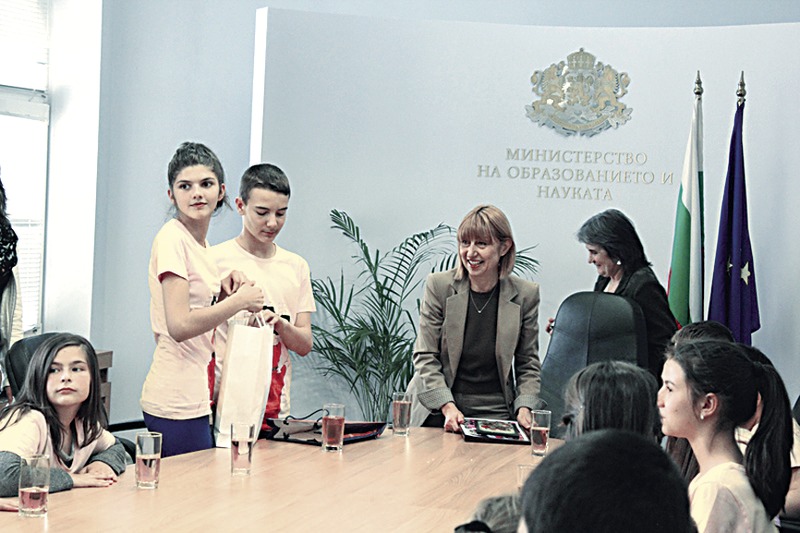
The Minister of Education Prof. Aneliya Klisarova is probably lost in the labyrinth of the new educational act, but instead she intends to compensate for that with success in the new Operational Programme „Science and Education for Smart Growth.“ Ten months ago, in an interview for the BANKER Mrs. Klisarova said that the programme must be approved by the European Commission, then the Ministry of Education and Science to win it, and finally – to get the maximum support because funds are vital for the creation of quality secondary and higher education, as well as support science. Now it seems everything goes according to plan, as the full version of the programme is now ready (or so they say) and duly posted on the site for public consultation. The one who wants to understand any part of it, can just read its resume which clearly shows that „Science and Education for Smart Growth“ will contain four priority axes – „Research and Technological Development“, „Education and Lifelong Learning“, „Educational Environment for Active Social Inclusion“ and „Technical Assistance“. This is a useful „preview“ because after opening the document one may lose hours to even find what the country’s goals and strategies for education are.
After a long wandering through the pages one might find that Bulgaria is applying for more than 582 million euros for the programming period until 2020 , and the amount of the national co-financing will jump to 685 million euros, which is more than 1.3 billion levs. But surely the country will not get even a penny if the Commission decides to look in the technical implementation of the project. It reminds a highly inappropriate joke or even a puzzle for technocrats in Brussels. The highly complex formulae that even Pythagoras would find difficult to figure out, mingle with endless succession of passages written in English and Bulgarian, but the language of Shakespeare is not used in its best form. The text is fragmented, chaotic and extremely vague. Bureaucrats from the European Union will have really hard time to understand what exactly it means. Surely what awaits them is at least a week of heavy and painful headaches. The document is abundant in arbitrary question marks, from which a reader cannot understand who asks what from whom. Separate passages of sentences are highlighted in yellow without even marking the most important things in the text.
Its vocabulary and reasoning can certainly claim a prize for innovation and alternativeness in the new EU programmes. We learn, for example, that the reform towards optimization, consolidation and reduction of the network of universities, needs „a motor from outside, a framewirk of the stages and necessary activities“. Hopefully the outside engine is loaded with quality gasoline because otherwise the country’s education may soon turn into a time-bomb.
Pernik University has already been closed and its example may be followed by other educational institutions. Again, in the same text a reader learnsthat the OP „Science and Education for Smart Growth“ has the potential to be a turning point for change in the „slow inertia of the status quo.“ And here again we have superior mechanics and dynamics of the sentence … The genius who wrote the text may find it more useful to think about the simple fact that the most brilliant young people, after completing his secondary or higher education, simply go to work or study abroad with the intention to continue their life plans in emigration.
The BANKER