While professional organizations in road construction continue discussing whether it makes sense to build a 15-kilometer-long highway tunnel along Struma river, southwestern Bulgaria, the government clearly has no such doubts. The BANKER found out that the Strategic Infrastructure Projects National Company has already signed the contract for carrying out geological studies for the construction of Lot 3 of the motorway (Blagoevgrad – Sandanski) in areas of the projected tunnels in the gorge and Zheleznitsa village. The contractor will be the registered in Asenovgrad union GEOPS Geotechnics Consult, which includes GEOPS – Balkan Drilling Services Ltd., Geotechnics – ABC Ltd and Start Consult Ltd. For their work the three companies will receive nearly 1.5 million levs, VAT excluded.
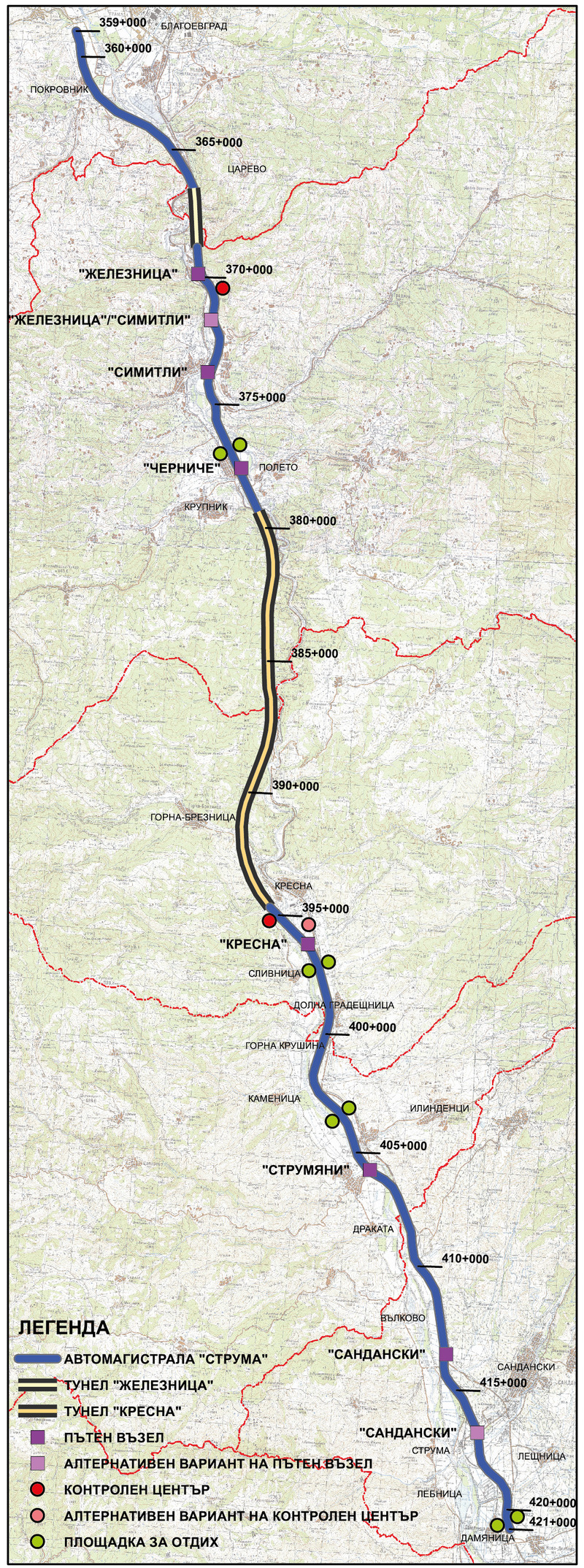
According to the draft project, the section of Blagoevgrad to Sandanski will have a length of approximately 64 km and will be divided into three subsections. Lot 3.1 from Blagoevgrad to Krupnik will include a tunnel with a length of about 2.6 km, near the village of Zheleznitsa. Lot 3.2 will stretch at 20 kilometers between Krupnik and Kresna, passing completely through the mountainous terrain there and the bulk of it will be a 15-kilometre-long tunnel in the Kresna gorge. The third section will go from Kresna to Sandanski and has a length of 23 km. It first two sections will require highly reliable geological data, geological mapping, a number of studies, collection of soil, rock and water samples to finally get to the engineering preparation of geological reports.
Stability studies on earth’s layers will be crucial because of the increased seismic risk in the area. In early March, the CEO of the company Strategic Infrastructure Projects Asen Antonov explained that the biggest tunnel is designed to withstand a level 9 earthquake on the Richter scale, but if it really will, only studies can show.
In practice, the award of this contract to GEOPS – Geotechnics Consult is the first step to beginning the actual construction of Lot 3 of the Struma highway. The entire amount that will be allocated to it comes to 1.7 billion levs and is expected to be provided under the new EU’s Transport Operational Programme. To ensure safety and rapid response in emergency situations three helipads will be built near the highway. There will be a control centre where the machines for winter maintenance will be deployed, as well as ambulances, fire surveillance cameras and so on.
The construction of the 15-kilometre-long tunnel, estimated at 1.1 billion levs, however, already began to cause tension in the sector. Construction companies that accumulated experience in recent years in the building of highways in Bulgaria fear that they will drop out of the game. And there is some reason to that, as the tunnel construction in the country has been more than modest in recent years. Large tunnels can literally be counted on the fingers of both hands. It is said that after the contract for Lot 3 has been officially announced, it will attract the biggest names in tunnel construction not only in Europe but also in the world. During the previous cabinet, that of GERB, some Swiss companies were interviewed whether they are willing to participate in such a tender and then the feedback was positive. It seems the interest has not dropped today and coincidentally in late April by the Construction Chamber in Bulgaria called for the project revision of the construction of the tunnel, to seek alternatives in compliance with all environmental and building performance requirements. Travel experts said that the construction of such a spectacular facility is impractical, unrealistic and uneconomical. They insisted again on evaluation of the conceptual design of the Italian company SPEA 2001, which recommended to extend the existing route to four lanes with a speed limit of 90 km/h. The alternative route projected 13 years ago would needed half as much money and would be quicker to recover in strong earthquakes, which is important for a highly seismic zone such as the one near the gorge, said also the president of Glavbolgarstroi Simeon Peshov. Another option was to make a number of smaller tunnels.
The truth was expressed by Valentin Trashliev, chairman of the board of the Bulgarian Association for Geotechnical and Tunnel Construction. According to him, there is nothing wrong in breaking the construction into several smaller tunnels, otherwise there was a risk the project to go to a big foreign player, and Bulgarian builders would remain only subcontractors. Last week Mr. Trashliev was already quite confident, noting that Bulgarian tunnel builders have the capacity to build a 15-kilometre-long tunnel on the highway Struma for 50-60 months and the construction would cost 350 million euros, against the forecast of between 500 and 600 million, as claimed by his colleagues construction experts. He noted again that such facilities are usually built by consortia and industry associations insist that these are formed up by Bulgarian companies.
The solution will be known by the end of the year when the country will have to announce tenders for all three subdivisions of Lot 3 along the Struma.
The BANKER