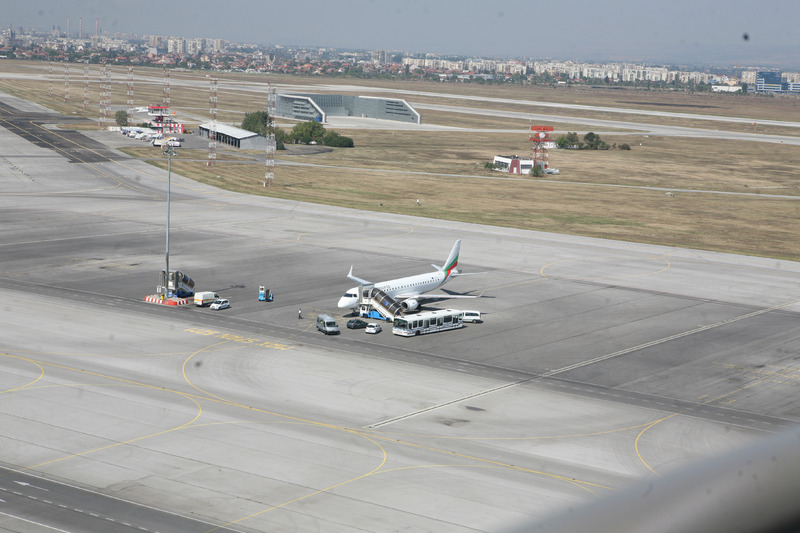
The long-awaited concession of Bulgaria’s largest airport – the one of the capital city Sofia – will not happen soon. By an order of the Minister of Transport Daniel Papazoff as of June 10 the preparatory actions around the public-private partnership have been terminated. The main reason is the need the transport ministry to carry out further actions in overcoming difficulties in clarifying the status of the property, which will become the subject of the future concession.
Already from the period in office of the previous GERB Cabinet, the official in charge of transport – Ivailo Moscovski – announced a public tender for selection of companies to establish legal, financial and environmental analysis for the concession of Sofia Airport plus the attached to it airport in Balchik as directed by the then Prime Minister Boyko Borissov. In general, the studies were worth 108,000 levs (respectively 53.5 thousand, 39.5 thousand and 15 thousand levs for the three lots). Then, the Cabinet of Mr. Oresharski gave additional time to contractors up intil the spring of this year to complete this work and based on this analysis to decide whether the largest airport in the country should go under the management of a private person. But yet then Minister Daniel Papazoff signaled that the opening of the concession procedure is entirely a matter of political decision. And this was the reason why the preparation of a public-private partnership was terminated. Sources of the BANKER said that Deputy Prime Minister responsible for economic affairs Daniela Bobeva took into consideration that the initiation of such a major concession in the current highly uncertain political situation can only bring negatives for the government. Especially because there is huge interest in the airport. Yet at the initial moment the country started talking about its concession, along with Bulgarian players companies from Canada, Germany, Switzerland, Turkey, USA and France showed interest. The airport is the largest in the country – it has two passenger terminals with a capacity to handle more than five million people annually. It serves the capital city – the region with the most developed economy in the country, and is also the most convenient entry point for the country’s two major ski resorts – Bansko and Borovets.
The big problem of the state company, which now operates the airport, is that its management was not able to utilize the best commercial opportunities offered by the new terminal. In practice the area can compete with the largest shopping malls in Sofia, but because of unaffordable rents the spaces are half empty.
An airport is usually concessioned when it must attract investment of a lot of money – as is the case with Burgas and Varna. In the capital city, however, Bulgaria has a completely new, modern and functional terminal and a new runway built with international funding, President of the Bulgarian Aviation Forum Milcho Milanov told the BANKER. That is, loans spent on modernization were in practice another reason for the failure of the concession. For the new terminal and runway were spent 210 million euros, of which 60 million euro came as a loan from the European Investment Bank (EIB), 38.1 million – from the Kuwait Fund for Arab Economic Development, a total of 50 million in the form of grants from ISPA and Phare and the remaining 61.9 million came from the state budget. Indeed Bulgaria has already received permission from the European Commission on forming a public-private partnership which is necessary because of the funding allocated to the two pre-accession programmes. However, the situation with other international agreements is far more complex. Not surprisingly, one of the main requirements for legal analysis was to determine whether and how loans concluded with the EIB and the Kuwait Fund for Arab Economic Development will affect a future concession.
„In establishing of any negative impact on the capacity and performance of the concession of the above documents (editor’s note: the Financial agreements with the EIB and the Kuwait Fund) the legal analysis should propose and justify one or more preventive legal solutions, respectively to overcome this impact“ says the technical specification to the contract. In the end it turns out that it will not be easy to transfer state commitments under the agreements, as the state is the guarantor. To do this, the need for complex coordination procedures between the debtor and creditor, is extremely time consuming and most often leads to aggravation of the conditions under which the loan was granted initially. Another option is to repay the debts in advance, but within the complex economic, and political situation, at least at this stage, this remains purely theoretical.
The BANKER