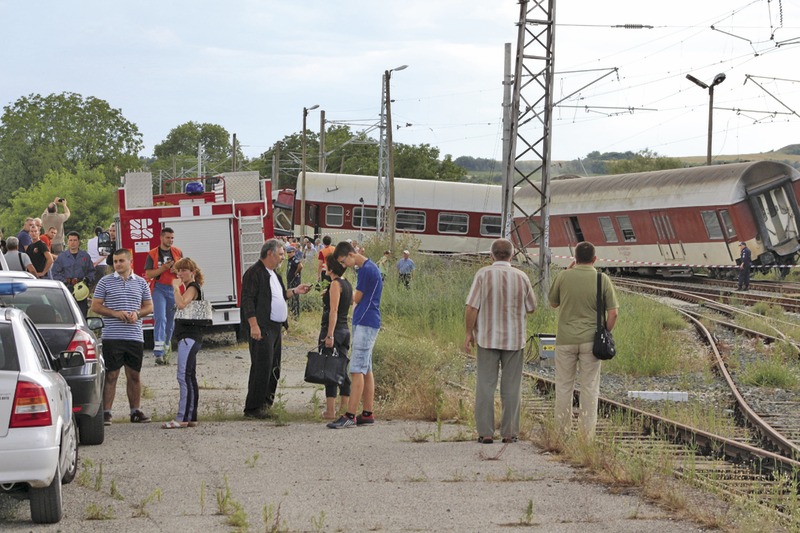
Two incidents of derailments within a few days showed again how desperate the state of the railway sector in Bulgaria is. The tragedy near Kaloyanovets when a train composition from Sofia to Varna derailed killing one person and leaving another 14 injured, however, is an emanation of institutional helplessness. According to the Minister of Transport Daniel Papazoff the rail track where the crash happened is the best available to the National Company Railway Infrastructure (NRIC). It meets all European parameters, was open just two months ago and was put into operation with the required technical inspection and documentation. The crashed composition was the best one available to the Bulgarian State Railways, as the locomotive was equipped with automatic speed monitoring system, Mr. Papazoff said.
So the logical conclusion was that it was a human error – the killed driver and his colleague who survived did not see in time the signaling for a deviation because if they had, they would have need to slow down their from 110 to 40 kilometers per hour. As a result, the train was thrown out by centrifugal forces when entering the deviation arrow. But it is interesting that no one wonders what necessitated a train composition passing its scheduled transit near Kaloyanovets at about 100 km/h, too be redirected to a diversion track where the speed is much lower? And if this depends only on the drivers.
According to the independent expert and coordinator of the association Friends of the Railways Mr. Varuzhan Apelian says that the National Railway Infrastructure Company (NRIC) official documents indicate that the section Mihaylovo-Stara Zagora (where Kaloyanovets is situated) is equipped with the so-called Automatic Locomotive Signaling System (ALS) JZG 707. The expert claims that its regulatory switching on and its use is mandatory when available. The goal is clear – to prevent situations of travelling through semaphore at a speed different from what is prescribed. I.e. at a red signal a train must stop. The problem is that the ALS system exists only in theory – and this has been the case for years. Nobody controls if it works and whether it is used, and as a result, nobody complains about it, and then it seems that there is no problem. Or at least there was no problem up until drivers entered a stretch at 98 km/hour that is supposed to accommodate trains travelling at 50 km/h. It is no secret that in Plovdiv ALS equipment is dismantled in some locomotives for some local self-initiative reasons, but the safety authorities do not react. If ALS was switched on, this incident would not have happened, said Apelian.
In the specialized forums drivers commented that the locomotive signaling system worksa, but no one switches it on. Nobody complained about the lack of it, so I it was considered to be not problematic. More interesting is that no one wanted to use it, because when this is done between Stara Zagora and Sofia there are about 25 emergency stoppages of the trains. In a nutshell, the railway stretch may be new, but the system is old. One can only imagine what happens in the other sections of the national railway network…
Almost in passing, the media mentioned that shortly after the great catastrophe, a carriage of a cargo composition flew off the tracks between the stations Chumerna and Gavrailovo. And that’s just part of a series signalling that nobody pays much attention.
The picture really is scary. Three years ago the BANKER published an article in which it stated directly that the BDZ is on the brink of a catastrophe because of faulty, outdated and non-serviced railways, bridges, fortifications and signaling systems, that are dangerous to everyday Bulgarian trains and hundreds of passengers who travel in them. The facts mentioned then were not invented by the BANKER, but were described in a special report to the Director General of the National Company Railway Infrastructure Milcho Lambrev. Apparently they did not alarm those who need to have been worried.
It was detected, for example, that there is no one to control the state of the railways and facilities. Because of an unstopping optimization of the staff, restructuring and reorganization in the sector, the number of roadmen and security workers in railway stations that need to exercise constant control has fallen to critical levels. Inspection of road and equipment is carried out mainly in daylight hours. Sections of the railway track, which is served by a linesman, now reach a length of 6-7 km or more, increasing the likelihood of any defects to railways not being seen in time.
Basically any normal modern railway company would replace manual labour with electronics and machines to avoid the subjective factors and human errors. The problem is that despite the reduction in staff in recent years NRIC has no modern technical means. Seriously deficient is also the security equipment at stations. Arrangement and locking of switches is done manually, and there is no control over the presence and position of trains. The lack of automation greatly reduces the handling capacity of these places as well as the possibilities for maneuvers and reduces the rate of passage of transit trains.
The BANKER