In the solution of the case with Corporate Commercial Bank the authorities in Bulgaria have broken the law. A change is made to the procedure, which should be adopted when handling a shortage of liquidity and especially with the persistent allegations for an only possible measure – the bankruptcy of the bank. This happens under pressure, the case is no longer a purely banking one but a criminal-political, with enormous socio-economic consequences for the country.
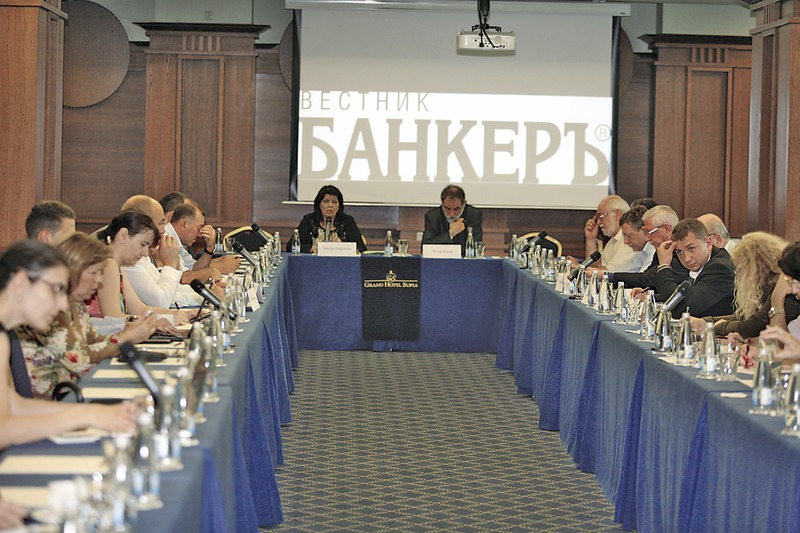
These were the theses which united economists, trade unionists and employers at the conference organized by the BANKER under the title „Corporate Commercial Bank – Possible Solutions“ held on July 16 in Grand hotel Sofia.
„We do not believe the official institutions: Prosecution, the Central Bank (BNB) and the Financial Supervision Commission (FSC), and we want to directly participate in the evaluation of what happened in the CCB,“ was said in an open letter by the father of trade unionism in the country, the president of the union Podkrepa Konstantin Trentchev. Addressing the social partners Trentchev pushed for „appointment“ of a „union attache“ in the checking of the CCB.
This launched the alternative thinking among the non governmental and informal elite of Bulgaria’s society. And it has much more to do with normality than the political shouting on the subject and the apparent subservience of the Central Bank.
Former Finance Minister Prof. Christina Vucheva developed the idea of a sequence of steps that the C-Bank had to follow by law. At first, in a liquidity crisis it should talk with shareholders to participate pro rata in raising the capital of the bank. Only when it turns out that this is impossible, comes the resorting to a special supervision regime. This first stage seemed to be missing. However, when the owners of the CCB requested special supervision, the National Bank was forced to announce it. But here’s the biggest mistake of talking now – special supervision is done with the expectation to restore the solvency of the bank, said the experienced financier. The announcements of a capital gap of 3.5 billion levs and 206 million levs withdrawn in cash pointed in a criminal direction without actually having evidence for that.
Financial adviser Prof. Vladimir Karolev supported Vucheva regarding the compliance with the procedure and emphatically pronounced that the main problem now is the behaviour of the C-Bank and the government. But he as a hardliner, said that if shareholders can not save the bank, he state must apply the current law on the ceiling of deposits. There is an option depositors and bank employees to be offered to to become shareholders. Eventually what was chosen is the worst scenario, said Karolev.
Lyubomir Datsov, deputy finance minister in the government of Simeon Saxe-Cobourg-Gotha, one of the longtime employees of the Financial Ministry, joined his colleagues, but … with pessimism. „It’s too late for many things. A bank is trust. It can withstand financial and economic attacks but psychological – not. Unmeasured actions have led to here.“
L. Bogdanov, managing partner in Industry Watch, took part in the pessimism of Datzov saying: „There can be no recovery of the bank, when everything is in the hands of prosecutors, its employees have been arrested, the head of Banking Supervision at the Central Bank is also accused.“ But on the other hand, in order to go into bankruptcy, the questors must prove insolvency.
Statistics disproved through the imposed opinion about the poor condition of the CCB. The Bank is a stable, well-managed, profitable, its bad loans were only 2% in the first quarter of 2014, while the average for the industry is 23 percent. This said Christo Mihailovsky, chairman of the Bulgarian Credit Rating Agency. „Why are we going directly to liquidation, without having walked the normal route to there?“ he asked.
Mihaylovski asked for a preparation of a chronological analysis of bringing the bank to this state a change of questors who „discovered“ the 3.5 billion capital hole and the withdrawal of hundreds of thousands of euro in bags, as well as for the appointment if public conservators selected to show the real state of the bank. Mihaylovski supported the argument that KPMG, former auditor of CCB, can perform an audit for no more than two weeks, but this lever, strangely enough, is not used.
The bomb on behalf of businesses threw a „revelation“ made by Petjo Milkov, Honorary Chairman of the Association of the Defense Industry at the Association of Industrial Capital in Bulgaria. He said that this year has a record amount of orders for special products – of up to 1 billion levs in exports against the average of around 300 million levs up to now. Accounts of this industry however are with the CCB from this bank and use half a billion dollars in credit.
Stoyan Alexandrov again repeated his position that the Bank and the government should adopt and follow a clear plan. „The auditors are unable to give a definitive assessment of these 3.5 billion levs. From these loans there can be some supervised, some non-performing and those having led to losses. What if they are provisioned as by law – first by 10%, the second – by 50%, and the third – by 100%. Then? It may be that the bank has good assets for 5 billion levs, for what capital hole then are we talking? But BNB and politicians are reluctant that CCB be saved. Because the appetite of those who provoked the event is not for the bank but for its loan collateral – the biggest Bulgarian enterprises.“
The BANKER