
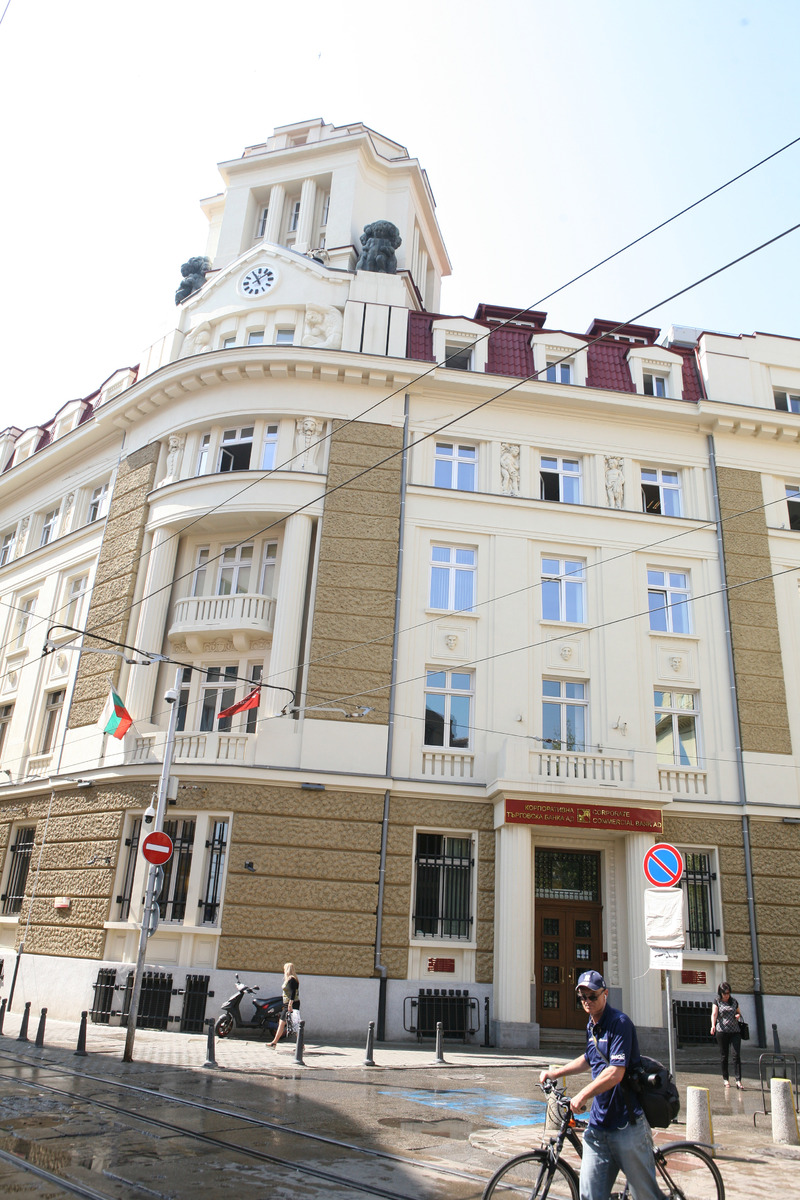
The innovative business strategy of Bulgaria’s Corporate Commercial Bank (CCB) and its corporate orientation has distinguished it significantly from banks operating on the Bulgarian market. The bank’s activities over the years can be defined more as investment banking, as opposed to the simple model of traditional banking that is widespread in Bulgaria. Most banks on the local market are foreign-owned, and are financed by short-term deposits in addition to cheap funds from parent banks. This resource is distributed in the form of short-term and expensive mortgage and consumer loans to individuals and corporate capital loans.
These forms of credits in no way contribute to the business development of Bulgarian producers. They are largely indirect funding channel for foreign production facilities (white and brown goods and travel services) by intrusive and widespread advertisements of loans for purchase of consumer goods that are not produced in Bulgaria, as well as holidays in countries of the region directly competitive to the local tourism market.
Lending at CCB has always been aimed at stabilizing and expanding the production activity of Bulgarian producers and companies in the services sector. A large part of the bank’s efforts have been focused on raising funds in a number of EU programmes for this purpose CCB directly involved in two consulting companies specializing in project management of these programmes.
Due to the lack of adequate capital market and limited access of Bulgarian companies to international markets, the main source of funding for the bank is the Bulgarian deposit market. Over the past four years the bank held a relatively aggressive policy by providing advanced and attractive deposit products, which has secured a good source of borrowed funds:
CCB has been dealing with long-term financial resource which logically makes it more expensive than that of the other players in the banking system. This comes from the attractive long-term savings products of the bank that account for over 50% of borrowings and have sustainably formed a large part of the so-called blocked minimal reserves. That is, although they have no fixed terms, these resources are not cashed withdrawn and remain available to the bank for use in longer-term investments. The proportion of permanent funds available under the deposits in CCB is currently at 80%. This is an extremely high proportion of stable resources in a bank and a slightly higher cost justifies the bank’s strategy to attract it because its investment in longer-term projects contributes to the higher profitability of these investments and provides a reasonable and appropriate interest rate spread.
For comparison, the interest spread CCB for 2013 was 2.37%, which is about 1 percentage point lower than that of the banking system as a whole, which is predominantly engaged in short-term financing because of the relative short duration of the resource, attracted by commercial banks. Just as an example,
interest rates of CCB
were the lowest in the system in short-term funds attracted (up to six months) and tend to be among relatively higher interest rates in the products with a maturity of one to two years, and that for deposits in Bulgarian levs and euros. For other currencies again the resource of CCB was among the cheapest.
The positive trend of the rising share of funds from citizens is accompanied by cleverly structured products. About two-thirds of funds from non-financial institutions are savings deposits – one of the most stable resources, 20% were fixed-term deposits.
The strategy of the bank to be sufficiently profitable
by maintaining a stable long-term resource
and investment of this resource is supported by the low cost of maintenance of the administrative activity – the share of administrative costs of the CCB in assets was always significantly lower than that of the system as a whole – 1.12% at December 31, 2013. It was almost two times higher in the banking system (2.08%) as a whole and almost 50% higher for banks of group A to which CCB belongs (1.86%).
Therefore, the bank has naturally been among the most profitable in the system with continuous expansion and adequate structuring of resources and their investment. At the same time through this policy the bank limits also the risk of concentration of funds, which makes it more stable than the shocks from loss of individually significant customers.
In terms of bank lending the institution has been focused and worked primarily with corporate clients. Since a significant part of the investment is for development projects, the entities being credited are
specifically established project companies
(Special Purpose Vehicles, or SPV), whose only property is the project they develop. The use of SPV is widely applied worldwide, which leaves no surprise or problems among business analysts. The institution funding such projects can not expect the same to have essential assets that can be pledged. For this reason, a significant part of the collateral of this investment bank is formed from claims arising from the implementation of the projects.
This type of collateral is nothing fictitious
nor is it illegal.
Outside supporting the development of new projects, the bank conducted exclusively forward-looking and conservative investment policy, the main goal of which was ensuring long-term stability.
It deliberately avoided taking significant exposures in transient phenomena in certain periods of the economic development of the country, such as the massive investments in the construction of hotels and residential buildings. At present, they have a great weight in the portfolios of other banks. It also avoided the unhealthy infatuation with massive unsecured consumer lending, which even after waves of restructuring, sales and write-offs continued to weigh on the banking system with more than 10% of all credit exposures.
Apparently the strategy applied by the bank was successful, as witnessed by its financial performance and results. First, these are the indicators of growth in the loan portfolio relative to non-performing exposures and the comparison with indicators for the system.
Over the past four years, the quality of the loan portfolio CCB was extremely high – despite sustained growth of its lending operations and consistent asset growth. Less than 1% were the bad credits in CCB against 15-16% for the banking system in recent years and this can not be a random fact.
Apparently this success, scale and approach was not to the liking of certain circles and they decided with a single blow to destroy what had been built for years, while in the same time trying to buy on the cheap some of the few remaining valuable assets in the Bulgarian economy.
The BANKER