See
- Alte Liebe (Old Love) is a former quai turned viewing platform at the entrance to the Cuxhaven harbour. Good view of passing ships. Loudspeakers announce their names and origin.
- Schloß Ritzebüttel Small castle-like building near the Nordersteinstraße shopping area.
- Harbor
- The Kugelbake marks the geographic point where the Elbe river ends. Originally intended as a navigation aid, it is one of the more notable constructions in the region. It was incorporated in the Cuxhaven coat of arms when the city was incorporated and remains one of its primary landmarks.
- Water Tower
- Semaphor Located next to the Alte Liebe, the Sempahor is a construction from the year 1884 that is used to communicate wind strength and direction to passing ships. It is still set every day.
- Wrackmuseum (Ship Wreck Museum). Dorfstraße 80, Stickenbüttel. +49 4721 23341 (fax: +49 4721 690876). Open March 28th to November 4th (in 2004, may vary each year), Mon closed, Tue-Fri 10AM – 6PM, Weekend + Holiday 10AM – 5PM. Only museum in Europe that has ship wrecks as its topic. € 3.00 for adults, € 2.00 for teenagers.
- Elbe 1 A retired lighthouse-ship [3].
- Relics of the launch pad of operation Backfire, the last launch of V2-rockets in Germany in form of a trough near the way from Arensch to Sahleburg and some shelter remnants [4], [5]
Do
- Beach/Dunes
- This is the area of the sea where the water recedes during low tide. It's one of the main reasons why people visit Cuxhaven. You can take walks, look at crabs, build castles from the sand and the mud, and so on. Be warned that the rising water can be tricky! See the "stay safe" section.
- Go via ship to Helgoland
- Take horse carriage to Neuwerk
- BEWARE! You have to pay for entering the beach! If you like pay-free beaches you have to travel a few miles to the north and try the coastline of Schleswig-Holstein.
Buy
The Nordersteinstraße is the primary shopping area of Cuxhaven. It is geared towards the general population and not really too touristy. Prices are rather normal as a result; the downside is that you cannot expect a store to accept credit cards. "EC" bank cards are usually accepted, however.
Neuwerk
From Wikipedia, the free encyclopedia
Jump to: navigation, search
Neuwerk

Neuwerk


Neuwerk
GeographyLocationNorth Sea, Elbe mouthArea3 km2 (1.2 sq mi)Country
Germany
StateHamburgBoroughHamburg-MitteDemographicsPopulation39 (as of (2007-12-31))Density13 /km2 (34 /sq mi)
Neuwerk (3 km², 39 inhabitants) is a tidal island in the Wadden Sea on the German North Sea coast. Neuwerk is located 13 km northwest of Cuxhaven, between the Weser and Elbe estuaries. The distance to Hamburg's center is about 120 km. Other English names for the island are New-Werk[1] and Newark.[2]
Administratively, Neuwerk forms a homonymous quarter of the city of Hamburg, Germany, which is part of the borough Hamburg-Mitte. This quarter includes the islands of Scharhörn and Nigehörn, which are bird sanctuaries and closed to the public. All three islands and the Wadden Sea around them form the Hamburg Wadden Sea National Park.
Dikes encircle the island, which is about 3 km square, and one can walk around it in an hour. Salt marshes (the "Outland"), lie outside the dikes and provide a hatchery for birds such as oystercatchers, scrays, sandwich terns, black-headed gulls, herring gulls, and others. During the summer farmers may pasture cows and horses on the northern Outland.

At low tide one can reach the island on foot or on a Wattwagen, horse-drawn mud flat coaches from Cuxhaven. A row of poles on the mud flats marks the way. The path includes some elevated cages. These are rescue pods. Should high tide catch a walker far from shore, the walker can climb into the pod and wait for the tide to recede, or trigger a flare. Triggering the flare summons a rescue boat; rescue involves a fee and non-negligible fine.
During the summer the vessel MS Flipper makes a daily trip at high tide from the "Alte Liebe" port in Cuxhaven to the island. Because departure times depend on the tides, the times are variable. The trip takes about an hour and a half one-way.
One may, for a small fee, visit and ascend the lighthouse to a viewing platform. This provides a view of the coast and the entire island. There is a small hotel with seven guest rooms inside the lighthouse, and a hostel in a building next to the tower. Near the lighthouse there is the "graveyard of the nameless". This is a resting place for the dead bodies that in past years washed ashore. Today, bodies washed ashore are transferred to the continent.
Contents
[hide]
History[edit]

Neuwerk lighthouse of 1369.

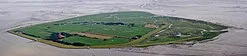
In this aerial picture, the island Neuwerk appears in green.
Because the Elbe was vital to Hamburg, a member of the Hanseatic League, the city's merchants with those from Bremen and Stade obtained the permission (a deed of 24 April 1286[3]) from Albert II, Duke of Saxony and his minor nephews Albert III, Eric I and John II, altogether co-ruling feudal lords of the Land of Hadeln of which Neuwerk formed a part then, to maintain a permanent fire on a mud flat island, then named O or Nige O, in the mouth of the Elbe.[4]
On 1 November 1299 Albert III and John II allowed the Hamburg and other seafaring merchants to build a fortified tower, named the new work (Neuwerk).[5] Right after work commenced on a 35-metre-high (115 ft) watchtower that could act as a daymark; the tower was completed in 1310.[6] After its completion, an alderman and ten men-at-arms seized the tower. The oldest existing document that mentions Neuwerk is a Frisian contract of 1316. This document uses the island's old name of Nige O.
The current tower dates to 1367, 1369, or 1377 (accounts vary), built after a fire destroyed its wooden predecessor. The tower is Hamburg's oldest existing building as well as the last remainder of Hamburg's fortifications.
In 1648 the tower received a beacon fire that was lit at night. The tower was converted into a lighthouse in 1814. Still, the island was the site of numerous shipwrecks.
During World War I, a shell destroyed the beacon and its signalling apparatus. On 3 September 1915 lightning struck the Zeppelin LZ 40 (L 10), causing it to crash into the North Sea near Neuwerk, with the loss of the entire 20-man crew.
Due to the Greater Hamburg Law Neuwerk became part of Prussia in 1937, and thus after World War II it became part to the new state of Lower Saxony.
In 1946 an 18 kW wind turbine, 15 metres (49 ft) in diameter, installed to economize on diesel fuel, helped power the lighthouse and residences on the island. This installation ran for around 20 years before a submarine cable to the mainland replaced it.[7]
In 1969 Hamburg waived older rights on harbour estate in Cuxhaven in favour of Neuwerk and Scharhörn.[8]