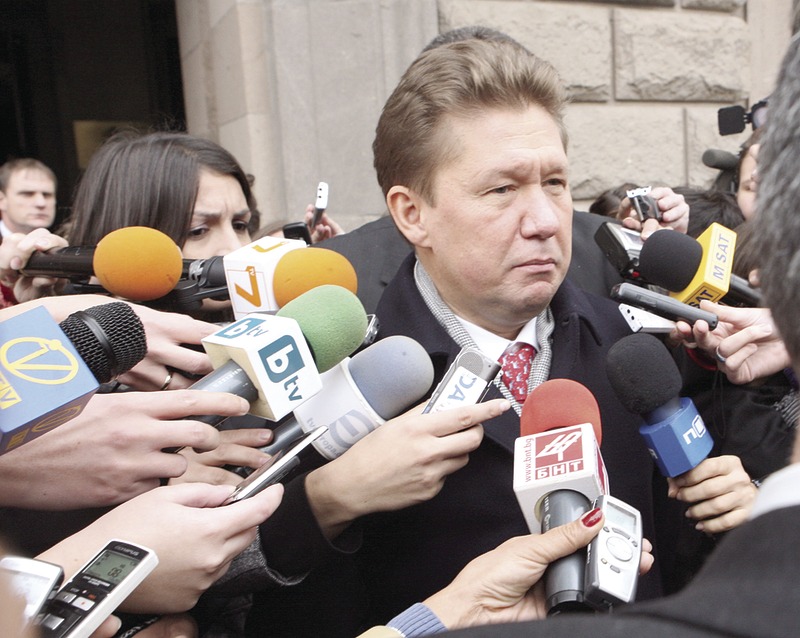
Exchange of preliminary announcements prior to the actual playing – this way we can briefly summarize the results of the few-hour visit of the Chairman of the Board of Directors of Gazprom Alexei Miller in Sofia. On February 29he met with Prime Minister Boyko Borissov, Minister of Economy and Energy Traicho Traikov and Deputy Prime Minister and Finance Minister Simeon Dyankov.
Information after the event was more than scarce, as the Russian guest chose not to make any statements to the media and left the Government Office in Sofia in good spirits. Bulgarian Prime Minister also refused to comment, but Minister of Economy, Energy and Tourism Traicho Traikov did. Bulgaria has started negotiations to reduce the current price of Russian natural gas and we expect within a month or two to have a decision on this issue, he said.
Our request is more than logical, since mid-February it became clear that Gazprom will reduce by 10% the price of blue fuel in its long-term contracts with France’s Gaz de France, German Wingas, Slovak state company SPP, and Turkish Botas. The move has been explained by increased production of shale gas in the U.S., which forced the Russian company to redirect supplies to Europe because it cannot sell more volumes overseas.
According to Mr. Traikov Bulgaria will insist that in determining the pricing formulas new trends in the calculation of the value of natural gas be taken into account. That is, it also include the component spot price that is generally by about 25% lower than those of long-term contracts, and thus reduce the dependence of as prices on crude oil. That last factor is key to reducing tariffs, as currently Gazprom tied their contracts with the oil price and it is constantly growing. Meanwhile, reserves of natural gas worldwide are several-fold larger than those of crude oil, and the extraction is not that much affected as much by political turmoil as is the case with the crisis with Iran, for example.
Our country calls for elimination of intermediaries in supply. Current contracts with the three controlled by Gazprom company – Overgas, Wintershall and Gazprom Export shall expire at the end of 2012. The future supply contracts should be directly between Gazprom Export and Bulgargaz, said Traykov.
According to information obtained by the BANKER, the talks with Mr. Miller included the issue of flexibility in supply. Originally, the intended duration of the contract with the gas giant was until 2030, but then very reasonable arguments were brought up as to it limitation in view of the developing gas system interconnections with Greece and Romania, the planned ones with Serbia and Turkey and the agreed with Azerbaijan 1 billion cubic meters of natural gas annually. The final decision on how many years the contract is to be, will depend on the price achieved in talks with Gazprom.