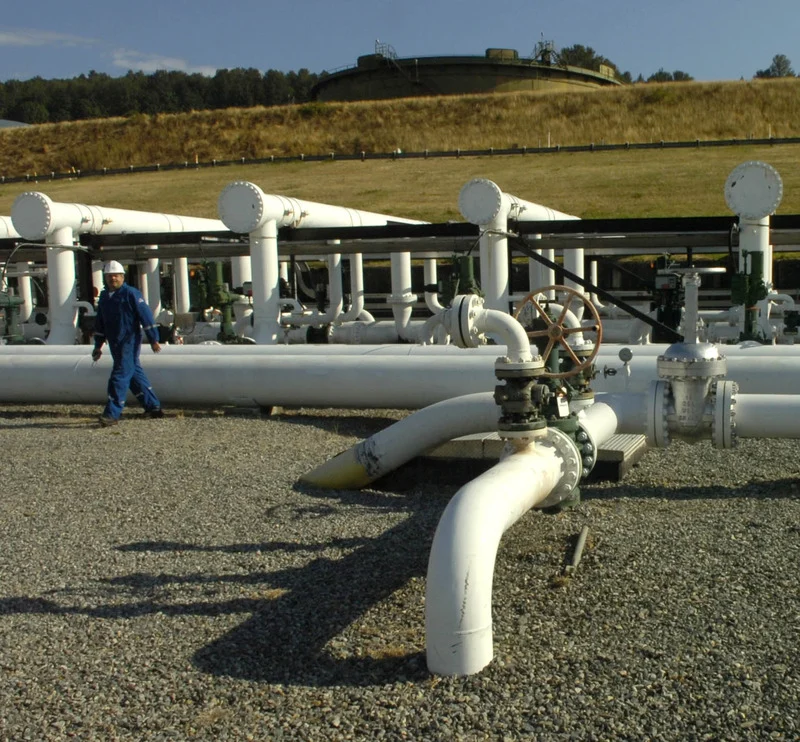
Having decided to speed up the weak absorption of EU funds under the Operational Programme Environment with the purchase of trams and trolley buses, the Government will apply the same approach for the other stagnant programme – Competitiveness. The only difference is that instead of vehicles this time money will be spent on gas infrastructure. Several days ago the managing authority of the programme for small businesses invited the Ministry of Economy, Energy and Tourism to submit a project proposal to obtain grants of more than 93.8 million levs to build a gas connection with Serbia. The later is quite a strange situation, provided that the governing body is a Directorate at the Ministry it intends to give money to.
For purchase and appropriation of land through which the pipeline will pass, is provided a sum equal to 10% of the total eligible project costs, or about 9.3 million levs. The rest of the funds will be used to acquire limited property rights and easements, preparing and obtaining the necessary documentation for the design, construction and commissioning of the facility, including feasibility studies, construction supervision, and even preview and publicity for the initiative.
Originally pipeline to Serbia was to be financed under the programme Regional Development, but at the end of last year its Monitoring Committee decided that the project had been delayed too much. Experts of Minister Liliana Pavlova were adamant that there is a risk that the money iunder it – about 60 million euro may not be spent until 2013, and so they preferred to redirect it to other activities. This hot potato was transferred to the Ministry of Economy and Energy, and it in turn saw a way out in the Priority Axis 2 of the Competitiveness – Increasing efficiency of enterprises and promoting supportive business environment.
Interestingly, at the beginning of 2012, i.e. long before it was clear whether there will be funding for the pipeline, the Energy Ministry signed a feasibility study with Gastec BG AD. The majority shareholder of the company is Overgas Holding, which in turn stands behind the Russian Gazprom. The Gastec was given a maximum of 12 months in which to make the necessary analysis and present at least three options for the route of the gas pipeline connecting our territory scheme for natural gas transmission and location of technological platforms. The company had to examine the applicable legislation in Bulgaria and Serbia, as well as at European level to establish the project scope and evaluate its financial performance and preliminary timetable for the implementation of different versions of the route. The company was also charged with the commitment to assess the cost-benefit analyzes to existing gas connections and capabilities of the transmission system to develop management activities of the project and assess the environmental impact as well as potential commercial interest. To do this it had to get 1,344,400 levs, but obviously the money is yet to be paid.
It’s very controversial to what extent such a pipelime will improve the business environment in the country. Just because it will not help in any way to diversify Bulgaria’s gas supply. Serbia receives mainly Russian gas (through Hungary) and has no terminal for liquefied natural gas. Therefore Bulgarian-Serbian connection will actually be one-way – from Bulgaria to our neighbors and it will still transfer only Russian fuel.
However the idea of ??a gas connection to Nis dates back to 1998, when a contract with Gazprom was signed. In the contract the Russians promised an additional annex to specify the actual size of the building and the transit fee to allow Bulgargaz to finance the facility. Such annex was never concluded, but the project is ready. It was developed by Topenergy and after the liquidation of the company – upgraded by Overgas. Now, though it primarily serves the interests of Gazprom and Serbia, it will be implemented with EU money. During the week, the Minister of Economy, Energy and Tourism Delian Dobrev confirmed that the contract for the construction of the Interconnector between Dupnitsa and Nis will be signed by the end of the year. But the actual construction will begin in 2013 or 2014. The pipe’s length on the Bulgarian territory is 50 km and the remaining 100 km are in Serbia. After completion it will be able to carry 2 billion cubic meters of natural gas annually.
Another question is whether the implementation of the initiative will fit within the terms of the operational programme Competitiveness and if it will be able to absorb the money for it.
The BANKER