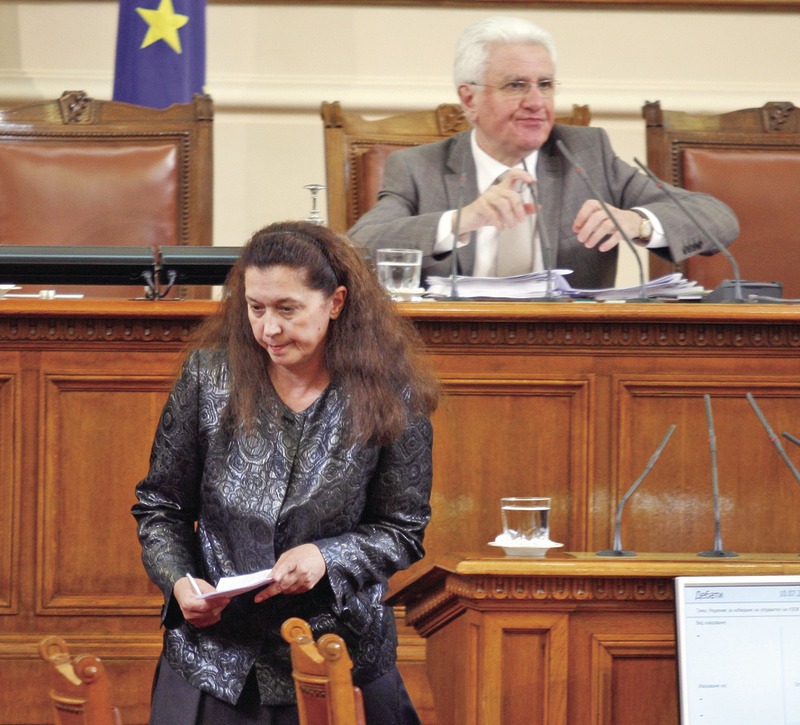
The spending on the National Health Insurance Fund (NHIF) has been so far more difficult to decipher even than the criminal mysteries of Alfred Hitchcock. The new manager of the institution, Dr. Rumyana Todorova lost herself in the figures, though it has been two weeks now of her digging through the reports and paperwork left by her predecessor Dr. Plamen Cekov. She first said that the deficit was to be expected at a level of between 50 million and 100 million levs in late 2013, and subsequently the amount climbed to 140 million levs. It is not known whether the gap will remain if the Fund decides to spend the operational reserves of 269 million levs, or the reserve will just cover the deficit for the first half of the year. Obviously there is chaos in the institution and the ratio pledged by the Supervisory Board between revenues and expenses in the budget of the institution is an abstract quantity which has no connection with reality. This is because the errors are systematic and are embedded at all levels. Even the best financial experts will stumble in the healthcare insurance sector if the country fails to change the rules of the game.
For a start the Fund cannot function as a budget appendage that serves the interests of the government. Hardly anybody would be talking of any deficit, if the former Finance Minister Simeon Dyankov hadn’t nationalized 1.4 billion levs of people’s health insurance. Nobody knows what this money was spent on. The state, however, turns to be
the worst villain for the health fund
also for other accumulated sins. For example, with the pension increase between 2.2% and 9.8% since the beginning of 2013 the health insurance contributions for pensioners had to bring in an extra 40 million levs to the fund, which is a sum not reflected in the budget. Former Parliament had adopted amendments to the health insurance act by which the contribution for the children jumped from 4 to 8% of the minimum wage, or by 33 levs per capita. As calculated by the Bulgarian Medical Association, for one million children in the country this is an amount of about 270 million levs, and also having in mind students and other categories of persons whose contributions increased after January 1, the income of the fund should have increased by about 400 million levs. But that of course did not happen. Furthermore, the over-collected in 2011 and 2012 health insurance contributions for a total of 89 million levs disappeared somewhere. Under the guidance of doctors the money is locked in a zero-interest accounts at the Central Bank. It turns out that the Government has been most unfair to the Fund and only for the last two or three years it harmed the health fund with 2 billion levs.
Due to poor control and an absurd system of hospital care financing, the only winners are suppliers of drugs and GPs. With recent changes to the Law on Health Insurance the sole governing body of the health insurance institution remained the Supervisory Board. Some members of supervision (for example, unionist Ivan Kokalov) have repeatedly complained that
decisions or changes in the budget
of the institution are just dropped from above without even clarification around them. It’s not normal if NHIF does not know what the collection of health insurance contributions is at a certain moment. This is information crucial to planning their budget, and cannot be only for internal use by the National Revenue Agency. Moreover, the management of the fund is forced to operate in the dark because the institution lacks a professional Statistical and Intelligence Unit, which to summarize the results of numerous other inspections the inspectorate takes.
Once managers of large hospitals received tenders for medicines, the prices of some drugs soared several-fold, yet without having anybody to blame. Logically, in this reality for the first six months of 2013 from the 107 million levs provided for cancer drugs, what is already spent comes to 70 million. Here also comes an inadequate planning and a lack of financial control. A total of 3,000 new cancer patients were reported, but no one can say whether this figure is real. What has also increased is the average hospital costs for treating a patient from 718 levs per stay in 2012 to 826 levs in early 2013, while officially medications did not appreciate over this period.
The BANKER