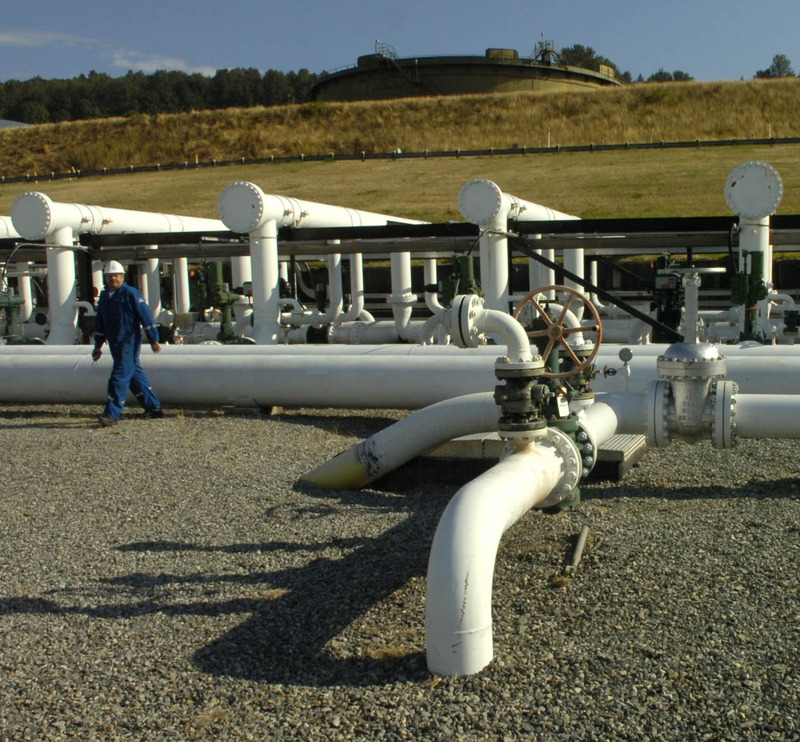
Just days after the Government announced that it has agreed with Gazprom the construction of the gas pipeline South Stream, the big political game around it began. President Rosen Plevneliev said he was not aware of the parameters of the contract and did not know if there was a contract at all. I deeply hope that apart from the existence of a contract, there is a fully transparent and market-based approach, which unfortunately I do not currently see in the terms of this project, and my advice is for a little more transparency. The reform in energy sector has not started yet, Mr. Plevneliev said.
Against the deal on the South Stream were rightist forces that remained outside Parliament in the polls this spring. According to the Democrats for Strong Bulgaria (DSB), the Bulgarian government just gave Bulgariarquote s energy sovereignty to the Russians. The party made ??a parallel between the South Stream and Belene project. The first turning of the sod was made without a signed contract just as it was done for the second nuclear plant in Belene and the national electricity company NEK borrowed 500 million euros. In the same manner the French bank Paribas provided a loan to the Bulgarian Energy Holding (BEH) more than 1 billion euros and the construction has not yet started. This way the holding now has an aggregate debt of 2.2 billion levs and is likely to be facing financial ruin and bankruptcy, which means bankruptcy for the countryrquote s entire energy sector, said Ivan Ivanov. He also stated that for one year the expected revenue from the South Stream will be 90 million euros from fees, provided that the country now earns 100 million euros fees. DSB also recalled that as a member of the European Union Bulgaria is obliged to request
a change in the agreement for the construction
the pipeline, eliminating the option Gazprom to be using 100% of the pipelinerquote s capacity.
Criticism was expressed by former Energy Minister Traycho Traykov: Currently, we are offered a poison pill with a colored sugar coating. The coating are the attractive interest rates of the contracted loan and the contractual terms providing compensation that a stretch of 90 km from the Romanian border to Provadia will become redundant. However, to be able to draw conclusions, we need to see the documents. The poison is the idea for this ridiculously high price for construction. The price is very high in comparison to what was talked about before, and also compared to similar pipelines in Europe that are pending to be built. We are told that this would be the real price. But at this price, the project becomes cost ineffective. The second problem is that the loan of 620 million euros will be taken by BEH, and not by the project company, as previously thought. So whether there will be dividends from the project company or not, BEH will have to pay the loan , said Traykov.
This whole political turmoil around the project possibly hid something very important around the South Stream project there will be many lucrative portions to be distributed.
On the day of the meeting between the Bulgarian and the Russian side in Sofia a competition for the detailed design was announced, as well as for procurement of equipment and materials, construction activities, staff training and putting into exploitation of the pipeline on Bulgarian territory. The agreement allegedly reached with Gazprom was that many of the activities in Bulgaria are to be performed by Bulgarian companies, which would possibly give a huge employment boost. The projected pipeline passes through municipalities that have high unemployment rate. Here, we will create jobs not only for the people of these communities, but also for some Bulgarian companies, which are currently in a very difficult situation , said Minister Stoynev, but did not specify what proportion of the work will be given to Bulgarian companies.
Formal agreements between the Bulgarian Energy Holding and Gazprom dating back to the Cabinet of GERB asked for local participation of at least 30 % of the construction works of the pipe through Bulgarian territory. This means that the updated investment of 3.5 billion euros will leave around 1 billion euros in orders to Bulgarian companies. And the main question here, as usually, is which companies would be selected?
The former leader of the youth organization of the Movement for Rights and Freedoms (MRF) Korman Ismailov signaled that
the distribution of shares has already begun.
On Wednesday (November 6th) in front of one of the national television channels he linked the withdrawal of Hristo Bisserov from his key positions in the party precisely with the start of the pipeline, suggesting that firms close to the political figures of the party had interest in the project. Former leader Dogan said quite frankly that around the party there are circles of companies, projects, consultants and subcontractors. If other players enter the project, MRF may remain aside from the lucrative pies.
Such an argument makes sense, since the route of the pipeline will pass through a number of municipalities in northeastern Bulgaria, where the compact electorate of the MRF lives. It suffices to mention the case of the water supply system Tsankov Kamak built in the Rhodopes with the active assistance of Mr. Dogan who received the impressive fee of 1 million levs. Most experts suggest that the favorite firm in an auction for the South Stream would be Gasstroymontaj. It was established in 1971 as a company specializing in the construction of high pressure gas pipelines. In the late 1990’s Multigroup holding made ??an unsuccessful attempt to privatize the company and back then the firm was linked to former blue Deputy Prime Minister Evgeniy Bakardzhiev and his circles. At the end of 1990s – 33% of Gasstroymontaj became property of MG Elite holding through mass privatization, 53.4% ??was bought by RMD Gazstroy and 13.6% were open for preferential purchase by employees. In 2002 the company became a 100% private limited company. According to the Commercial Register at the time majority stake is held by Borislav Zakov as a representative of Gazstroy JSC.
Insiders believe the other big candidate to take part in the building of the pipeline is Glavbolgarstroy. The company owned by Simeon Peshov can even boast experience in this area. In April, it won the contract for modernization of four compressor stations of Bulgartransgas over the next three years, which is a project estimated to cost nearly 104 million.
The BANKER