For fifteen years there have been talks in Bulgaria for building a catastrophic pool, but there has been no progress on the issue. Perhaps this is because its construction is still imagined to be done from top to bottom: the state gives guarantees and insurers join efforts.
An initiative to create a stable catastrophic pool was launched by lawmaker from the leftist Coalition for Bulgaria Dimtcho Mihalevski. For this purpose, the first step has already been taken, but we need at least two more, said the chairman of the parliamentary Committee for Regional Development Mihalevski specifically for the BANKER.
According to Mihalevski the new seismic map of Bulgaria is now ready, which states in which localities how big the risk of an earthquake is and of what degree. In 2007, during the tripartite coalition a seismic map of the country was commissioned to be prepared. This was a job of the Geophysical Institute. After three years of work and 3 million levs spent, it resulted a thorough study of 500 pages whose core is the updated seismic map of Bulgaria, said Mihalevski. On this solid basis, then the country will be regionalized, the risk zones will be outlined and the system to cover damages from catastrophic risks will be created.
It’s about a system that covers residential buildings throughout Bulgaria. Insurances will be sold by private insurers, they will be left with a minimum percentage commission and the money will go into a state fund, says Mihalevski. The idea is that the insurance will be obligatory, but this idea must be supported by the public before implementing, he said. Mihalevski offered the price of the insurances to be a small percentage of the property value so that it may be affordable for people.
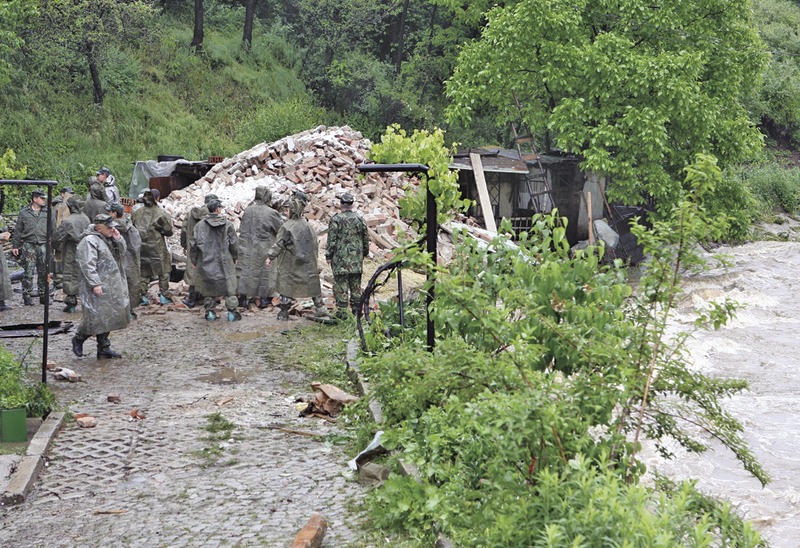
Stoyan Prodanov, Deputy Chairman of the Board and CEO Bul Ins, said he was a staunch supporter of the idea. He recommended the Romanian model. Romanian catastrophe insurance pool was established in 2008 by the World Bank. Its core is the conversion of residential property insurance into a mandatory one (subject to minimum levels). This will solve two questions. One relates to the fact that such a steady scheme will easily cover damages such as in the village of Biser, and even larger. On the other hand, the proliferation of this important insurance will jump from 7-8 percent, as it is now, to at least 30-40 percent. The experience of Romania has shown it endash in the first year the proliferation of property insurances have jumped to 40 percent and later reached 70 percent.
The insurance companies participating in the catastrophic pool in Romania gain a share of the pool and then sell their policies to their customers. Because at the beginning the amount of accumulated funds is not huge, the pool itself is reinsured and the re-insurer pays if a disaster happens. According to Prof. Prodanov a minimum mandatory policy will not be well accepted if it exceeds 20 levs. According to him, except earthquakes, floods and landslide the risk should cover also drought.
Tsvetanka Krumova CEO of Armeetz, however, is of the opposite opinion. She thinks that the country needs to carefully assess dangerous areas – houses in riverbeds or in the zone of the retaining walls of dams, in earthquake or landslide zones. Namely the owners of buildings in such areas should be in focus, because there are major risks for them and for the country as a potential payer of damages. Krumova made a rational proposal endash to implement tax incentives for people who insure their homes, including against catastrophic risks. According to her, this could happen as a rebate of the property tax.
If Bulgaria should do something Krumova says she supported the French model. There, 90 percent of people have insured their properties. The French state actively participates and controls the process through reinsurance. This is done when each insurer pays part of the premium to a special fund to cover catastrophic risks.
Among the hottest fans of catastrophic pool is Lev Ins. According to its representatives it is the exactly catastrophic policies that should be at the heart of the property insurance of buildings, which should be mandatory and cost not more than 20-30 levs per year. To it the current insurance Home may be tied and it should remain voluntary. What should be clearly described are the limits of liability and coverage as well as the minimum levels of a basic premium, which may be acceptable to all citizens. This could be the only way how the nature of this scheme may not be distorted and the proliferation of this type of insurance on the Bulgarian market may be lifted.
Borislav Bogoev, Vice President of the Financial Supervision Commission and Head of Insurance Supervision Department, joined the above position. It is one of the fathers of the idea of ??a catastrophic pool. Bogoev believes that a catastrophic policy should be mandatory, but a voluntary insurance of the property against normal risks may be added to it if so desired by owners. He also is a supporter of the Romanian model where a catastrophic policy per year costs from 20 to 40 euros. Bogoev pointed out the seismic risk as extremely dangerous, even if it is a rare event. Our country is in one of the world’s seismic hotspots – around the Mediterranean basin, where the crestrquote s tremors are most common; we have dangerous zones in the country, and the hearth Vrantcha is very close to us, he noted.
The BANKER