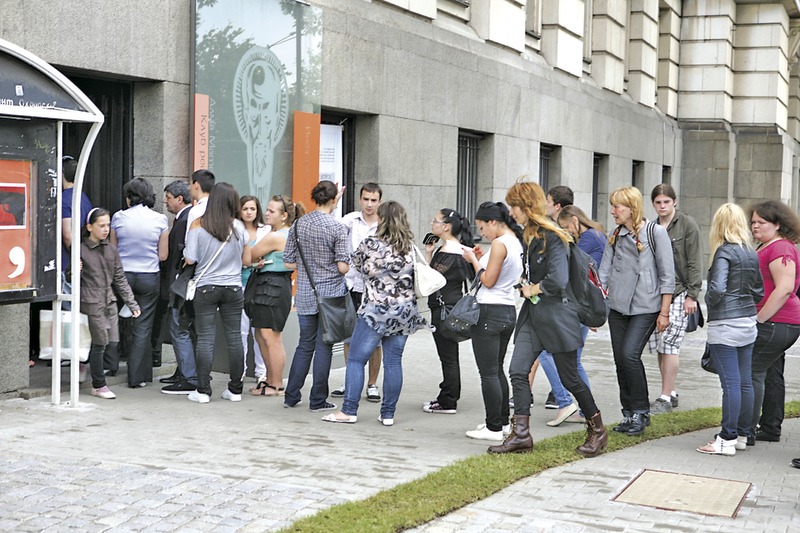
At the peak of passions around the the entrance exams, 52 public and private universities found that those who want to cross their doors progressively decrease in numbers. The graduates in 2013 did not exceed 60,000 people, while the state had opened more than 73,000 seats for admission of new students. As a result, the directors of universities were tapping nervously on their desks. In the name of His Majesty the Student the entrance criteria become less and less stringent, and still the tests are taken in half-empty halls.
In the most prestigious university – Sofia University St. Kliment Ohridski, the exam in music attracted less than 100 candidates, and the seats in the majors that require music as a test were more. It is very doubtful whether the University in Sofia will be able to fill their groups of non-market disciplines such as geography (70 people), different pedagogies (405), history (60 persons), philosophy (80 people), social activities (80 people). For the most popular law school the places are 360; 120 students will enter Bulgarian philology and 100 – English studies. In turn, for the currently more popular majors: Scandinavian studies, Korean, Chinese, Japanese Studies and Indology the overall admission for each is restricted to 12 or 20 places.
Sofia University announced just over 5000 places for all undergraduate and graduate programs. In the other two leading metropolitan universities – the one of World Economy and the Technical University, the total number of places are 7,000.
Another general problem is the tragically poor training of those who wish to enroll in higher education. Almost 50% of prospective students in Sofia University received a the lowest grade („fail“) in Bulgarian language and literature and there was not a single A achieved at the exam. Those who had to take the test were offfered two topics to choose from – „Spiritual heroism in the poetry of Pentcho Slavejkov“ or to compare quotations taken from the works of Elin Pelin and Pencho Slavejkov and a month earlier, the preliminary entry test asked them to write on Bulgarian poet of the first half of twentieth century, Vaptsarov, or another national poet, Dimtcho Debelyanov, who wrote in early twentieth century. Those exams showed some „brilliant“ achievements in sentence structure and huge factological gaps, but the majority of those who failed the exam, however, did in fact so because of tonnes of spelling errors. Many freshmen, however, will get round this situation, though, by asking the universities to take the assessments of their A-level exams.
Nevertheless the Ministry of Education is not thinking of reducing the number of universities, but even will lift four of them to higher status. Ministry of Education started a procedure to convert the status of the four colleges. These are the College of Telecommunications and Post – Sofia which will will become University of Telecommunications and Post, and the International College – Albena will be converted to specialized private Graduate School of Management – Varna. Technical College of the Southwestern University Neophyte Rilski of Blagoevgrad will become the Technical Faculty while the European College of Economics and Management in Plovdiv will be transformed into a specialized private European School of Economics and Management. Hopefully the new universities will produce a bit higher quality in education.
The BANKER