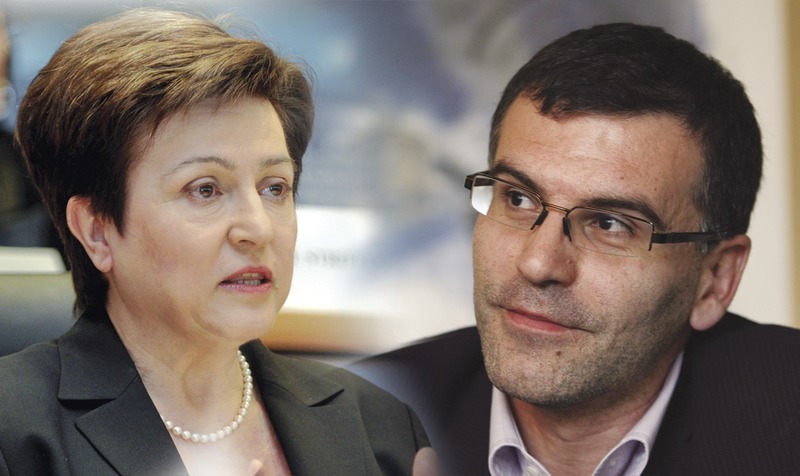
The mission of the International Monetary Fund, led by Catriona Purfield, which ended on May 9, strongly supported the guardians of the Silver Fund in the country, a participant in the talks who asked to remain anonymous told the BANKER. As is known, the Bulgarian National Bank and the Financial Supervision Commission are strongly opposed to the concept announced by Finance Minister Simeon Dyankov to spend part of the reserve for pensions purchasing state government securities. The source explained that IMF is hardly likely to issue and official position of the Fund on this controversial issue for Bulgaria, as the European Central Bank has done. ECB pointed out its considerations the legislative change thas is being mulled over in Bulgaria, but said this a matter of national and political choice.
Apparently irritated by the different opinion of the Fund, Finance Minister
Simeon Dyankov sharply criticized uts work, saying that the IMF is part of the problems causing the crisis, and not part of their solution. That is the reason why Bulgaria’s Finance Minister prefers to fund the repayment of bonds next year through a new bond issue rather than a credit line from IMF.
In an interview for the BANKER last month the President of FSC Stoyan Mavrodiev recommended that Sofia consider also negotiating a flexible credit line from IMF (the so-called. FCL), which is given only to financially sound economies. Such for an example was extended to Poland and Mexico. It could be used to increase the reserves of the country but cannot be used for payment of government debt or deficit financing. This tool is only available to low-risk countries and would contribute to enhancing the reputation of Bulgaria, increase investor confidence, reduce the country risk premium and the cost of financing when the time comes to issue debt, said Mr. Mavrodiev.
In the talks with the IMF mission, however, this issue was not raised. A source from the Central Bank told the BANKER that this happened due to lack of coordination with the Ministry of Finance and no preliminary discussion of this option. Such an agreement would mean only one thing – to put an approval sign on the country from the highest possible financial instance in the world – to the policy that we have, and this is very important for the country’s credit rating in these turbulent times, the insider commented.
Minister Dyankov believes that
Bulgaria has no need of IMF
nbsp;
because: first, the IMF is sought when you are troubled. We are very far from being troubled. We are one of the three countries with the best financial results in Europe. Second, in the last three or four years the IMF has shown many missteps with Greece, Spain, in the very thinking of what should be done to overcome the crisis. And added that the IMF now have a new general director (Editor’s note: Christine Lagarde), my former colleague, the French financial minister. I hope that things will soon improve in IMF.
The IMF delegation discussed with representatives of the government the economic development of the country and its prospects, the official information says. Meetings with experts from the Ministry of Finance, National Bank and other public and private institutions took place. In all conversations
IMF representatives were very clear that the country should
keep its stability, and enhance structural reforms,
said insiders .Mrs . Purfield confirmed the latest forecast of the Fund of December 2011, when the previous mission to the country took place, that Bulgaria would report economic growth of 0.8 percent in 2012 and 1.5 percent in 2013.
A year ago Purfield recommend that Sofia find a balance between the needs and opportunities on the labour market, go on with the administrative reform and work hard in areas like health, education and pension reform. In May last year during the Fund’s Spring Mission Mrs. Prurfield said that for Bulgaria it is very important to sustain its deficit within 2.5 percent by the end of 2011 in order not to enter an excessive deficit procedure. Back then the fund said it expected inflation this year to exceed 4% (annual average) because of high food and fuel prices. Among the Fund’s forecasts was also a 3 percent GDP growth for the year, driven mainly by exports.
The budget deficit for 2011 was 2.1 percent of the gross domestic product (GDP), which was below the forecast of the IMF. The average annual inflation for 2011 was 4.2 percent, which is within the provisions of the Fund and the gross domestic product (GDP) of Bulgaria for 2011 increased by 1.7 percent compared to 2010, which is about the half of what IMF expected as increase.
Now Mrs. Purfield noted that Bulgaria is among the top three according to share of nonperforming loans in the European Union. However, the country is among the leaders in terms of the indicator measuring thhe system’s stability – the capital adequacy ratio. The volume of arrears of over 90 days in the country’s banking system is at the average level for Central and Eastern Europe. The share of nonperforming loans is 14.9 percent of total loans. The level is similar to that in Romania, Greece and Ireland. Latvia and Lithuania show bigger share of unserviced credits.