Balkan railway part of Chinese 'express lane' to Europe
Published: 18/12/2014 – 11:07

Passengers board train in newly build Guangzhou South station, China [Shutterstock]
Serbia said on Wednesday (17 December) it expected Chinese construction of a new rail link between Belgrade and Budapest to begin by mid-2015, part of Beijing's strategy to accelerate the flow of goods into Europe through the Balkans.
China, Serbia and Hungary signed a memorandum of understanding on the 370 km rail route on the second day of a summit in Belgrade between China and 16 central and eastern European states.
Serbia also sealed a $600-million loan deal with China Exim Bank for the construction of a new power plant.
"This will put in place a corridor between China and Europe," Chinese Premier Li Keqiang said of the Belgrade-Budapest rail link. "With more such express lanes, the scale of our trade will be greater. We are confident we will complete this within two years."
The rail upgrade fits with a Chinese plan to turn Greece's main port of Piraeus – where Chinese shipping giant Cosco Pacific holds a 35-year concession to upgrade and run two container cargo piers – into a regional trade hub.
The rail programme was first agreed last year, but it remains unclear how it will be financed.
Serbian Prime Minister Aleksandar Vucic said a feasibility study and other paperwork would be finalised by June 2015, "so that the railway could be built by June 2017".
"We are dedicated to this project," he said following talks with his Hungarian counterpart, Viktor Orbán, adding the upgrade would cut train travel times between Belgrade and Budapest from eight hours to under three.
Gateway to the EU
China sees central and eastern Europe, comprising the EU's newest members and others in the Western Balkans that aim to join the bloc, as a potentially lucrative market and bridgehead to the wider EU, drawn by relatively low wages, an educated workforce and scope for further development.
>> Read: China seeks gateway to EU via cash-strapped Balkans
Also on Wednesday, Serbia and China inked a loan deal from China Exim Bank for the construction of a $715-million, 350-megawatt coal-fired power plant, the first to be built in the former Yugoslav republic in 25 years.
The project, which includes expansion of a coal mine supplying the plant, will be financed with a $608 million, 20-year loan at an interest rate of 2.5 percent and grace period of seven years, an energy ministry official told Reuters.
Serbia's state power utility EPS will pay for the rest.
The new plant, within Serbia's second largest coal-fired complex of Kostolac, is slated to come online in 2019.
China 'to knock on EU's door' with US$3b central and eastern Europe investment fund
Li Keqiang pledges to increase trade links during trip to region. He will also ratify deal for Chinese-built rail link from Serbia to Hungary
PUBLISHED : Wednesday, 17 December, 2014, 10:58am
UPDATED : Thursday, 18 December, 2014, 4:44am

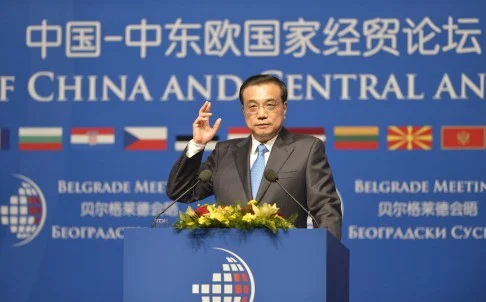
Premier Li Keqiang addresses the summit of central and eastern European leaders in Belgrade yesterday. Photo: Xinhua
China said yesterday that it would create a new US$3 billion investment fund focusing on central and eastern Europe, a move that will strengthen its foothold in the region as a door to the wider European Union.
During a three-day visit to the Serbian capital, Belgrade, Premier Li Keqiang is also expected to ratify a deal with Hungary and Serbia for Chinese construction of a high-speed rail link between Belgrade and Budapest.
The mainland regards central and eastern Europe as a potentially lucrative market and bridgehead to the wider EU, drawn by relatively low wages, educated workforces and scope for development on the fringes of the bloc.
Chinese investment in the region usually comes in the form of loans financed by China's state-owned banks for projects carried out by Chinese companies, particularly in the infrastructure and energy sectors.
Li, however, told a summit in Belgrade, attended by the leaders of 16 central and eastern European countries, that China was open to "new models of financing and investment".
"We expect new ways of cooperation through private-public partnerships, various leasing arrangements, and that will make our cooperation more efficient, more productive," he said.
Li said closer ties would bring massive Chinese investment and open up large markets in China for central and eastern European goods.
He sought to alleviate fears voiced from some within the EU that China's regional deals could contravene the 28-nation bloc's strict financial and trade rules.
The timing of the China summit, the third in as many years, is significant as it comes while Russia, the traditional regional powerbroker, is struggling with deep economic problems caused partly by crippling Western sanctions over Moscow's role in Ukraine.
"The difference between the Russian and Chinese approach in the region is that Russians are more political, while Chinese are more commercial," Miroslav Prokopijevic, a Serbian economy analyst, said.
Unlike Moscow, which is applying a combination of economic and political pressure on the region's governments, Beijing sees its increased economic influence in the area as a chance to boost ties with the EU.
Zhang Jianrong, a Russian affairs specialist at the Shanghai Academy of Social Sciences, said the US$3 billion fund was part of Beijing's attempts to boost trade in the region.
But he said US$3 billion was not a significant amount compared with other Chinese investment funds in other areas of the world.
"It's a goodwill gesture that China wants to cooperate with the region, but I don't expect many large projects will come out of it," Zhang said.
Reuters, Associated Press
This article appeared in the South China Morning Post print edition as China unveils US$3 b fund for eastern Europe
Premier Li Keqiang is meeting 16 central and eastern European leaders at a summit to cement Beijing's plans for a new transport network to funnel exports into Europe.
Infrastructure and transport top the agenda of the two-day meeting that ends today in Belgrade.
Beijing hopes to turn the Greek port of Piraeus – where the Chinese shipping giant Cosco has a 35-year concession to hugely expand its two container terminals – into a new hub for trade with Europe.
Despite being hit hard by the economic crisis, Greece still has the world's largest merchant marine fleet, and China is one of its key customers.
Li discussed investment in Greece's crumbling railways during a visit to Athens in August, including a high-speed rail project.
"We will propose construction of a rapid land and maritime route based on the Budapest-Belgrade railroad and the Greek port of Piraeus to improve regional connectivity," Li told Serbian media ahead of the summit in Belgrade.
The signing of a deal for a high-speed bullet train link between Budapest and Belgrade, to be built by 2017, with Li's Hungarian and Serbian counterparts, Viktor Orban and Aleksandar Vucic, is the centrepiece of the gathering. "We will set a mid-term agenda to define our future cooperation and present financial measures that will facilitate it," Li said.
Beijing said it was interested in investing in energy, agriculture and industry as well as infrastructure projects in the 16 countries.
Trade between China and the region, which has expanded five-fold since 2003, is also on the agenda. Commerce Minister Gao Hucheng said trade with the region could exceed US$60 billion this year, up US$4.9 billion on last year.
Some countries, including Poland, hope to increase exports to China after Russia banned food imports in retaliation for EU sanctions over Moscow's role in the Ukrainian conflict.
"We hope to sell a lot of Polish food to China because we have problems with Russia right now and Russia was rather a huge market for Polish fruit, vegetables and meat," Professor Bogdan Goralczyk, of the Central & Eastern Europe Development Institute, said.
This article appeared in the South China Morning Post print edition as Li in Belgrade to back plans for new trade hub
China seeks gateway to EU via cash-strapped Balkans
inShare3
Published: 16/12/2014 – 07:25 | Updated: 16/12/2014 – 13:03

Belgrade is due for a railway upgrade. [Hunter Desportes/flickr]
China is preparing a fresh investment push into central and eastern Europe, promising more than $10 billion in loans for energy and infrastructure projects to be discussed in Belgrade this week.
China is seeking a new foothold on the continent, outside the European Union, under a strategy adopted in 2012.
Prime Minister Li Keqiang arrives in Belgrade late on Monday for a four-day visit and will meet leaders of 16 European countries, all hoping to attract funding. The focus will be on the Balkans.
"The Balkans is a very interesting region (for China)," said Kalman Kalotay, an economist for the United Nations Conference on Trade and Development (UNCTAD) in Geneva. "It is a gateway to the European Union but not yet in the EU and the EU rules don't apply," he said.
Investments in the region so far have offered double benefits for China: they are financed with loans from China's state-owned banks and Chinese companies are invariably picked to carry out the works.
But as debt levels across the region grow, some countries say they will be looking for alternatives.
"Serbia will try to agree some other way of financing, for example concessions," Deputy Prime Minister Zorana Mihajlovic told B92 television on Sunday.
China's Prime Minister Keqiang told Croatia's Jutarnji List on Monday the focus was infrastructure and energy development.
Projects "like the Stanari thermal powerplant in Bosnia, Mihajlo Pupin bridge in Belgrade, Bar-Boljare motorway in Montenegro and Budapest-Belgrade railway, will certainly promote local development and benefit the local population," Keqiang said.
Since 2010, $1.75 billion of Chinese money has gone into projects in Serbia, including construction of a coal-fired power plant, a bridge over the Danube in Belgrade and a stretch of motorway.
Neighbouring Bosnia has agreed projects worth a total 1.4 billion euros to be financed by China. Montenegro, another former Yugoslav republic, chose a Chinese company to build an 800-million-euro stretch of a motorway linking it with its northern neighbour Serbia.
Two Chinese companies are among the top bidders to build a coal powerplant in Montenegro.
"We feel we have a powerful and reliable partner in China," Serbian Prime Minister Aleksandar Vucic wrote in an article for the Tanjug news agency on Sunday.
One major project expected to be ratified at the meeting is a 2 billion euro fast rail track between Belgrade and Hungary's capital Budapest, which would help China boost trade with Europe.
Positions:
The CEE Bankwatch Network has published a press release, noting that most coal plants that the Chinese want to invest in across the Balkans have serious issues related to environmental permitting, pollution standards, tender procedures, etc.
Claudia Ciobanu of CEE Bankwatch told EurActiv that it's worth looking better at how these projects look before celebrating their growth potential, especially now that we have the Sostanj debacle to prove what can go wrong.
“The latest revelations show that it's time to stop treating the lignite sector as a holy cow which will save our economies”, said Igor Kalaba of Center for Environment. “When subjected to closer analysis, it is revealed that lignite is no longer a driver of our economy but a drain on it. The last thing we need is another case like the Sostanj plant in Slovenia which is predicted to lose EUR 70-80 million annually and is only employing a fraction of the people predicted”, he added.