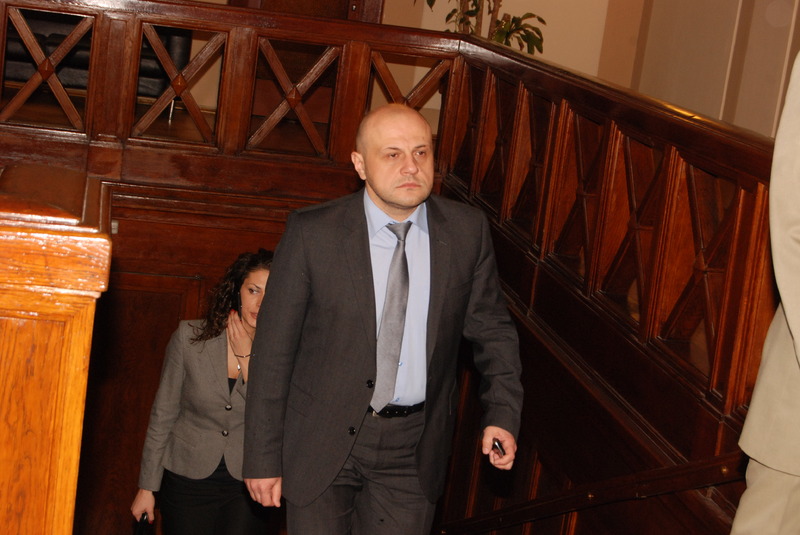
Repeated promises by government and especially by the Minister responsible for EU funds, Tomislav Donchev, that by the end of 2011 and will absorb at least 20% of money available through operational programmes have not been met. Official data are already available and no excuses can hide the fact that targets have not been achieved.
The Information System Management and Monitoring of EU Funds shows that on 1 January 2012 the actually disbursed amounts were only BGN2,965,412,401, or 18.91% of the total budget of the OPs, which is approximately EUR15.7 billion. True, accumulated money is almost twice as high as those accumulated a year earlier, but remained below three billion, which was declared mandatory by the Minister Donchev.
Not as good as we have been promised, is going on the negotiating of grant financing. Just two years before the deadline the combined value of signed contracts accounts for about 65% of the funds, while the rest they need to announce procedures, then to approve projects, sign contracts, and select contractors …
Apart from the lack of quality projects among
reasons for the slow progress are still
nbsp;
the sluggish and incompetent officials, who according to a study of the NGO Coalition for Sustainable Development are the main obstacle to the money from the European Union. Despite the reforms, procedures continue to be unnecessarily complicated, and the administration is generally uncooperative.
Similar is the general opinion of businesses. Representatives of the Bulgarian Industrial Association have repeatedly indicated that the biggest problem are the difficult procedures requiring large volumes of documentation when applying for and reporting of EU projects. Trouble also create delays in payment, provision of financing, unclear instructions to the administration, lack of transparency in the evaluation of projects and controversial texts in the regulations allowing for different interpretations.
The good news is that the state finally seems to have found out what the problem it about, and a week ago promised to significantly reduce bureaucracy and facilitate access to funds. According to Minister Donchev, there is already a plan to eliminate the so-called intermediate bodies in the adoption and approving of projects under the Operational Programmes. The bad thing is that reform can only happen after 2014 but since the current rules are approved by the EU and it is difficult to change them en passant.
Furthermore this way it will
save much money.
nbsp;
All officers involved in them receive double pay for their work with EU funds, but their wages do not depend on the quality or quantity of their work.
It is almost certain that in the next programming period we will not need the intermediate structures, because their value is questionable, but the procedures are slow. The projects will be considered by the governing body and it will significantly speed up their processing, as now actually our work is duplicated, said Tomislav Donchev. Institutions that are now in the role of intermediate bodies, the Agency for Promotion of Small and Medium Enterprises will continue to exist, but will perform only basic functions .
In fact, it is the officials in that agency, which is an intermediate unit under the Competitiveness programme, who are among the most criticized ones. And it is hardly an accidental fact, since this is the programme to have recorded the greatest number of failed business projects – over a quarter of companies do not fully implement the signed agreements due to late payments and other obstacles. At the same time, if we look only to statistical data, it appears that the Competitiveness is doing extremely well. By the end of 2011 it disbursed over BGN531.6 million or 23.4% of the entire EUR2.27 billion. What reached companies, however, is only about BGN130 million. The reason for the drastic difference is that the total includes BGN400 million under the Jeremy tool learned from the European Investment Fund and recently granted in the form of loans to be returned, rather than grants.
Certainly last year
the best pace was registered by the Transport Programme.
Starting from the last place in termes of money disbursed in 2009 now it is at the top with BGN888.3 million (22.67% of budget). The fact that about 670 million of it were used only in 2011 is indicative. Otherwise, most funds – BGN457.4 million, were received by municipal company of the capital, Metropolitan, which builds an underground railway. It has two approved projects totalling BGN 1.5 billion, so that revenues in the coming months will inevitably increase. However, the deadline for completion of the second metro line in Sofia and corresponding payments on previous work, is this spring.
Another big share of funds under the Transport – BGN249 million has gone to completion of the Trakia highway. For new lots of Maritza, whose construction began last summer, funds the have been utilized reached BGN43.7 million, while payments for the modernization of the railway line Plovdiv-Burgas have reached BGN50 million.
Expectations to the Transport Programme are still high. Besides the listed sites what is yet to be received are two tranches under two other major projects – the reconstruction of the railway line Plovdiv-September and Struma highway, whose total value is over BGN1.3 billion.
Well presented was also the
Regional Development programme.
nbsp;
In 2011 what was paid here increased almost two-fold as compared to the previous year – up to BGN633 million, and already passed the 20-percent-threshold of the total. But the greatest contribution (64.5 million) for this result is a financial agreement between the Government and the European Investment Bank under The European Joint Undertaking for Sustainable Investment in City Areas (JESSICA).