
Митът за независимите централни банки
Въпреки инфлацията е време за инвестиционна предпазливост, не за паника
За да се осъществят правилните инвестиции в този разкъсван от пандемията свят, трябва да се изечават правилно политиките на основните централни банки.
Федералният резерв поведе спасителна акция от пораженията на вируса през март 2020-а. "Бенк ъф Джъпен" и Европейската централна банка станаха важни източници на подкрепа за финансовите пазари и икономиките. Народната банка на Китай следваше по-стриктна политика от останалите си колежки, избягвайки рецесия. Но пък акциите на китайските компании, както се очакваше, бяха ударени от по-скъпите пари и от атаките срещу сектори като недвижимите имоти.
Покупките на облигации и ниските лихвени проценти подкрепиха инструментите с фиксиран доход и насочиха инвеститорите към акциите с по-висока доходност, които изглеждаха по-евтини в сравнение с постната и дори отрицателна възвръщаемост на облигациите.
Така се стигна до днешните високи цени на борсовите индекси, които до голяма степен се дължат на решенията на централните банки да орежат лихвите, за да знаводнят с кеш пазарите на активи и да поддържат ниски дългосрочните кредитни разходи. Именно Федералният резерв реши да налее над 3 трлн. щ. долара, за да компенсира черната дупка на карантините, което стимулира инвестициите на фондовите борси от лятото на 2020-а в очакване на рязкото им възстановяване с всичките тези средства.
С наближиване на края на годината, въпросът е дали централните банкери ще изтеглят стимулите прекалено бързо за вкуса на пазарите, за да върнат в бутилката духа на инфлацията, който пуснаха на свобода. Засега инвеститорите имат добри доходи от вложенията си в акции, защото поддържа интереса в тях.
Пазарите вярват, че големите централни банки са независими и че това е правилното решение. ЕЦБ е моделирана, отчасти по подобие на Бундесбанк, съобразно идеята за независими експерти, определящи краткосрочните лихви с цел да държат инфлацията ниска. "Бенк ъф Джъпен" и Федералният резерв също имат целеви инфлационни равнища от 2% годишно.
The high noon of the idea of independent central banks providing discipline came in the first couple of decades of this century. The theory says they will be run by wise, impartial people, who understand economies and markets so well that they know when to expand money and credit and when to contract it by shifting interest rates, to keep inflation at around 2 per cent.
It is difficult to know why people believe this. After all, economies were badly scarred by the banking boom and bust, where central banks allowed commercial banks to expand credit and inflate asset values, only to stop them too abruptly in 2008 and cause banks to collapse, as well as triggering a big fall in markets and a great recession. The central banks managed to blame commercial banks for the excesses, without properly accepting their part in the boom and bust.
It has proved very hard to find these uniquely insightful people who can call it well and avoid major lurches. They are usually appointed by presidents or prime ministers with the help of finance ministers who have a political interest in the policies they follow. This year, several major central banks forecast inflation to be much lower than it turned out to be.
It is difficult to identify a fully independent central bank even during this era of fabled independence. Today we can see a trend of governments having more explicit influence.
Recep Tayyip Erdogan, Turkey’s president, flexed his power to appoint the central bank governor, seeking an appointee who will keep rates low or cut them, whatever the rate of inflation or the stresses on the currency. The People’s Bank of China makes no secret in all its statements that it sees its task as implementing the ideas and policies of president Xi Jinping and the Communist party.
The Fed itself has long had a dual mandate — to keep inflation down and to ensure decent growth. Where there is some tension between the two aims, the Fed has to make a judgment and would usually listen to the views of the administration.
Some central banks have been associated with extravagant fiscal policies. In some Latin American countries, they have been unable or unwilling to offset government excesses and ended up assisting or putting up with very high rates of inflation. Argentina and Venezuela are no great advertisements for the work of their central banks.
Joe Biden, the US president, has started to remodel the Fed, using his powers to make appointments to the board. He appears to have negotiated a policy platform for the new Fed between Jay Powell, its incumbent chair, and Lael Brainard, its newly appointed vice-chair, who wishes to move it closer to the full Democrat agenda.
The new Fed will take its duties towards net zero carbon emissions and social inclusion more seriously and may follow a tougher course against banking activities as regulator. Both the Republican-inclined chair and the Democrat vice-chair want to run the economy as hot as markets will allow, seeking a stronger and longer recovery. Both are worried about inflation, while Biden is encountering rough political criticism for presiding over inflation above 6 per cent.
Markets need to adjust to more political central banks. Mexico is getting a new central bank head from the government’s own ranks. The ECB is the custodian of the EU project, and will always take into account what is required to buttress and advance economic, monetary and political union. What is needed to reassure markets is that any given central bank is working well with its government, and that between them they take a responsible but market-friendly view.
The FT fund has benefited once again from US exceptionalism, where the combination of great technology companies and a very accommodating monetary policy have led to substantial gains.
As we reach the end of 2021, there are more worries about how fast the Fed will need to withdraw stimulus and how long inflation stays elevated. It does look, however, as if the world economy will continue to be backed by zero rates and plenty of extra money from the Bank of Japan and the ECB. The People’s Bank of China does not want to trigger a recession, but it is helping the government cut the tall poppies of the enterprise world, especially in property.
It is time for caution, not panic. The Fed will try to talk its way down from high inflation, and Biden will seek fixes to sort out the numerous supply bottlenecks to help. The Fed has a new political deal to find a way through that allows the Democrats to promote their vision of recovery and social justice.
Sir John Redwood is chief global strategist for Charles Stanley. The FT Fund is a dummy portfolio intended to demonstrate how investors can use a wide range of ETFs to gain exposure to global stock markets while keeping down the costs of investing.
Bank of Israel bought $4 bln of FX in Nov, hits $34 bln in 2021
By Steven Scheer
JERUSALEM, Dec 7 (Reuters) – The Bank of Israel said on Tuesday it bought $4 billion of foreign currency in November, its highest monthly amount since May, in a bid to contain a surging shekel .
Over the first 11 months of 2021, the central bank bought some $34 billion of foreign exchange.
In November the shekel hit a 26-year high of 3.04 per dollar, and a more than 20-year peak of 3.44 per euro . That came after a planned $30 billion forex purchase plan was reached in late October.
The shekel was the best-performing emerging currency during the pandemic, having risen as much as 10% against the dollar since 2020 on the heels of an economic rebound amid a rapid COVID-19 vaccination roll-out, a wide current account surplus, and massive foreign inflows into the high-tech sector.
It has since eased back to 3.15 per dollar and 3.55 to the euro.
Bank of Israel Governor Amir Yaron told Reuters on Nov. 23 the central bank would continue to intervene occasionally in markets to prevent big movements in the shekel, although there "is no need to announce a specific figure" in advance as it did this year. read more
Helped by the forex purchases, Israel's foreign currency reserves grew by $1.3 billion last month to a record $208.8 billion, or 45.9% of gross domestic product, the central bank said.
The bank also said it bought 3.4 billion shekels ($1.1 billion) of Israeli government bonds last month to bring its total since March 2020, when it began that purchase programme, to 83.5 billion shekels.
Its balance of corporate bond purchases held steady at 3.5 billion shekels.
The Bank of Israel had planned to buy up to 85 billion shekels worth of government bonds under the programme. Last month it said it would end the bond-buying stimulus scheme by early December.
($1 = 3.1534 shekels)
Half of All Global Financial Assets Need Tighter Rules, BIS Says
Jeff Black, Bloomberg News
BC-Half-of-All-Global-Financial-Assets-Need-Tighter-Rules-BIS-Says , Jeff Black
Инвестиционната активност извън банковата система изисква нов, по-широк набор от глобални регулации, които да следят за фундаментална нестабилност, твърди Банката за международни разплащания.
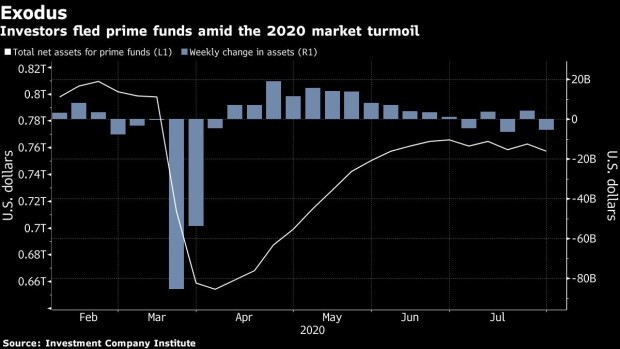
След ударната експанзия през последното десетилетие небанковите финансови посредници: мениджъри на активи, хеджингови фондове и други инвестиционни дружества, покриват почти половината от всички глобални финансови инструменти, но все още не са защитени срещу масови тегления на авоари и пресушаване на ликвидността, посочва Клаудио Борио – главен икономист на базираната в Базел международна институция.
The “dash for cash” in the early days of the pandemic last year has refocused regulators’ minds on a long-standing weak-spot, as panicked investors wrenched more than $155 billion from so-called prime funds in less than two months, helping to trigger a seizure in the U.S. commercial paper market and global ructions in dollar funding. Central banks have warned that elevated asset prices, rising inflation and debt in many markets signal the potential for further turbulence.
After “a period in which there is aggressive risk taking, you have a build-up in leverage. You think that markets are liquid, whereas in fact under stress they are not going to be liquid,” Borio said in an interview. “You can smooth this out by building buffers in good times – whether that’s in the form of capital, for solvency, or in the form of liquidity, to avoid fire sales – so that when bad times arrive you will have a bit more room for maneuver.”
The Financial Stability Board, which reports to the Group of 20 nations, is pursuing an overhaul of global regulations for money-market funds and other non-bank institutions that would seek to prevent investors from pulling their money out of such instruments in a panic. After central banks in Europe and the U.S. had to step in to support the sector during the financial crisis of 2008 and again last year, officials are seeking a longer-term fix that would prevent that happening again.
Read More: Money Funds Need New Guardrails to Shore Up Markets, FSB Says
“Repeated central bank interventions in those stressed markets can generate distortions because they can encourage further risk taking,” Borio said. “What you need to do, which is what effectively has been done in the case of banks, is to come up with a regulatory framework that reduces the probability and intensity of these stress episodes and reduces the need for central banks to go in. Critically, that framework must take a system-wide perspective.”
The BIS is advocating a broad regulatory discussion that would encompass industries like those that suffered blowups this year, such as the private investing undertaken by Archegos Capital Management or the trade financing carried out by Greensill Capital. The collapse of both those firms spilled over into the formal banking system, as lenders including Credit Suisse Group AG were caught out by seizures in poorly-understood, opaque transactions.
In its quarterly report published Monday, the BIS also highlighted the risks arising from the growth of decentralized finance, or DeFi, which could potentially spill over into the real economy through the use of so-called stablecoins backed by official currencies. The rapid growth of Environmental, Social and Governance investing also brings the threat of financial turbulence due to the varying definitions for investment products that are being used, the BIS warned.
Bitcoin's Current Holders Are New, With 55% Getting In This Year
DECEMBER 6, 2021 • VILDANA HAJRIC
Interest and demand in Bitcoin rose a lot in 2021 despite the digital asset’s turbulence. More than half of current investors got in over the last 12 months, according to crypto-firm Grayscale Investments LLC.
In a survey of 1,000 people, about a quarter said they already owned Bitcoin and of that 55% said they started investing this year.
The results underscore the explosive growth cryptocurrencies have seen this year as investors plowed money toward the volatile asset class amid growing popularity of even ancillary products, like non-fungible tokens (NFTs).
Bitcoin is up about 70% in 2021 after a recent sell-off, while some other tokens, such as Ether, have seen their value surge five times over.
“It is becoming increasingly difficult for investors to ignore Bitcoin as its price continues to rise,” the survey said.
Nearly 80% of those polled in the U.S. said they’d be more likely to put money toward the asset class if a Bitcoin exchange-traded fund existed, a product regulators have yet to approve.
Grayscale, which conducted the survey in mid-August, recently filed to convert its $35 billion Grayscale Bitcoin Trust (ticker GBTC) into a physically backed ETF. But so far, U.S. regulators have only allowed the launch of a futures-based Bitcoin fund.
According to Grayscale’s survey, investor preferences for how they’re buying cryptocurrencies is shifting. In 2020, more than three-quarters said they preferred buying Bitcoin via an exchange, whereas close to 60% now say they favor trading through a crypto app like eToro or Coinbase. Just over one-third said they prefer an exchange now.
The digital-asset manager said investors are increasingly treating Bitcoin, the largest cryptocurrency, as a store of value and many are choosing to hold on to their investments.
Crypto Complex Erased $480 Billion in ‘Cascade of Liquidations’
Justina Lee
Mon., December 6, 2021, 5:32 p.m.·4 min read
Crypto Complex Erased $480 Billion in ‘Cascade of Liquidations’
(Bloomberg) – As Wall Street traders bedded down for the weekend after the stock volatility last week, Nikita Fadeev in London was woken up by a Bitcoin market alarm at 4:55 a.m.
Thanks to the cell-phone notification on Saturday morning, the head of cryptocurrency hedge fund Fasanara Digital was back at his desk as the world’s biggest token plunged 20% in an hour.
For all the talk about the allure of cryptocurrencies to diversify portfolios, Bitcoin proved susceptible to a textbook flight to quality – dropping as low as $43,000 after speculative stock favorites sold off last week on monetary-tightening fears.
“When things set in motion, we got this cascade of liquidations as it always happens,” Fadeev said. “It’s quite an unstable situation. A lot of the guys went risk-off and crypto is very obviously a risk-on asset so that’s the chain reaction.”
The entire crypto complex erased as much as $480 billion Saturday before rebounding to $2.2 trillion. Bitcoin is down again Monday at around $48,700 and the ProShares Bitcoin Strategy ETF dropped about 9%.
Wall Street pros and day traders alike are grappling with the ever-tightening links between crypto and mainstream markets: Whether it’s the YOLO cohort trading in and out of meme stocks to whipsaw hedge funds, or institutional players driving Bitcoin ups and downs to catch the retail crowd off guard.
Both groups are confronting a cross-asset regime shift unthinkable just a year ago as the Federal Reserve pares pandemic stimulus to fight inflation.
“A big part of the new money and rally over the past 18 months has been Bitcoin buying with a monetary-debasement lens by the TradFi world,” said David Fauchier, who runs a multi-strategy crypto quant fund at Nickel Digital, referring to traditional finance. “The newsflow in the past couple of weeks is a big challenge to that.”
The Bloomberg Dollar Index is not far off July 2020 levels as short-term borrowing costs rise on expectations for Fed tapering.
In the telling of Fauchier and the like, the Saturday selloff kicked off with TradFi investors turning risk-averse, leading to divestments at over-the-counter desks. Throw in thinner liquidity during late-night hours in the U.S., and a classic crypto liquidation frenzy ensued.
Funding rates in crypto futures turned negative over the weekend, meaning short traders were paying a premium to hold their positions in a sign of bearish sentiment. In Bitcoin contracts on FTX, the rate has turned positive, though they remain below zero for a slew of coins like Solana and Binance Coin.
On the plus side, there are signs some of the leverage has been flushed out of the system – indicating narrower room for another sharp drop. Outstanding Bitcoin futures slid from nearly $23 billion on Friday to $16.5 billion currently, the lowest since early October, Coinglass data show.
Crypto Whales
But the 10 biggest Bitcoin deposits on exchanges now make up 95% of all deposits on a 72-hour average basis, an indication large crypto holders may be selling their tokens, according to Ki Young Ju, chief executive officer at CryptoQuant.
“The poor sentiment in the riskier pockets of the broader markets was what caused crypto to eventually fold,” said Martha Reyes, head of research at crypto prime brokerage Bequant. “Hedge funds and retail investors who invest in Tesla options and the like may also be the same ones who play with leverage in crypto.”
Correlation charts increasingly show the latter story: Since August, Bitcoin has consistently posted a positive 50-day link with the relative performance of volatile S&P 500 stocks. All that means traditional assets are now having a bigger sway on crypto now that institutional flows have increased. As such, Bitcoin is looking more like a risk asset than an inflationary hedge.
Much now depends on the extent to which U.S. policy tightening snuffs out the speculative euphoria embedded in a slew of investing strategies.
“The market is still fragile here, and as long as we’re not back in the $53,000 or $54,000 area – historical volume cluster – it will remain the case,” Felix Dian at crypto hedge fund MVPQ Capital wrote in an email.
Hungary to Boost Pensions More Than Planned in 2022, Orban Says
(Bloomberg) – Hungary will boost pensions more than planned next year, Prime Minister Viktor Orban told lawmakers on Monday.
State pensions will rise 5% instead of the previously planned 3% as higher-than-expected inflation is seen to last through 2022. It’s also a year when Orban hopes to clinch yet another re-election in general ballot slated to take place in the spring.
The central bank said last week it expects prices to rise between 4.7% and 5.1% next year, above the initial forecast of inflation staying below 4%.
This hike is on top of the previously announced pension increases that amount to 1.2% of the country’s gross domestic product and are part of a large spending package.
Европейската комисия глоби "Ейч Ес Би Си холдингс", "Креди Сюис груп", "Барклейз" и "НатУест" (новото име на "Роял бенк ъф Скотланд груп") с общо 344 млн. евро за участието им в картел за договаряне на еднакви валутни курсове. Най-солено наказание от 174.3 млн. евро "отнесе" "Ейч Ес Би Си холдингс", следван от швейцарската банкова група – 83.3 млн. евро, "Барклейз" – 54.3 млн. евро, и "натУест" – 32.5 млн. евро.
"Ю Би Ес груп" се спаси от определената й глоба в размер на 94 млн. евро благодарение на смекчаващото вината обстоятелство, че е разкрила съществуването на въпросното съглашение. "Барклейз", "Ейч Ес Би Си" и "Нат Уест" пък си признаха, че са нарушили правилата в замяна на намаление на сумите на наказанието. "Креди Сюис" е отказала да сътрудничи, но въпреки това е получила 4% редукция на глобата заради факта, че "не е отговорна за всички аспекти на казуса".
"Противозаконното сътрудничество на петте банки подкопава целостта на финансовия сектор за сметка на европейската икономика и потребители", посочи в официално изявление на 2 декември еврокомисар Маргрете Вестагер, която отговаря за конкуренцията в Европейския съюз.
Търговците на петте банки са управлявали картела чрез онлайн сайтове за комуникация, на които са споделяли вътрешна информация и търговски планове. Това е позволявало на "заговорниците" да вземат информирани решения за покупка или продажба на валути, твърдят регулаторните органи. В този случай те са използвали сайт, наречен "Sterling Lads" (групата "Стърлинг"), за да планират сделки за купуване и продаване на валути на фиксирани цени.
Макар и в размер на стотици милиони евро, тези глоби за валутен картел са по-ниски от определените 1.3 млрд. евро наказание за банките, които манипулираха стойностите на EURIBOR. И доста под рекордните 3.8 млрд. евро глоба за картелно споразумение между производителите на камиони. (Бел. ред. – През 2016-а ЕК глоби "Даймлер", "Волво/"Рено" и две други компании от сектора за договаряне на единни цени и прехвърляне на разходите за нормативните емисии върху клиентите.)
"Доволни сме, че сключихме това извънсъдебно споразумение предвид сериозните нарушения, които са се случили в един единстев сайт и в които е участвал бивш служител на банката преди десетина години", коментира говорител на "НатУест". Той допълва, че "банковата култура и контрол са се променили фундаментално през последното десетилетие и подобно поведение няма място в банката, каквато е сега".
Швейцарският кредитор "Креди Сюис" не успя да договори намаляване на глобата си. През март банката заяви, че "продължава да е убедена, че не е участвала в каквито и да било системни действия на валутните пазари, които противоречат на правилата за честна конкуренция на ЕС". Институцията отказа да коментира наказанието на 2 декември.