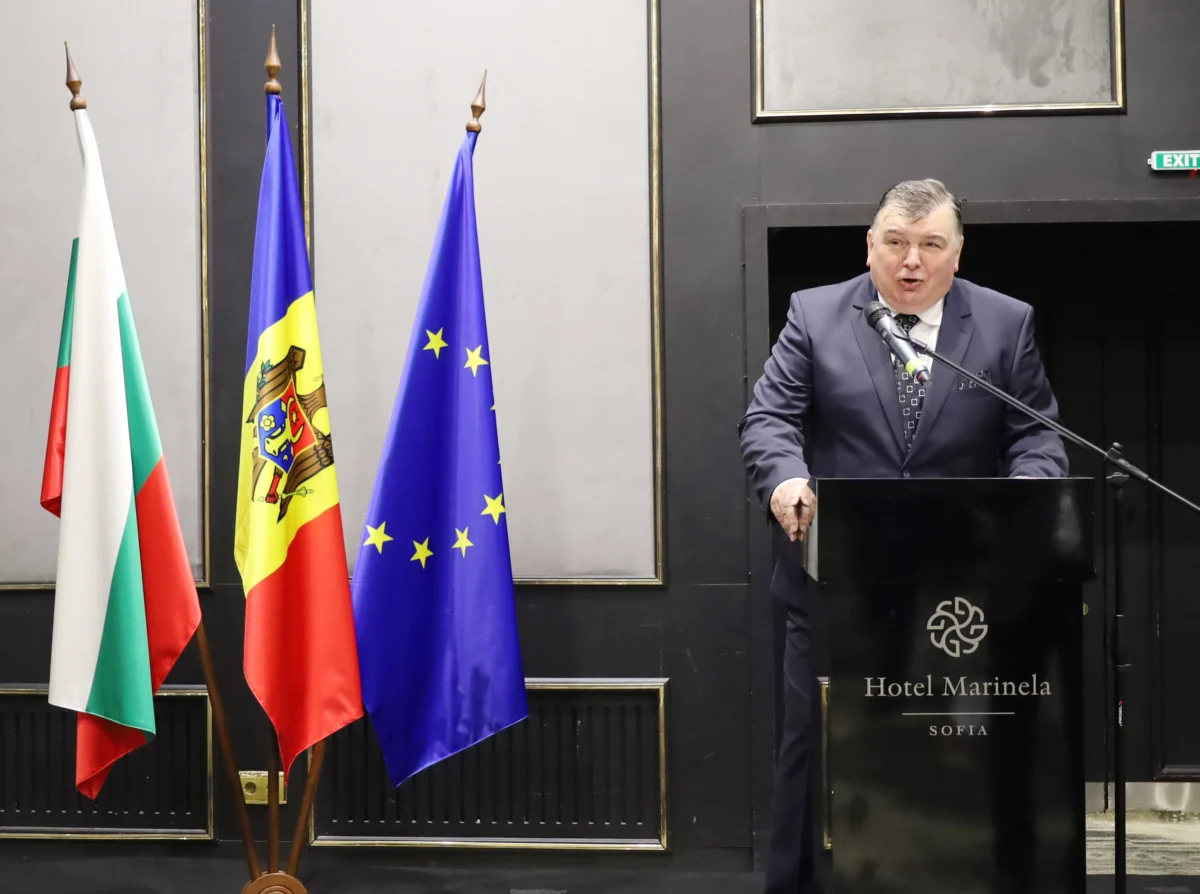
His Excellency Emil Jacotă, the Ambassador of the Republic of Moldova, hosted a formal event marking 34 years since the declaration of Moldova’s independence and 33 years of diplomatic relations with Bulgaria. On the occasion of Moldova’s national holiday, we spoke with him about his diplomatic mission in Bulgaria. H.E. Emil Jacotă speaks fluent Bulgarian, having studied at the Agricultural University in Plovdiv.
Your Excellency, what do you wish for Moldova on its Independence Day?
– We truly want to be independent. We want Moldova to continue on the path of European integration.
The fact is, in the last few years, we’ve taken significant steps toward fulfilling this dream – just days ago, Moldova completed the bilateral screening process in Brussels, which began in July 2024.
During this process, experts from public institutions analyzed more than 100,000 pages of Moldova’s national legislation and compared it with that of the European Union. This shows that the EU sees Moldova as ready to begin accession negotiations. Now we are waiting for the September 28 elections to pass and to see what the next steps will be.
How many of your fellow Moldovans do you expect to vote in Sofia?
– We expect up to 1 000 people, because traditionally around 500 – 600 Moldovans vote in Bulgaria. According to our law – as in Bulgaria – if more than 100 voters request it, a polling station can be opened in that city.
We discussed this with Eng. Veselin Chipev – the Honorary Consul of Moldova in Plovdiv, and he was ready to open a polling station at the consulate, but there weren’t enough applicants. So, for now, voting will take place only in Sofia. If, in time, people realize how much their vote matters, we will open stations in other cities as well. In neighboring Romania, up to 30 000 Moldovans vote – and Bucharest is only 50 km from Ruse.
I want people to vote en masse – to show the strength of the Moldovan diaspora, especially the Bessarabian Bulgarians. Sadly, they are not very united, and that’s why I invited them to the reception and am encouraging them to take part in the upcoming festivals we’re organizing – to make their presence in Bulgaria visible.
What are your wishes for the future of Moldova-Bulgaria diplomatic relations?
– I want Bulgaria to know more about Moldova. Yes, it is known that many Moldovan tourists come here in both summer and winter, but there is little awareness of Moldovan products.
We want to promote more Moldovan wineries, like Purcari, which participated in the reception. We want Bulgaria to open not just a window, but a door to Moldova.
It’s also well known that around 60,000 Bulgarians live in Moldova, but that’s not enough. We need to deepen this connection through more contacts, business forums, and cultural festivals where people from both countries can participate.
This year, we achieved quite a bit – for the first time, a Moldovan jazz band (Valy Boghean Band) performed at the Bansko Jazz Festival and was warmly received.
In your speech, you said Bulgaria and Romania are Moldova’s “advocates.” What specific support has Bulgaria provided?
– The fact that Bulgaria supports Moldova’s EU integration and places no obstacles in front of our accession path means a lot.

We’ve experienced situations where other countries tried to hinder our progress toward the next stage of EU accession.
In August 2025, Bulgaria’s former Chief EU Negotiator, Meglena Kuneva, visited Moldova. She observed our progress firsthand and offered guidance on how to proceed confidently and address key challenges. That was a great help.
Our collaboration with the Bulgarian Ministry of Foreign Affairs is just as strong – they provide valuable consultations and advice on what to focus on in the negotiations with the EU. This helps us be better prepared.
Do you have any early data on Bulgaria–Moldova trade in 2025? (In 2024, trade increased by over 25% compared to 2023. Moldovan direct investments in Bulgaria reached €19.5 million, while Bulgarian investments in Moldova amounted to €250 million.)
– The year isn’t over yet, so we don’t have full data. Most Bulgarian investments in Moldova are in the financial sector. This year, Bulgartransgaz entered the Moldovan market, which is important for us, as EU directives require multiple companies to have access to the Moldovan gas market.
Yes, our market is small – just 2.4 million people – but it’s crucial to offer consumers more choice, so they can pick the services they prefer.
You visited Plovdiv in July. What investment opportunities did you see there?
– In terms of agriculture, Plovdiv offers great opportunities for developing technologies to process agricultural products. In Ruse, I saw potential in developing agricultural mechanization, which is also essential for Moldova.
Culturally, we plan numerous festivals in Plovdiv in 2026 to showcase Moldova in Bulgaria.
Of course, Sofia is the capital and the center of events, but for me, Plovdiv is like a second home – I spent my best years there as a student.
You were one of the first Moldovan diplomats in Bulgaria after independence.
– Yes, in 1994, along with my colleagues, we opened the embassy in Sofia. That happened on February 10, 1994, and I arrived in March.
Looking back 31 years, have any of your goals remained unfulfilled?
– We always set big goals and want to see them realized. Bulgarian institutions have been supportive – their doors are open to us. We’ve faced no obstacles in that regard.
One thing I’d really like is to organize a wine festival, and not in Sofia, but in Plovdiv – because it’s a wine-producing region where Moldovan companies are also active. This will be another reason for Bulgaria to learn more about Moldova.